
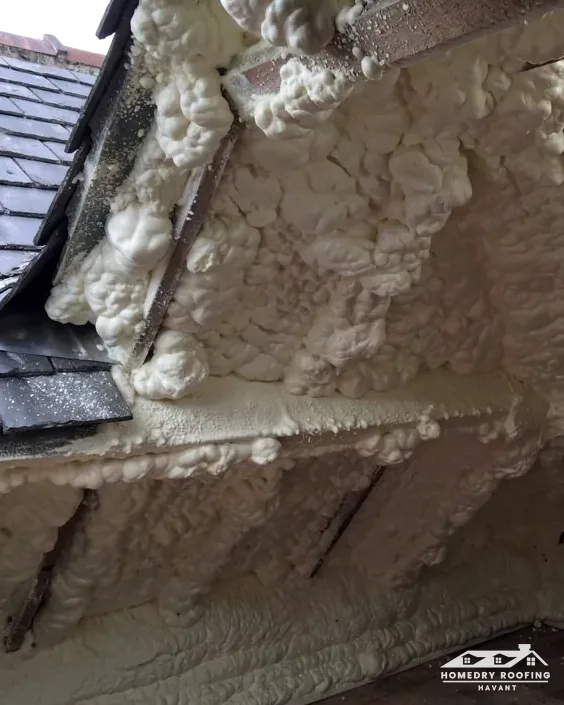
Spray Foam Insulation Removal in Havant
We take spray foam out of your loft, check the timbers it covered, then re-felt and re-insulate wherever the roof needs it.
10-year workmanship guarantee, in writing
Spray foam explained
All guides- What spray foam does to a roof: the facts without the scare storiesGuide
- After the foam: timber checks, re-felting and re-insulatingGuide
- Open-cell or closed-cell spray foam: why the type mattersGuide
- How much does it cost to get spray foam insulation removed?Guide
- Can you sell a house with spray foam insulation?Post
- How hard is it to remove spray foam, and what happens to the roof?Post
- Can you have spray foam insulation removed?Answer
- Will spray foam insulation stop you getting a mortgage?Answer
- Does spray foam insulation cause damp or condensation?Answer
- Why does spray foam matter for equity release?Answer
- Why can a surveyor not see the timbers behind spray foam?Answer
- What happens to the waste when spray foam is removed?Answer
- How long does spray foam removal take?Answer
- Is spray foam on an older house a different job?Answer
- Will removing spray foam change your EPC rating or home value?Answer
- What should you insulate a roof with after spray foam comes out?Answer
Rain behind the foam, from ridge to eaves
Foam hides the route rain takes through a roof. These six places show where it can get in behind the foam, and what taking it out uncovers.
A surveyor's question is about what sits behind the foam, where nobody can look.
RidgesWhat the foam hides at the top of the loft
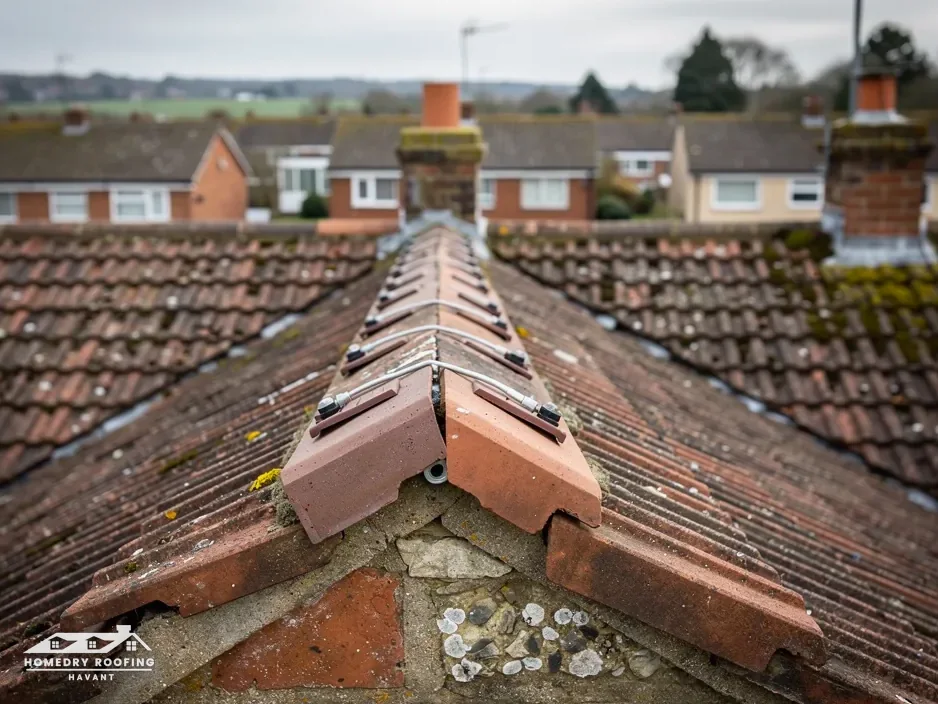
Rain meets a roof along its highest line, on the ridge tiles, and the route down starts there. A ridge tile that has lifted, or a joint that has opened, can let water into the top of the roof. In a loft with no foam you could stand at the hatch with a torch and look at the ridge board, the long timber the rafters lean against, for dark stains. Once foam reaches that line, the board and the tops of the rafters sit behind it and the view has gone.
That lost view sits at the centre of this whole subject. A surveyor looking at the house for a buyer or a lender meets the same wall of foam, which is how it ends up in a report. Our answer on whether spray foam can stop a mortgage sets out what is known and what your lender has to tell you.
Foam in a loft is not automatically a fault, and removal is not the answer for every house. So we begin with an inspection: the ridge and slopes from outside, then whatever timber still shows from the loft. If the roof is sound and you are content to keep the foam, we tell you that. If you want it out because of a sale, a remortgage or a leak, you hear what that involves on your house before you decide. A wider roof inspection can look at the rest of the house on the same visit.
What we check
- Ridge tiles
- Lifted, loose or open joints
- Ridge board
- Whatever the foam leaves visible
- Foam edge
- How far it reaches
- Paperwork
- Installer, product and date
From the loft hatch
Stay at the hatch rather than walking across the joists, because a foot through the ceiling helps nobody, and take a photo of what you can see. Note how far the foam runs: up to the ridge, down towards the eaves, across a gable wall. That picture tells us plenty before we visit. Dig out any paperwork from the installer as well, because the product name and the date of the work are details a surveyor may want.
Where it shows
A survey report saying the roof timbers could not be seen, or a faint stain on a bedroom ceiling.
Where it gets in
Past a lifted ridge tile or an open ridge joint, then down onto timber the foam has covered.
Can a tile be repaired with foam behind it?
Yes, where the foam sits clear of the tile. Where it has bonded to the back, the tile may break on the way out, so the repair can spread further across the slope.
SlopesThe signs of a problem behind tiled slopes
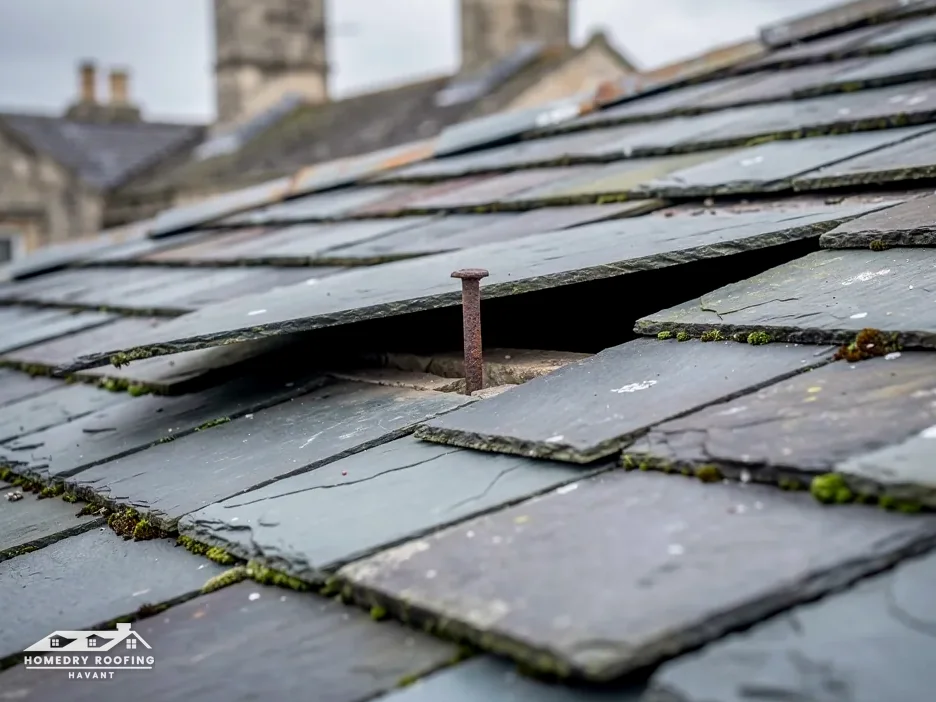
Below the ridge, the slopes carry rain down over tiles or slates, each one lapped over the next. A slipped or cracked one opens a gap, and rain goes through to whatever is behind it. On a roof with underlay, that is a sheet steering the water towards the gutter. On a roof with none, foam may have been sprayed straight onto the backs of the tiles.
The signs can be quiet, because the foam stands between you and the wet:
- A survey or valuation report that mentions the foam
- A ceiling stain below the slope, with nothing to see in the loft
- A musty smell, or damp where the foam has pulled away from a timber
- Tiles that will not lift for a repair because foam holds them
That last one matters to a roofer. The usual tile repair is to slide the broken one out and fit another. Where foam has bonded to the back, it may break as it comes, and so may its neighbours, so a small job can grow. We look at how the foam sits before we say what a repair will take.
None of this means your roof has a fault. It means the ordinary ways of finding one, a torch in the loft and a look along the timbers, are harder to use. Our guide to the problems with spray foam insulation keeps to what is actually known, so you can weigh it up calmly.
The ordinary ways of finding a leak get harder once foam stands in the way.
Reading a ceiling stain
A stain marks where water stopped, and on a foamed roof the place it entered can be some way up the slope. So we work from outside, looking at the tiles above and to either side of the mark, before anyone touches the foam. If a loose tile explains it, we repair that tile and tell you so. Removing a whole loft of foam to chase one slipped tile would make no sense.
Where it shows
A stain below the slope, with dry-looking foam above it and no mark you can trace from the loft.
Where it gets in
Through a slipped or cracked tile higher up, then along the back of the foam or the sheet.
Does the felt always have to be replaced?
No. Where foam comes away and leaves the sheet whole and sound, it can stay. We look at it once the foam is off and tell you what we found, with a photo.
UnderlayWhich type of foam sits against the felt
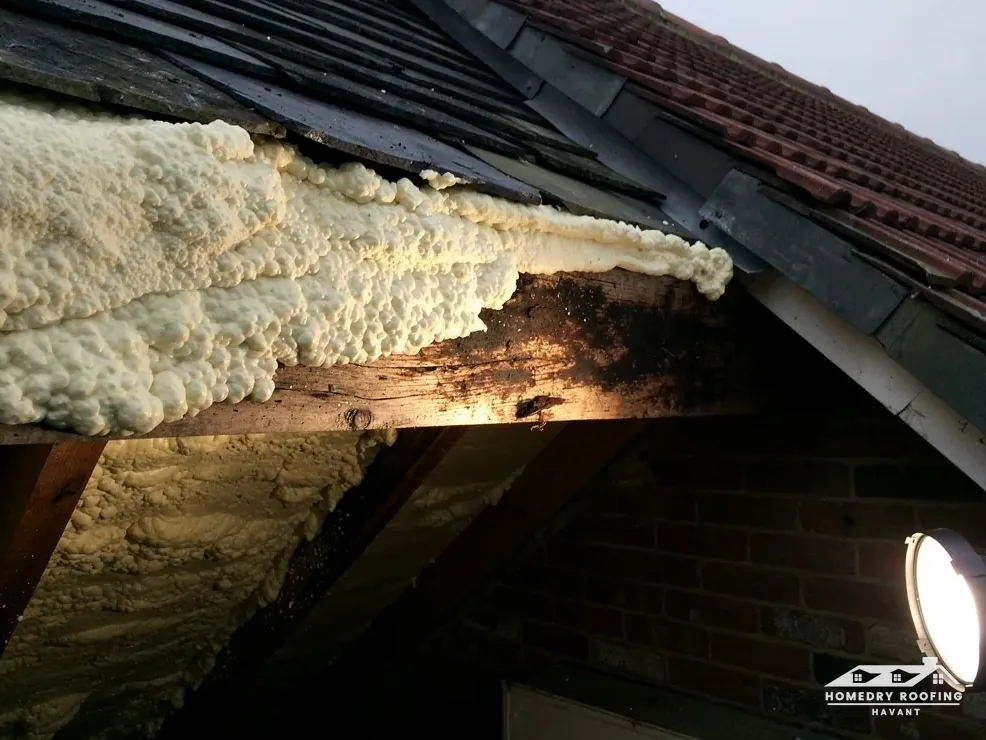
Under the tiles lies the underlay, the sheet people call roofing felt. It catches anything that gets past the covering and runs it down to the gutter. Foam sprayed from inside the loft can land on the back of that sheet, on the battens, on the rafters or, where a roof has no underlay, on the tiles themselves. A sheet that has been sprayed cannot be inspected from the loft until the foam has gone. What it touches shapes the whole job.
| Surface | What removal may mean |
|---|---|
| Felt or a plastic sheet | The sheet can tear, so we plan for new underlay |
| Bare backs of tiles | Tiles may have to come off from outside |
| Rafters and battens | Cut back, then the timber is checked |
The foam itself comes in two main types, closed-cell and open-cell. They behave differently with moisture, since closed-cell foam lets no water vapour through it. Our guide to open-cell or closed-cell spray foam explains why the difference matters, and the damp answer further down this page gives the wording on rot.
This is where a roofer's view earns its place. New underlay goes on from above, with the tiles lifted and the battens renewed, so it is roofing work as much as insulation work. If the sheet is torn or brittle once the foam is off, you will want the same people able to put that right.
What we look for
- Underlay
- Felt, plastic sheet or none
- Foam
- Type, depth and bond
- Tile backs
- Bonded to foam or clear
What the foam is stuck to decides the job more than the foam itself.
Telling the types apart
The installer's paperwork is the easiest way to learn which foam you have, if you still hold it. Without that, we look at the foam when we survey and give you our view on what it is and how sure we are. Either way, we plan the job around what it is stuck to, since that decides how much of the roof has to be opened up, far more than the name on the drum.
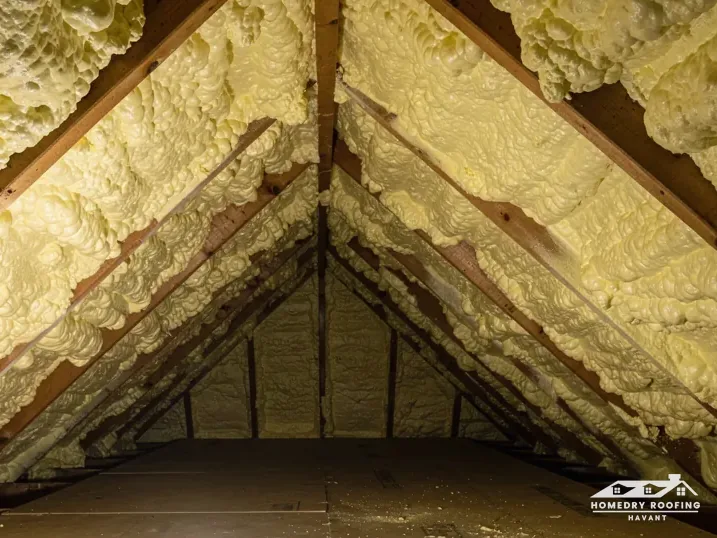
Removal is slow, physical work, and the real judgement comes before it starts.
BattensHow the foam comes out, step by step
Battens are the thin timber strips that the tiles hang from, fixed across the rafters over the underlay. When foam has been sprayed up between the rafters, it can wrap round them and fill the gaps, and that is where removal gets slow. Spray foam is treated as a permanent installation, so nobody should tell you it simply peels away. Here is the process we follow in the loft:
- Clear a safe way in, with boards laid across the joists and the hatch and landing covered.
- Cut the foam back in sections, working along each rafter bay and bagging it as we go.
- Scrape the remaining foam from the timber so that its surface can be seen.
- Go up on the roof where foam is locked around battens or tiles, and lift what has to come off.
- Stop, look at the bare timber and felt with you, and agree what comes next.
Step four is the one that decides the shape of the job, and the survey is how we judge it beforehand. If tiles have to come off, scaffold may be needed, and that goes in the same written price.
Our post on how hard it is to remove spray foam goes further into what happens to the roof along the way. You will have dust and disturbance in the loft while this is going on, so we talk through what to move beforehand. When the foam has gone, we take the bags with us and leave the site clean.
Taking some and leaving some
Sometimes only part of a roof has foam, or only one slope is causing concern. Taking out one section can be possible, though it leaves a line where foamed and open timber meet, and a surveyor may still see foam there. We tell you what partial removal would and would not settle, so you can check with whoever asked for it before you spend the money. That one conversation can save a wasted job.
What you see
Foam filling the bays between rafters, sometimes running over the battens and up against the back of the tiles.
What we do
Cut it back bay by bay, then lift tiles from outside wherever the foam has locked itself around them.
Before we start
- Loft contents
- Moved clear of the work
- Access
- Hatch, landing and joists
- Scaffold
- Only if tiles come off
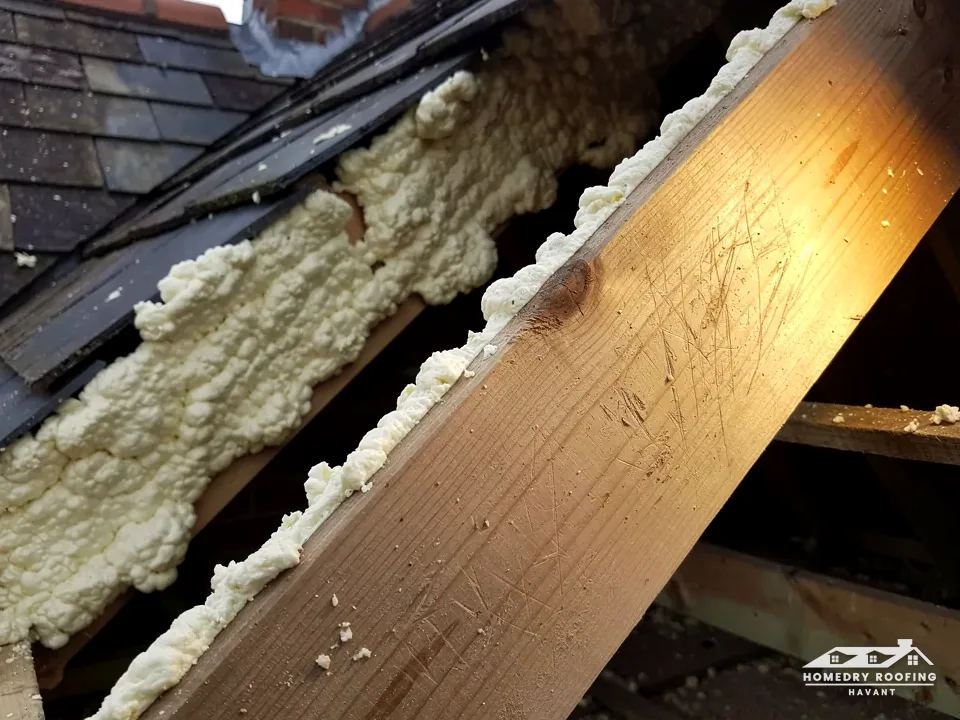
Will the rafters definitely be rotten under the foam?
No. Plenty depends on whether the roof above has been keeping rain out and how the foam was applied. We check each timber once it can be seen and report what is actually there.
RaftersChecking the timber once the foam is off
Rafters are the sloping timbers that hold the whole roof up, and they sit at the heart of the reason for removal: nobody can vouch for timber they cannot see. When the foam is off, we go along each one looking at the surface, the top ends at the ridge, the bottom ends at the wall and the places where a leak would have run.
We look for dark staining, soft spots when the wood is probed, and signs of decay where damp has sat against it. Staining alone may mean an old leak that has long dried out. Soft timber is a different matter, and the answer depends on how far it goes:
- Sound timber is left alone, and you see that it is sound.
- A soft area at the end of a rafter can be cut back and strengthened, where enough good wood remains.
- Timber that has lost its strength along its length gets replaced, which can mean opening the roof above it.
Where foam has left the structure in poor shape, the real choice may be between that work and a whole new covering. We tell you which your roof calls for and why, repairing wherever a repair is sound. If a re-cover does turn out to be the better answer, our roof replacement page explains how that goes.
Nothing new goes over the timber until the check is finished and you have heard the result. Timber is far easier to inspect today than it will be under new insulation.
Nobody can vouch for timber they cannot see, so the check matters as much as removal.
Photographs for the file
We photograph the bare timber before anything new goes over it, and those pictures are yours to keep. They give a buyer's surveyor something to look at, along with a chance to inspect the roof space for themselves. Whether a surveyor or a lender is then satisfied is their decision, and we cannot make it for them. So ask them, before the work, what they will want to see afterwards. Keep the pictures with any paperwork from the installer.
Where it shows
Dark marks running down a rafter once the foam is off, or a soft patch near the bottom end.
Where it gets in
From an old or current leak in the covering above, held against the timber where it could not dry.

Is ventilation really needed in the loft again?
It depends on the underlay and where the new insulation sits. A loft insulated at ceiling level is a cold roof, and some sheets rely on air at the eaves to stay dry behind.
EavesRe-felting and re-insulating where the roof ends
The route ends at the eaves, where the underlay and the bottom course of tiles hand the rain to the gutter. It is also where air gets into a ventilated loft, so foam that blocked those gaps needs clearing right down to the wall. New underlay is dressed into the gutter here, with fresh battens above it and the tiles put back, or replaced where they did not survive.
Then the heat has to be dealt with, because you have just taken away your insulation. The main options are these:
- Insulation laid at ceiling level between and over the joists, which leaves the loft cold and ventilated.
- Insulation fitted between or under the rafters, if you use the loft as a room, with an air path kept where the underlay needs one.
Which suits you depends on how you use the loft and what underlay is up there, because some sheets let vapour through and others need ventilation at the eaves. Our guide to re-felting after spray foam removal takes that choice further. Part L of the Building Regulations can come into it when enough of the roof is being renovated, so we confirm the route before work starts.
You get all of this as one written total price after the survey, from the first bag of foam to the last tile. Our guide on spray foam removal cost explains how those figures build up.
Take the foam out and the loft needs insulating again, with air moving properly.
What moves the price
Four things move the figure more than anything else: how much roof the foam covers, what it has bonded to, what the timber and felt turn out to need, and how the loft is insulated again afterwards. Access matters as well, along with any scaffold. We ask to see the loft before quoting, because a figure given blind cannot allow for any of those, and you would only hear the difference later.
Putting it back
- Eaves
- Air gaps cleared of foam
- Underlay
- Dressed into the gutter
- Battens
- Renewed where tiles came off
- Insulation
- Position agreed before fitting
Look behind the foam before you decide
Send a photo from the loft hatch and we will say what we can see.
Spray foam removal questions
Lenders, damp, cost and what comes out with the foam, in plain terms.
Can you actually have spray foam insulation taken out of a loft?
Yes, though how it goes depends on what the foam was sprayed onto. The Energy Saving Trust says "spray foam is considered a permanent installation. If you decide to remove it at a later stage then you might also need to replace the structure it was applied to." So be wary of anyone who says it always comes away cleanly, whatever is behind it. Foam on sound rafters, with a separate underlay behind it, leaves us the most room to work. Foam bonded to old felt or to the backs of tiles can mean part of the roof has to come off as well. That is why we start by looking at the roof from outside and from the loft, and you hear what removal means on your house before you agree to anything.
How difficult is it to strip foam from a roof?
It is slow, physical work more than it is complicated. Foam sets hard against whatever it touches, the bays between rafters are tight, and the space narrows towards the eaves, where it is hardest to reach. Cutting it back from clear timber is the easier part. The difficult part is any foam that has locked around battens or stuck to tiles, because that can only be dealt with by opening the roof from above. A leak or an old repair behind the foam can add to the work too, since nobody can see it until the foam has gone. We judge all of that at the survey, so the difficult parts are in the plan and the price before anyone climbs into your loft.
What does spray foam removal cost for a loft?
MyJobQuote says "The average cost of spray foam removal is £40 per m²", and gives its own total: "For a standard 3-bedroom property with roughly 80m² of roof space, total removal costs typically come to around £3,200." Those are MyJobQuote's figures, not ours, and yours depends on your roof. What sets the price is how much roof the foam covers, what it has bonded to, access, whether tiles have to come off, what the timber and felt need afterwards and how the loft is insulated again. You get a quote as one written total after a survey, covering the work your roof needs. Comparing it against another figure? Check the VAT and scaffold position on each one, because a number that leaves either of them unclear is not a fair comparison.
Can you sell a house with spray foam in the roof?
Yes, a house with foam can be sold, though a buyer's surveyor and lender will each want a view on it. RICS's consumer guide gives the reason it comes up in a report: "If the timber roof structure is covered with spray foam it cannot be fully seen or inspected". The Energy Saving Trust says "there should be less of an issue with getting a mortgage for homes that have had spray foam insulation installed correctly." So find what you can from the installer: the product, the date and any paperwork. If a sale is held up, ask the buyer's surveyor or lender what they need to see before you pay for anything, as removal may or may not be what they want. We can then tell you what the roof itself would involve.
Will foam in the loft stop me getting a mortgage?
That depends on the lender, so ask yours directly. In March 2023 RICS said "there has been concern within specific sectors of the lending market, such as equity release mortgages, which is now having a wider impact on lenders." Its consumer guide says "Do check with your mortgage provider whether their lender policy allows the installation of such products." The Energy Saving Trust's advice, updated in October 2026, is that "there should be less of an issue with getting a mortgage for homes that have had spray foam insulation installed correctly." Both can be true of different lenders and different roofs. We cannot answer for a lender, and taking the foam out does not settle their decision for them, so get their position in writing before you commit.
Does spray foam cause damp or condensation in a roof?
It can, depending on the foam and the state of the roof, and a foamed roof is not always a damp one. The Energy Saving Trust says "Spraying foam directly to the underside of the roof will partially seal the timber." On closed-cell foam it says "Its main drawback is that it's not vapour permeable." On rot, it adds that the risk "should be much lower with an open-cell foam." That is a lower risk in its wording, and never no risk. A roof letting rain in is a separate problem from condensation, but the two can look alike once foam hides the timber. So we check the covering outside and then whatever timber we can see, and we report what we find rather than assume the worst.
Who deals with the waste once the foam is out?
We do. Foam goes into bags as it is cut back, and it comes away with us along with any old felt and battens taken out of the roof. There is no skip for you to arrange unless the job turns out to be big enough to need one on site, in which case we sort that out and tell you where it will sit. Please clear stored boxes from the loft beforehand, because cut foam makes a mess while the work is going on. We clear up as we go, and you get a clean site back at the end. Any broken tiles that come off during the work leave with us too, unless you want to keep some.
How long will the removal work take on my house?
There is no single figure, and we would be guessing without seeing the loft. The length of the job turns on the area of roof covered, how thick the foam is, how tightly it has bonded and whether tiles have to come off. Re-felting, timber repairs and new insulation all add time after the foam is out. Once we have surveyed the roof, we tell you how long your job should take and in what order it runs. Any scaffold standing on the highway has to be licensed, and we arrange the licence with our scaffolder, so the programme allows for that. Weather also plays a part once tiles are off, so we plan those stages with care and keep the roof covered between them.
Do the Building Regulations apply when the loft is re-insulated?
They can, depending on how much is affected. Under the Planning Portal's guide, re-roofing does not normally need a building regulations application if it affects less than 25 per cent of the building envelope and less than 50 per cent of the roof. If more than half of a roof is renovated, AD L 2021 looks for the whole roof to meet Table 4.3 where feasible, on a simple payback of 15 years or less: a threshold of 0.35 and an improved 0.16 W/m²K. AD L 2026 takes effect on 24 March 2027. With a high-resistance underlay in a cold roof, Marley gives 25 mm of eaves ventilation at 15° or less and 10 mm above 15°. In Havant, we confirm the building regulations route with your building control body before work starts.
Do you remove loft foam across Hampshire, or just around Havant?
Both. HomeDry is a local roofer, and spray foam insulation removal in Havant sits alongside the same work up to 30 road miles out, taking in Leigh Park, Cowplain, Waterlooville and Bedhampton, Hayling Island and Emsworth on the coast, Southsea and Portsmouth, Petersfield to the north, Fareham to the west and Chichester in West Sussex. Where tiles go back on a coastal address, coastal homes are graded for higher exposure, so the fixing specification is calculated for the site under BS 5534. For a quote, call 023 9396 0313, send photos from the loft hatch by WhatsApp or fill in the quote form here. We then inspect the roof from outside and from the loft, tell you what removal would involve and put it in writing as one total price.
Where's the water showing?
You'll get one written total price.