
What decides how much has to come out
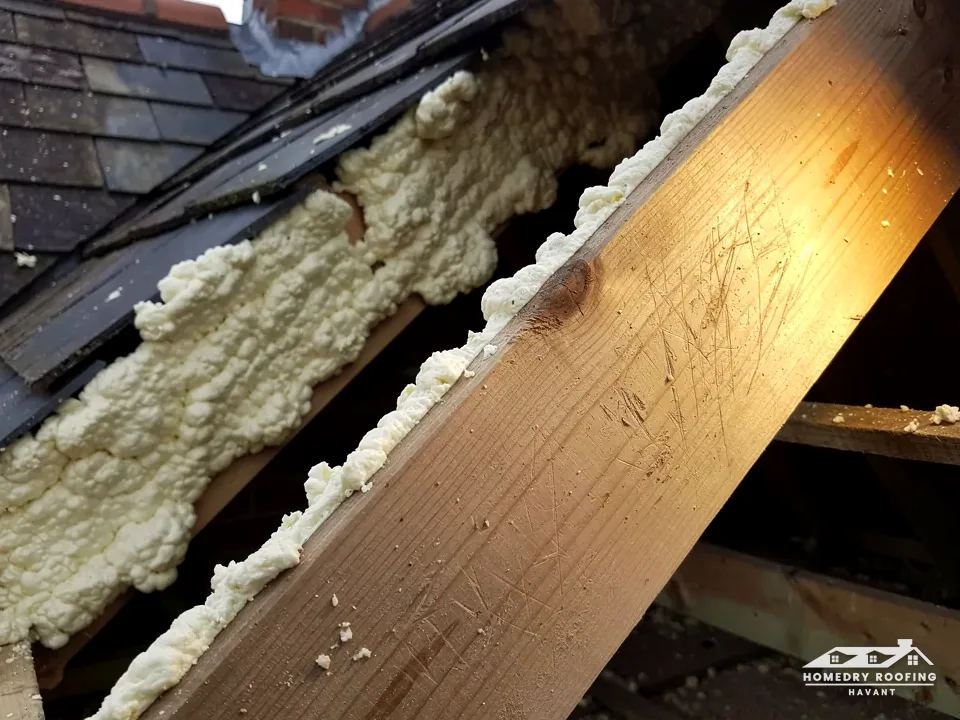
Foam is sprayed as a liquid and sets hard against whatever it lands on, so the surface behind it matters more than the foam itself. On one roof it may sit against bare rafters with a separate sheet behind. On another it may have reached the old felt, the battens or the backs of the tiles. Each case calls for a different amount of work from the roof side of the job.
- Foam against clean rafters can be cut back, and the timber examined.
- Foam bonded to old felt usually means the felt goes as well, with new underlay to follow.
- Foam that has reached the tiles can mean lifting part of the covering from outside.
- Foam packed into the eaves has to be cleared back to the wall, so that air can move there again.
None of this can be judged from the hatch alone, which is why a visit looks at the roof from both sides. You are then told what removal involves at your address, and a repair comes first wherever a repair would be sound.
Why the timber is part of the question
Removal is about more than getting the foam out. The question matters because the roof structure under the foam cannot be examined, and RICS says so in its consumer guide: "If the timber roof structure is covered with spray foam it cannot be fully seen or inspected." Taking the foam off is the only way to look again.
With the foam gone, each rafter can be checked for staining, soft spots and the track of old leaks. Sound wood stays as it is. A soft end can be trimmed and reinforced if sound wood remains beyond it, and a rafter that has lost strength along its length may need replacing. That is the sense in which the Energy Saving Trust warns about the structure, and it is why nobody should promise you a clean result before the timber has been seen.
New materials go over the timber only after that check. Photographs from this stage are yours to keep, and a buyer's surveyor or a lender can read them. Whether either is satisfied is their decision, so ask them what they would want to see.
Planning the work and the price
A job of this kind is priced as a whole after the survey. For a sense of scale, MyJobQuote's September 2026 guide says "The average cost of spray foam removal is £40 per m²", and gives its own total of around £3,200 for a standard 3-bedroom property with roughly 80m² of roof space. Those are MyJobQuote's figures, not ours, and a rate per square metre is no basis for working out your own total.
What moves a genuine quote is easy to list: the area the foam covers, the surface it has stuck to, whether tiles have to come off, how simple the loft is to reach, and whatever the survey finds in the timber and the underlay. The price you receive is a single written total. If you set it beside another, check that each states if VAT and scaffold are in the figure, since a figure that leaves either unclear cannot be compared fairly.
The spray foam insulation removal page walks through the whole job from survey to finish, and our guide to the cost of spray foam removal goes into the figures.
Insulating the loft again afterwards
Removing the foam also removes the insulation, so the roof has to be insulated again. In England that can bring in Part L of the Building Regulations. AD L 2021 gives two figures in Table 4.3 for a roof that already exists: a threshold of 0.35 and an improved 0.16 W/m²K. If more than 50% of the roof's surface is renovated, the guidance expects the whole roof to reach the improved figure, so long as that is technically feasible and the saving repays the cost within 15 years.
Whether a particular job reaches that point depends on how big a share of the roof is being worked on. For that reason the Building Regulations route is confirmed with your building control body before work starts, and the answer shapes what goes back into the loft. Until 24 March 2027 the 2021 edition is the one that applies in England.
Our answer on what to insulate with after spray foam goes through the choices, and the guide to re-felting after spray foam removal covers the underlay that goes on first. Either way, the roof is left clean when the work is finished.