
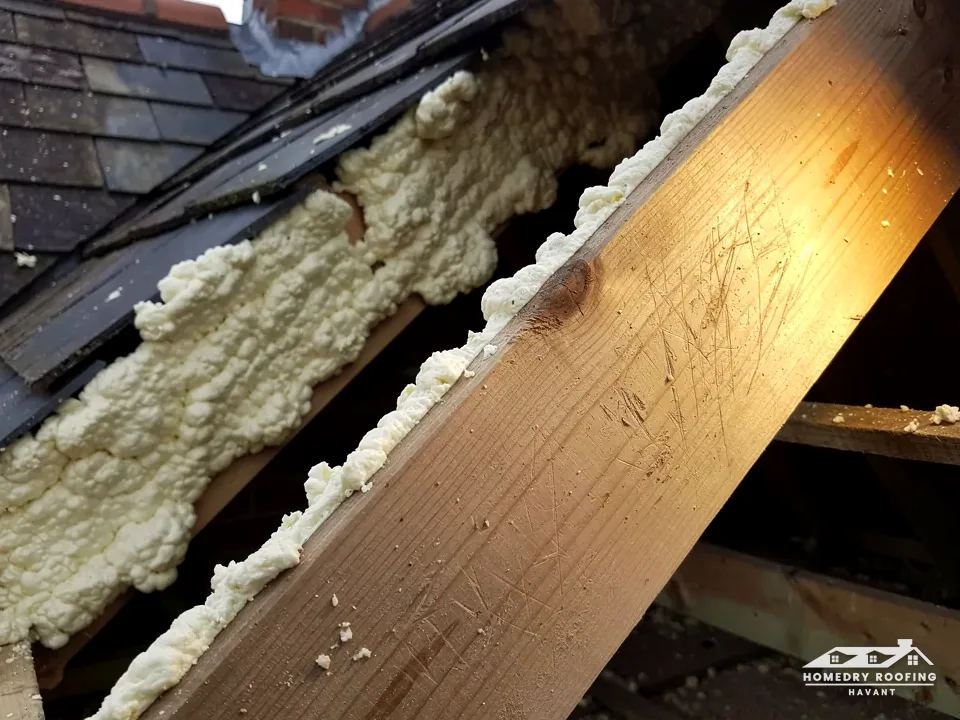
Anyone asking what spray foam removal costs wants a number, and there is one in print. It comes from a third party, it is an average, and it is given as a rate for each square metre of roof. Used carefully, it tells you the kind of scale involved. Used carelessly, it produces a total that has little to do with your loft.
This guide gives the published figures with their sources, dates and units, and does not turn them into anything else. It then goes through what moves the price on a real roof, what a written quote should state so that you can understand it, what costs follow once the foam is out and how a survey turns an average into one total.
The work itself is described on our spray foam removal page. Here we stay with the money, and with the order in which it is sensible to ask questions.
What the published figures say
MyJobQuote, a UK cost guide, publishes two figures for removal on a page it dated 17/09/26. We give them as it gives them, a rate and a worked example, and we use no other published figure for this job.
| Figure | Its wording | Its unit |
|---|---|---|
| Average rate | "The average cost of spray foam removal is £40 per m²" | Per m² |
| Its own example | "For a standard 3-bedroom property with roughly 80m² of roof space, total removal costs typically come to around £3,200." | Total, for that example |
Two things to notice. The first figure is an average, and an average is a middle, not a limit: real jobs sit on both sides of it. The second is MyJobQuote's own worked example for one kind of house, not a quote for yours, and it is a total that stands alone.
Neither figure is ours. Our price comes after a survey, the rate is never applied to your roof by us, and we would ask you not to apply it either. A rate per square metre is only useful when the area, the foam and the roof are known, and none of those is known until someone has looked.
The page gives no VAT basis, so we state none. When you compare any quote with these figures, check what each says about VAT and about scaffold, because those two are easy to assume and awkward to argue about afterwards. If a firm quotes a total close to MyJobQuote's example without having seen the loft, ask what it has assumed.
A published average shows the scale of the job, but it cannot give the price of your roof.
Why an average cannot price your roof
Every loft is different, because the foam went on wherever its installer chose. A rate for each square metre treats the job as if every square metre were the same, and they are not. What follows is what moves the price on a real roof, none of it visible from the street.
- Area: how much of the roof the foam covers, which is not always the whole roof.
- Bond: what the foam has stuck to, whether the timbers, the felt or the backs of the tiles.
- Access: how easily people and material get into the loft and across it.
- Tiles or slates: whether any have to come off to free foam locked around the battens.
- Scaffold: whether the work needs access from outside, and the licence that can come with it.
- Findings: what the bare timber turns out to need.
- The finish: what goes back afterwards, from felt and battens to new loft insulation.
Any one of those can move a figure a long way, and several can apply at once. The Energy Saving Trust says that if you remove foam "you might also need to replace the structure it was applied to." That sentence is a good reason to be wary of a figure given without a visit. A person who has not seen your loft cannot know whether the structure is in question.
This is why our price follows a survey. We look at the covering from outside, the foam from inside and any paperwork about it, and we then give you a single total in writing. Where something unexpected turns up under the foam, we tell you before we go further.
What a quote should state
A written quote for foam removal is easier to trust when it says what the total covers and what it leaves out. You do not need the work split into parts to judge that. You need to know what the total takes in. When quotes arrive, check each one against this list before looking at the totals.
- The area of roof the foam covers and where it runs.
- The type of foam, if known, or an honest note that it is not yet known.
- Whether the removal includes checking the timber and reporting what is found.
- What happens to the felt and battens, and who decides.
- Whether the covering is to be lifted, and what happens to tiles or slates that do not survive.
- Whether scaffold is included.
- Whether VAT is included.
- What is to be done about insulation and who is responsible for it.
A total that omits several of these may look cheaper than one that states them. When two quotes differ, the gap is usually a difference in what each assumes, and you can only judge that by asking.
What we hand you is one total for the whole job, in writing. It names the work, states whether scaffold is in it, and leaves the site clean at the end. Our short answer on how long spray foam removal takes says what the schedule depends on, which is a matter of the same facts.
Costs that arrive after the foam is out
A removal figure is a figure for removal. The loft the foam leaves behind is bare, and a roof in that state needs more than a clear-out. MyJobQuote's average rate describes the removal, and the work that follows is a separate question that your quote should answer in writing.
That work depends on what the foam hid. Timbers that look sound are photographed and left. Timbers that do not are treated or replaced. Felt that comes away whole can stay, and felt that does not is renewed. The covering is refixed where it is sound. Our guide to re-felting after spray foam removal follows each stage.
Re-insulating can bring Part L into the picture. In AD L 2021, a roof above the Table 4.3 threshold of 0.35 is brought to the improved 0.16 provided that is feasible and repays itself within 15 years. Your building control body will tell you whether an application is needed.
| Work | What decides it |
|---|---|
| Timber repair | What the bare rafters show |
| Felt and battens | Their condition once the foam is off |
| Covering | Whether tiles or slates were lifted |
| Insulation | The plan for the loft and Part L |
None of these is certain before the work starts. A good quote says how each is handled when it arises, so that a surprise under the foam does not turn into a surprise on the bill.
Weighing removal against leaving the foam
Cost is not the only measure of whether to remove foam. The cheaper course in the short run can be to leave it, and sometimes that is the right course. The Energy Saving Trust calls spray foam "a permanent installation", and it says a mortgage should be less of an issue for homes where foam was installed correctly.
RICS reported in March 2023 "concern within specific sectors of the lending market, such as equity release mortgages", and its guide says to check with your mortgage provider whether their policy allows foam. So the first question is whether anybody who matters to your plans needs the foam gone.
- Not selling, not borrowing, no leak: removal may bring you nothing you need, and a survey can confirm that.
- Selling or remortgaging: put the question to the buyer's surveyor and the lender before spending anything.
- A leak or a stain: find the source, because a repair from outside can settle a local fault.
- A re-roof planned: the foam may stand in the way, which changes the sums.
This is the kind of decision where an hour of advice beats a day of work. We can tell you what we see in the loft and what a roof like yours would call for, and you can set that against what your lender and surveyor say. Our short answer on whether spray foam can be removed sets out what is possible.
If you decide against removal, a survey has still told you the state of the roof, which is worth knowing whatever you do next.
How a survey turns an average into a price
The step between a published average and a price you can sign is a visit. It does not commit you to anything, and it replaces guesswork with a look at your roof.
- The covering is checked from outside, from the ridge down to the gutters.
- The loft is examined for the extent of the foam, its depth and its bond.
- Paperwork on the foam is noted, whether product, installer or date.
- Photographs record what is visible, and the report names what is not.
- The report sets out what the work would involve and what it depends on.
You then receive the price in writing, as one total. It says what the job covers, with scaffold and VAT stated, so that any other quote can sit next to it fairly. If the roof needs a repair and not removal, we tell you that, and the price is for the repair. A survey can therefore save the whole cost of removal, where the fault turns out to be a loose tile or an open ridge joint and the foam is not the cause of anything.
Photographs from the loft hatch help us before we visit. Send a few showing the foam and how far it runs, and any paperwork you have, and the first conversation can be about your roof instead of about averages.
The published rate and the published example are there to show scale. The number you pay should come from a person who has seen your loft, and be in writing before work begins.