
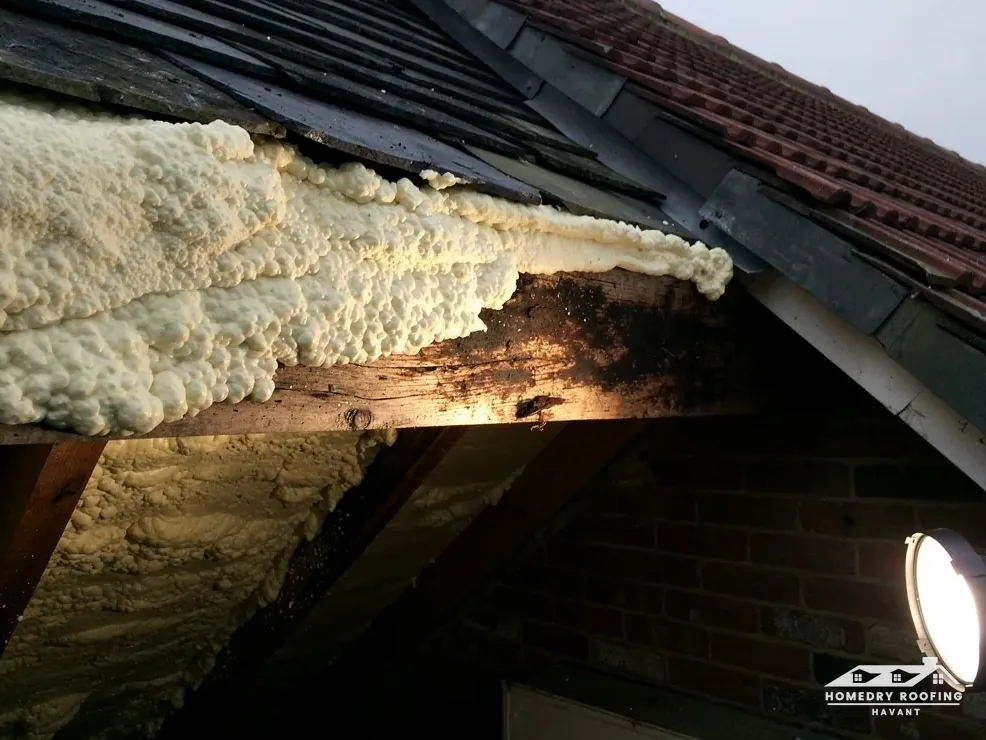
What the length of the job depends on
Two houses of the same size can need very different amounts of time, because the foam may have been applied differently on each. A thin coat on clear timber is a different task from a deep fill packed into every bay between the rafters.
- The extent of the foam, and whether it runs down to the eaves and across the gable ends.
- The thickness of the foam, and how firmly it has bonded to what is behind it.
- Whether it sits on bare rafters, on old felt, or on the backs of the tiles.
- Whether tiles have to come off from outside, which brings in scaffold.
- How easy it is to get into the loft and to move waste out of the house.
A job on foam that has bonded to the tiles can run a good deal longer than one with clean timber behind it, since the covering over that part has to be opened up from above. These are the points the survey looks at, and the programme is built on what it finds there. A fair programme names the stages that could change, and the reason each one might.
The stages, in the order they happen
Removal is a sequence, and each stage has to finish before the next can start. The loft comes first, then the structure, then whatever goes back on top of it. Keeping that order matters, because insulation fitted before the timber has been checked would only have to come out again.
- Survey of the roof outside and the loft inside, ending in one written total.
- Clearing the loft and protecting the hatch, landing and floors below.
- Cutting the foam back in sections and bagging it as it comes away.
- Examining the bare timber, with photographs and a decision on any repairs.
- Renewing the underlay and battens where the foam has damaged them, and refixing or replacing tiles.
- Insulating the roof again, with the Building Regulations route confirmed beforehand.
Stages three and four decide the rest. If the timber is sound, the later stages move along steadily. If it needs work, the programme grows, and you are told so before the extra work starts, not after it. Ask how much time the firm has allowed for stage four and what would change it, because that is the stage nobody can judge from the hatch.
Scaffold, weather and permissions
Some of the time is spent waiting for things that sit outside the loft. Scaffolding that stands over the pavement or road has to be licensed by the highway authority, and we arrange the licence with our scaffolder, so the programme has to allow for it. Hampshire County Council, for example, licenses scaffolding for a first period of 2 weeks and charges again for each further 2 weeks, and says it does not offer extensions. That is one reason the length of a scaffold stage is worth settling at the start.
Weather matters only once tiles are off. A roof that is open to the sky is covered between visits, and the work on it is planned around the forecast, which means a wet week can move a stage without changing the quote.
The Building Regulations route is also confirmed before work starts. Re-insulating a roof can bring in Part L, and your building control body can say whether a notice is needed. Sorting that early keeps it from holding up the last stage, when the roof is open and everyone wants it closed.
Getting the programme in writing
After the survey you get a written total price, and the stages and their order are explained alongside it. Ask for the stages as a list, with a note of which ones depend on what the timber shows, so you know where the programme could change. A programme that never mentions the timber check is leaving something out.
It also helps to say why you need the foam out and by when. If a sale, a remortgage or a surveyor's request is behind it, tell us at the start, since that may change what is done first. Our answer on whether spray foam can be removed explains why the work varies so much from roof to roof.
For the cost side, MyJobQuote's own total (September 2026) of around £3,200 for a standard 3-bedroom property with roughly 80m² of roof space is a useful comparison for scale, but it tells you nothing about the hours on site. The spray foam insulation removal page shows the full route from survey to a clean site.