
Verges
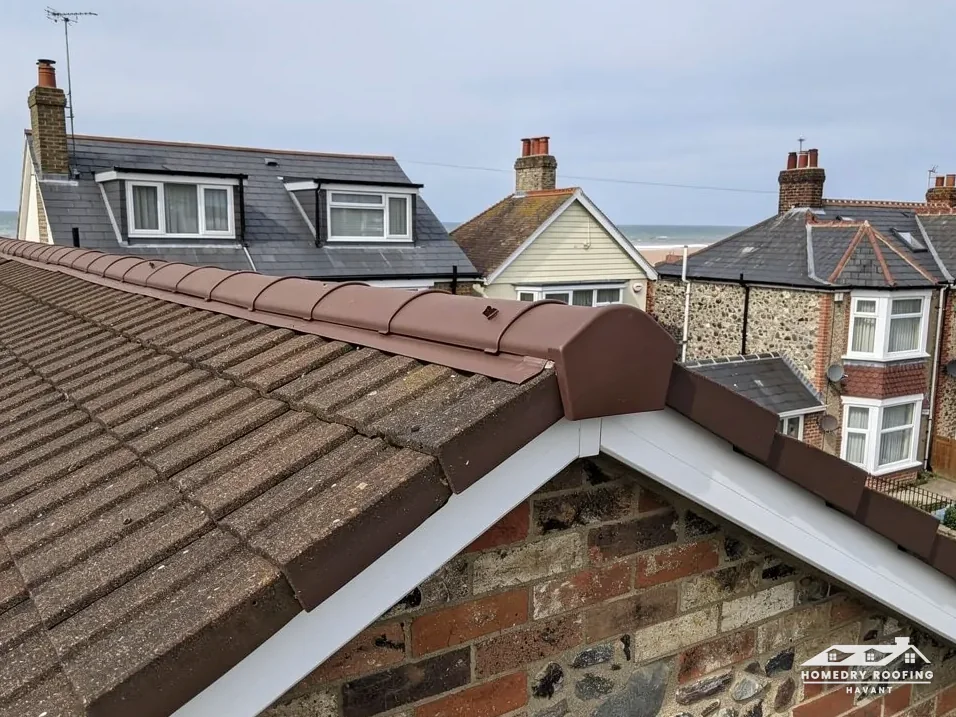
Where a gable roof ends in an open edge on Hayling Island.
Tired pointing at the verge leaves the end tiles to the wind, and a gust can work them loose.

Roof repairs and re-roofs on Hayling Island, 4.9 road miles south of Havant, with fixings chosen for the site and one written total price after the survey visit.
10-year workmanship guarantee, in writing
Where a gable roof ends in an open edge on Hayling Island.
Tired pointing at the verge leaves the end tiles to the wind, and a gust can work them loose.
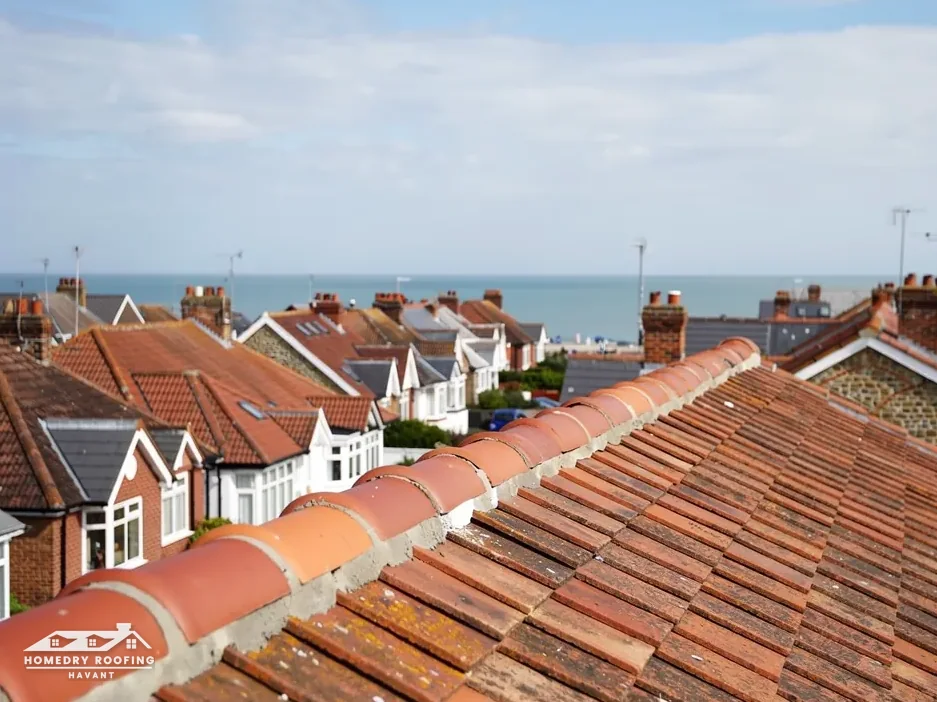
Where two slopes join, with capping tiles in a row to hold them together.
A ridge held by mortar alone can loosen, and rain follows the gap.
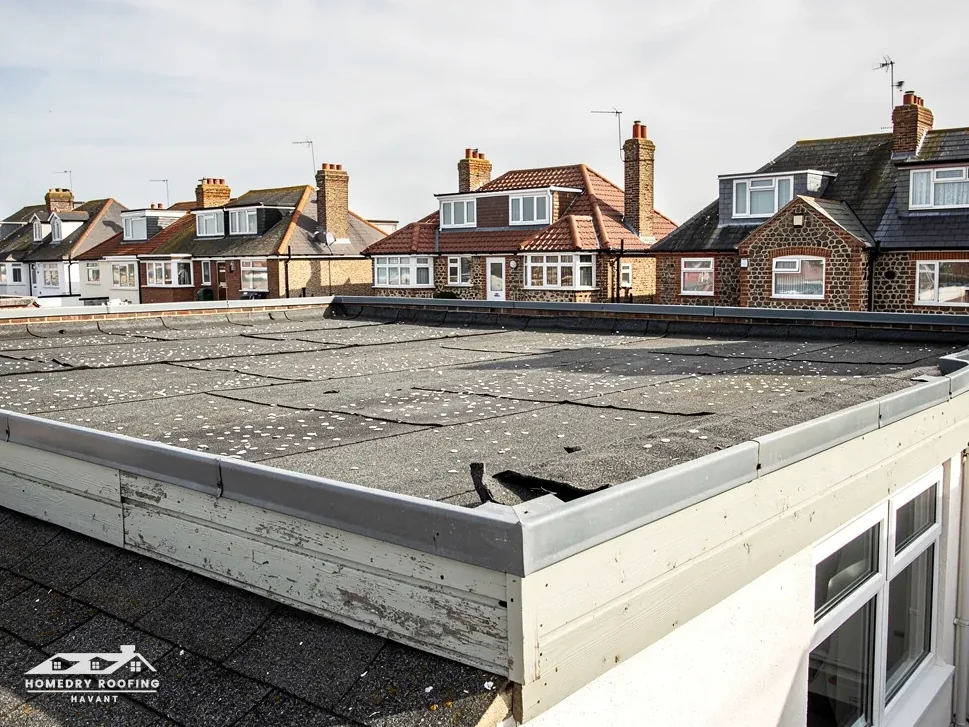
Where a flat roof sends its rainwater through one opening into a pipe.
When leaves block that opening, the roof holds a pool against the wall and the pool stays.
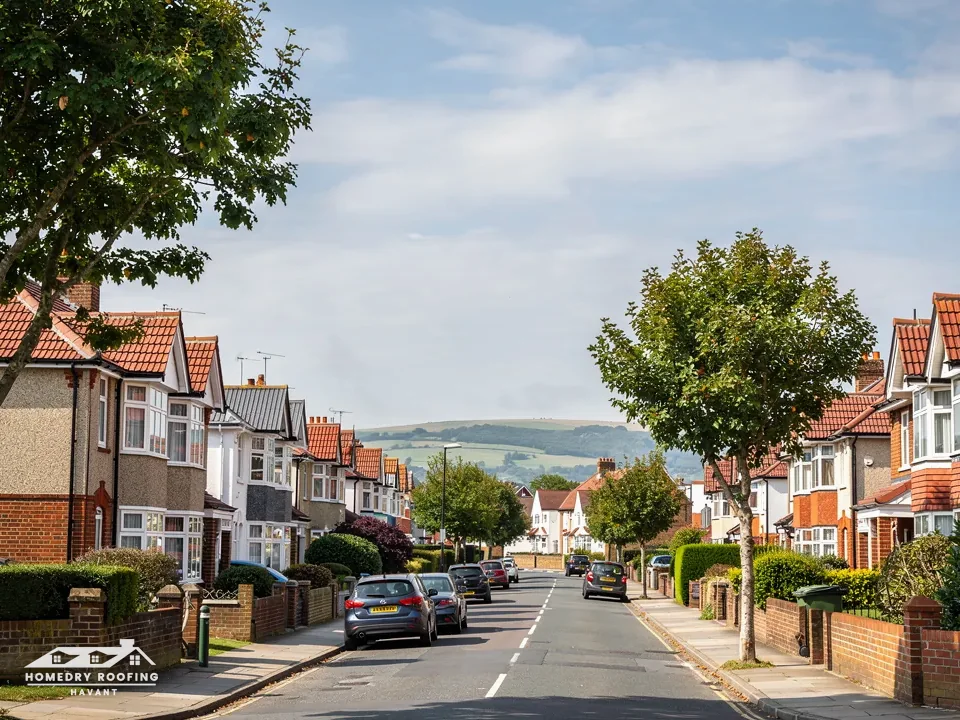
On an exposed roof we fix and check the edges with that exposure in mind.
The parts of a pitched roof that stand proud of the weather are the ridge, hips and verge, so a Hayling Island survey spends time on all three. Cupa, the slate maker, names exposure to wind and rain as the two main factors in a roof's environment, and writes that coastal areas "will be graded with higher exposure". That is why BS 5534 governs how a coastal roof's fixings are specified for its site. Marley says installing to BS 5534 "isn't required by law", but that mortar alone "could no longer be relied upon", so ridge and hip tiles here are fixed mechanically with clips or screws. Marley also notes that BS 8612:2018 is the specification for dry-fixed ridge, hip and verge systems, which our dry ridge and verge page explains.
On the slope below, we read the tiles course by course, check the pointing at the verge, and look from the loft hatch at the underlay and the battens. A roof repair is aimed at the exact place the rain entered, and you learn whether mending is enough or a fresh covering is called for, and why, before anyone talks about price. If the fault is a single slipped tile, the repair is small and the quote says so.
On the island, planning decisions rest with Havant Borough Council. The National Heritage List includes Mengham Farm House, Grade II, and a listed house keeps its permitted development rights for roof work while still needing listed building consent for any change to its character. Chichester Harbour National Landscape lies near Hayling Island, but it is a designation and not a decision-maker, and the planning guide linked below covers what it changes for dormers. Our planning guide for roof work also covers ordinary re-roofing, so none of those rules need repeating on this page.
A ridge bedded in mortar alone depends on that bedding staying whole through every season of wind and rain. Once it cracks, the capping tile can loosen and rain gets under it. Mechanical fixing, with a clip or a screw through the tile into a batten or a ridge board, holds the tile in place without relying on mortar to do so. We show you which method your ridge has when we survey it.
A ridge tile sitting crooked on its bed, or fragments of mortar lying in the gutter after a blustery night.
A cracked bed under a capping tile, which lets rain run in beneath it and onto the timber of the roof.
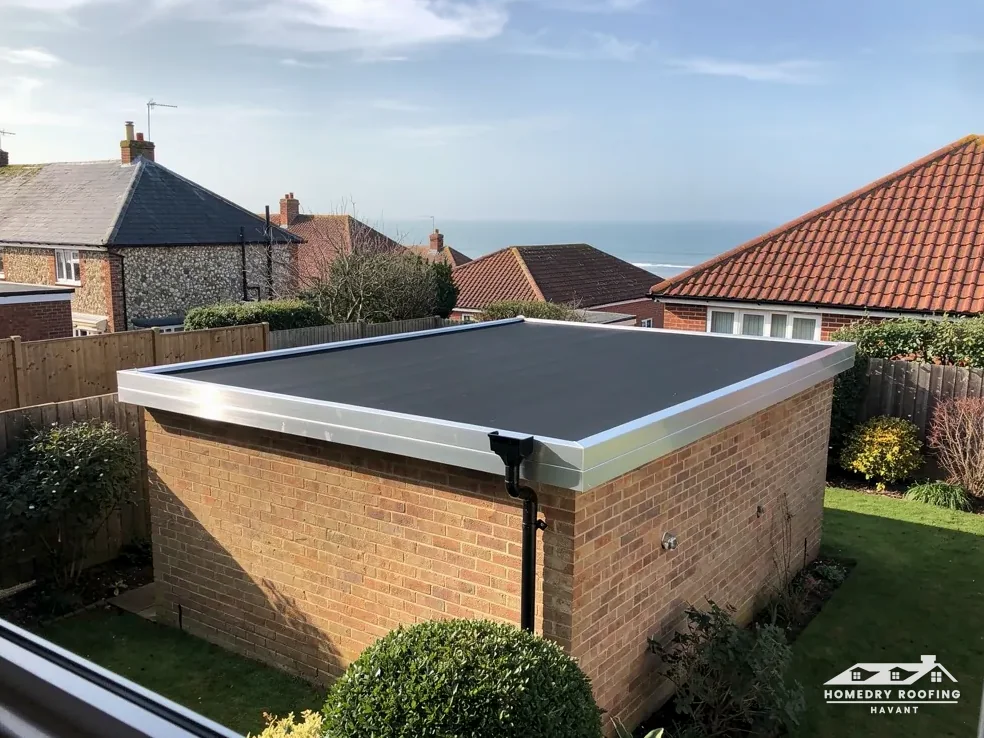
Look at it a day after rain. Water still standing in the same place means the surface is not draining, or its outlet is blocked. A straight edge and a spirit level at the survey show which it is.
A flat roof sheds its water differently from a pitched one. There is no ridge to throw rain either way, so the whole surface must fall gently to an outlet, and the covering is carried up the wall behind it to form an upstand. The survey follows that route. We look for ponds that stay after rain, because they show a fall that has gone wrong or an outlet that has clogged. We check the upstand for splits and for a loose edge, and the laps and joints in the covering for lifting. The flat roofing page describes the membranes we lay; after the survey you learn whether the present one can be mended or needs stripping.
Flood Zone 3 land near Hayling Island can be found on the Environment Agency's flood map. The flooding in question is at ground level and has no bearing on the roof specification, so the roof is not specified differently because of it. What the roof can do is send its water somewhere sensible, so we note where every downpipe and outlet discharges and tell you if it ends at a wall or a blocked drain, so nothing is left to run down the brickwork unseen. If a downpipe has to be moved or a gutter regraded to suit a new outlet, that goes into the same written total.
On the island, the council's Article 4 list carries directions for land use, titled for camping, for caravans and residential use outside tents, and for hovercraft use. They are land-use titles and say nothing of roofs, but an Article 4 direction may remove more rights; check with Havant Borough Council for your address. Coastguards is a conservation area close to the centre of Hayling Island, and Havant Borough Council's full list covers the rest. Whatever the roof needs, the site is left clean afterwards.
A flat roof with no fall is a tray waiting for the next shower.
An outlet that blocks leaves the flat roof behaving like a shallow tray. Leaves, grit and moss gather at the opening, the water stands, and it presses on the upstand and the joints until one gives. We clear the outlet at the survey where we can, photograph it before and after, and tell you if the fall itself is the problem, which a clean-out alone cannot cure, so the repair you are quoted fits the fault.
Map of Hayling Island and the places around it, with the dashed line of our 30-mile service area from Havant. The same places are listed below the map.
Mechanically, with each capping tile held by a clip or a screw into the timber beneath it, not by mortar alone. Cupa writes that coastal areas "will be graded with higher exposure", and the fixing specification is then calculated for the site under BS 5534. Marley says installing to that code "isn't required by law", while mortar on its own "could no longer be relied upon". We show you the method your ridge has and the one we would use, so you can compare the two, and the choice is written into the quote, with the reason beside it.
The council's list carries Article 4 directions for island land, which sit alongside the planning rules for houses, titled for camping, for caravans and residential use outside tents, and for hovercraft use. Those titles concern the use of land and say nothing of houses or roofs. Even so, further rights can be removed by an Article 4 direction, so ask Havant Borough Council about your own address before work begins. A question now is better than a notice later, long after the scaffold has come down.
It depends on how much is touched. The Planning Portal sets the point at under 25 per cent of the building envelope and under 50 per cent of the roof; stay below both and no application is normally required. A new covering that weighs 15 per cent or more extra needs approval, whatever the area. For island roofs we put the building regulations question to your building control body before the work begins, and we relay its reply to you in plain words, so that you can see for yourself what the work does and does not trigger.
A scaffold on the highway needs a licence from Hampshire County Council, whose fee is £211.90 on application for the first 2 weeks and £72 for each additional 2-week period. Hampshire County Council needs ten clear working days to elapse before the licence begins, and says scaffolding companies must apply on behalf of their customers. We arrange it with our scaffolder. A scaffold that stays inside your own boundary is a different matter again, and the survey establishes which case you are in so the start date allows for any wait and nobody is surprised on the morning the poles arrive.
No. The National Landscape, which the planning rules still call an area of outstanding natural beauty, lies near Hayling Island and is a designation, with the decisions staying at Havant Borough Council. The map is what shows whether a given address lies inside the boundary. Dormers are treated differently there, which our planning guide explains, while ordinary re-roofing stays under the normal rules. Look at the map first, then ask the council if the answer is not obvious, and keep what it says with your paperwork for the sale or the survey that follows.
Coastguards is a conservation area close to the centre of Hayling Island, and Havant Borough Council keeps the full list for the island, so start there. For a house, re-covering the roof stays within permitted development in a conservation area, though further rights can be removed by an Article 4 direction. Boundaries are the council's to confirm, which is why we do not tell you a street is in or out from memory. Ask for the map and the direction list together, keep the reply with your records, and show it to us before the survey so that the specification can take account of it.
The Environment Agency's flood map describes the chance of flooding at ground level, and Flood Zone 3 land lies near the island. Rain getting through a roof is a separate matter with separate causes, so no roofing specification follows from the zone. We only use the map to take care over drainage, by checking that outlets and downpipes carry water clear of the walls, and by telling you where they discharge. Everything else on the survey concerns the roof itself, ridge through to gutter, and that is where any repair or replacement is aimed.
The quote is one written total price, produced after the survey, and ought to state if the VAT charge and the scaffold cost fall inside that total. If any quote you compare is silent on either point, ask, because a low figure that leaves them out can end up dearer once they are added. We also tell you whether repairing the roof is enough or it should be renewed, giving the reasons, and a sound repair comes first. The price is fair for the work, and we clear the site when we leave, taking the old material with us so that nothing is stacked by the side of the house.
You'll get one written total price.
Fill in what you like. It opens WhatsApp with your message ready to send.