
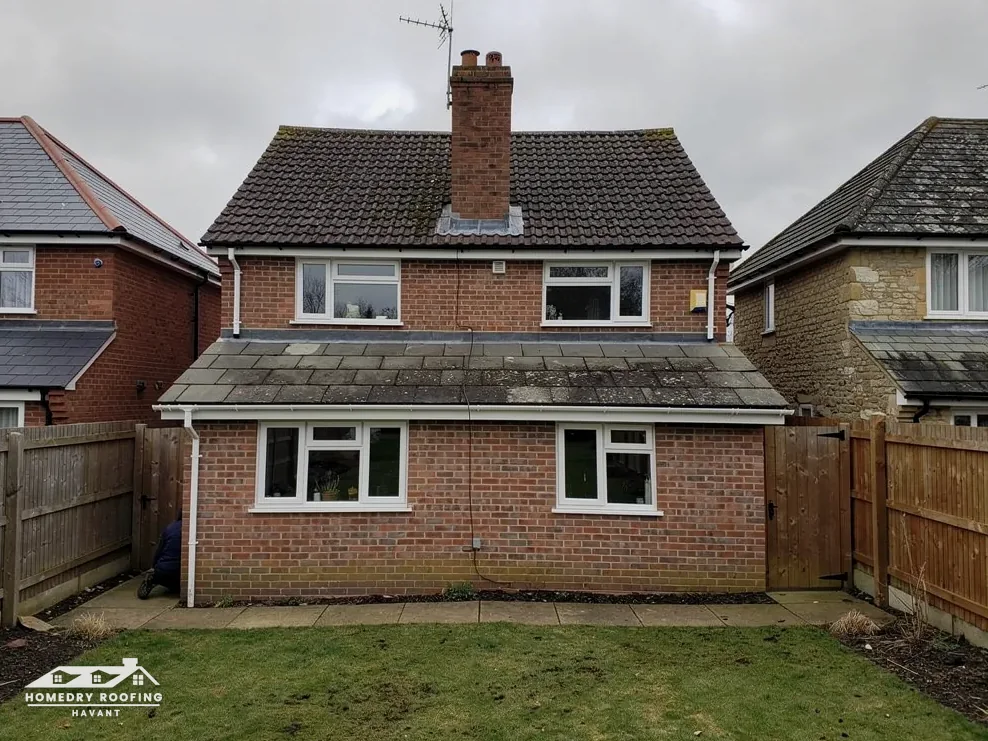
Slopes
Where a single cracked or slipped tile leaves a gap in a Milton slope.
The underlay beneath takes the rain until it tears, and then the loft timbers take it instead.

Roof repairs and re-roofs in Milton, a district of Portsmouth, following the rain from first tile to last drain, with one written total price.
10-year workmanship guarantee, in writing
Where a single cracked or slipped tile leaves a gap in a Milton slope.
The underlay beneath takes the rain until it tears, and then the loft timbers take it instead.

Where a brick stack meets the tiles and the flashing has to bridge the join.
Lifted lead or a cracked fillet gives rain a route behind the stack and into the bedroom wall.
Where the downpipe's water drops into a drain at the foot of the wall.
Once a gully silts up, water stands against the masonry and the roof takes the blame for the damp.
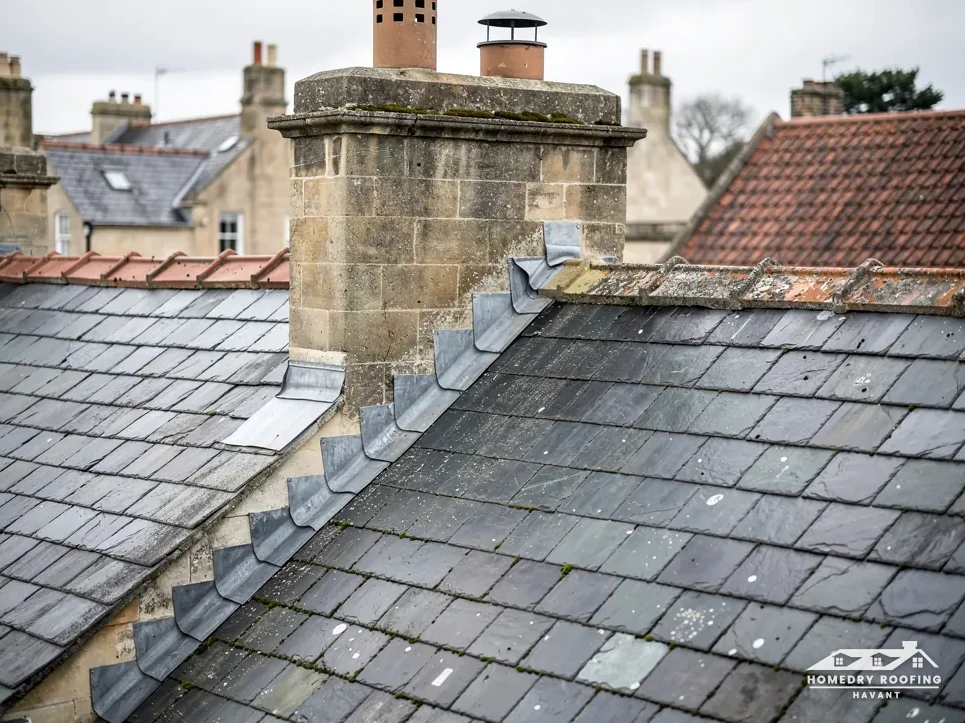
Where the lead or the cement fillet has lifted or cracked, rain runs behind it instead of off it, and travels down the stack into the loft. Checking the upper edge, the joints and the pointing shows which it is.
Picture a raindrop landing on a Milton roof and follow it. It strikes a tile, runs down the slope to a valley or a flashing, and drops into a gutter, and the survey travels the same route in the same order. On the ladder we check the ridge and hips first, then each slope for tiles that have slipped, split or lifted, then the places where the roof meets something else: a chimney, a party wall, a dormer cheek. Last comes the loft hatch, for a view of the underlay and the rafters, where damp, daylight or a stained timber shows what the outside hid. If the drop has got in, the route shows where, and a roof repair closes that spot rather than the stain below it.
Listed at Grade II, Church of St James (National Heritage List entry 1412162) is a working Church of England church, which means the church's own works follow the Church of England's faculty system, not listed building consent, and that includes its roof. Houses are a separate case. Portsmouth City Council has designated the Rochester Road and Essex Road conservation areas, and a house inside one is still normally covered by permitted development when it is re-roofed, though Article 4 directions withdraw more at named addresses. Portsmouth City Council's directions name Nos 1-43 and 2-36 Rochester Road, and Nos 98-154 (even) and 115-169 (odd) Essex Road, reaching chimney stacks and main elevation roof cladding, so ask about your own number.
A listed house keeps its permitted development rights for roof work, though listed building consent covers anything that changes its character (Listed Buildings Act 1990, section 7). A single listed building stands near the centre of Milton according to the National Heritage List, so search it by address before assuming anything. The rest of the planning picture, dormers included, is in our planning guide for roof work.
Follow the drop from the first tile to the drain, and the fault shows.
If you manage a church building near Milton, the route depends on the denomination. A Church of England church in use goes through the faculty system rather than listed building consent, while listed Unitarian, Quaker and redundant churches need listed building consent. A homeowner's roof is a separate case, but knowing both explains why two listed buildings on one street can face different paperwork, and why a neighbour's answer may not be yours.
A damp corner beside the chimney breast on an upstairs wall, brown at the top and fading downwards.
Failed flashing where the stack meets the tiles, so rain runs behind the lead and down the brickwork inside.
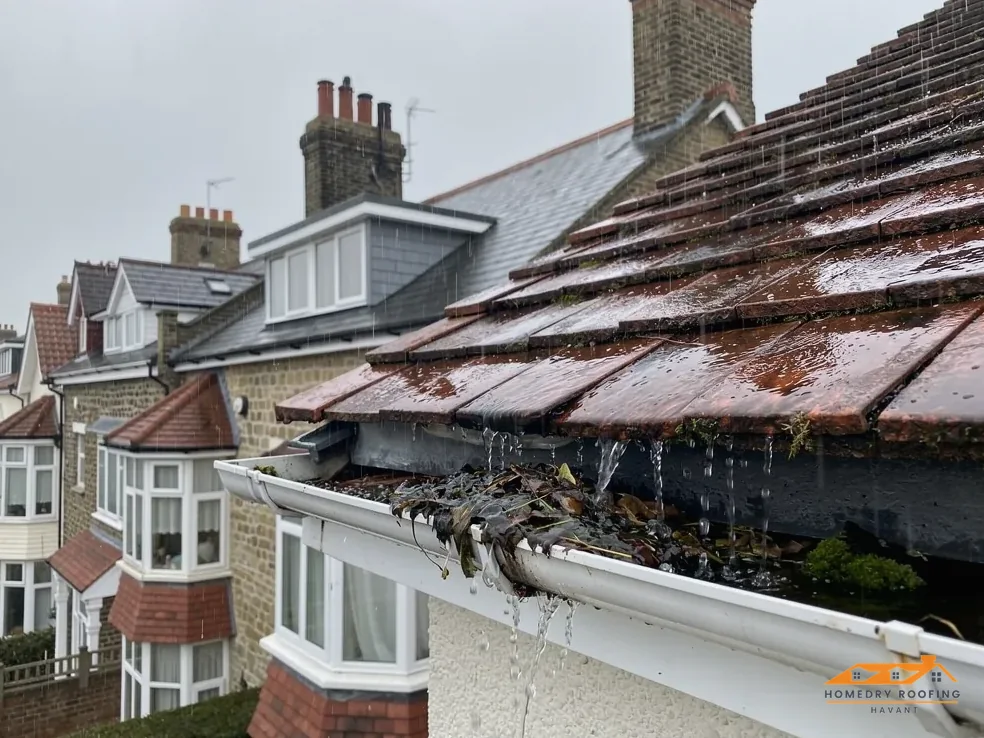
The last stretch of a roof is the pipe that takes the rain away.
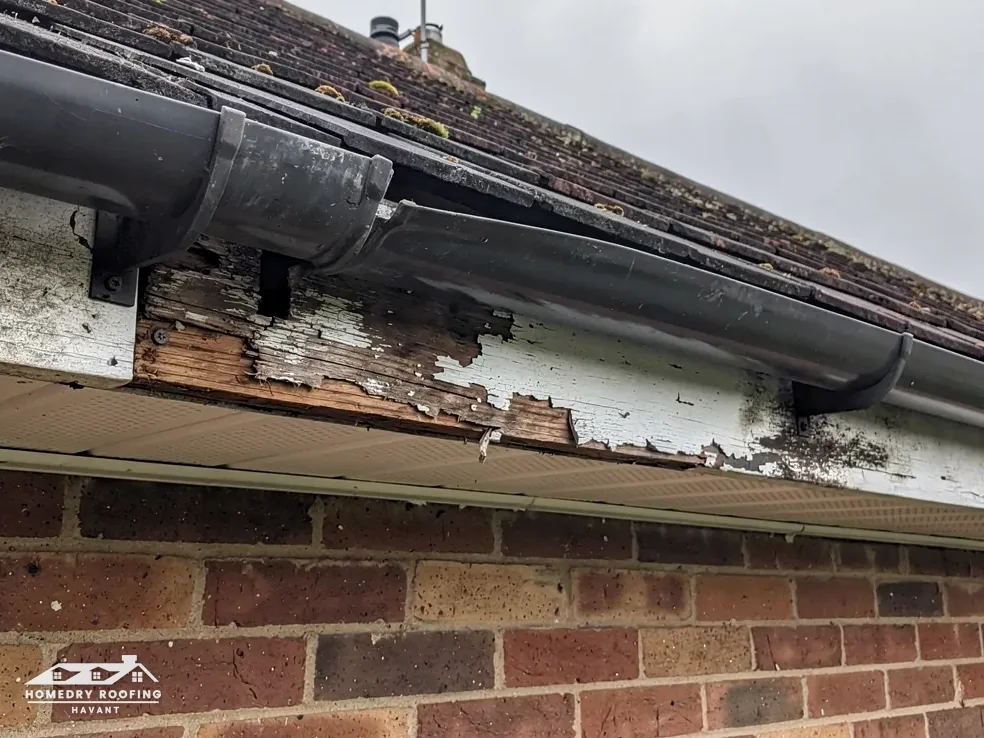
Down at the eaves, the raindrop reaches the gutter. A Milton gutter is judged on three things: whether it falls to the outlet, whether its joints hold, and whether its brackets still grip. A run that holds a puddle, drips at a joint or has pulled forward from the fascia is doing less than it should, and the sign of it is plain once you know where to look. The downpipe is followed to its foot, and the fascia and soffit above are pressed for softness. The cure may be small, a clear-out or a refix, and on our gutters, soffits and fascias page we describe the repairs, from realigning a run to fitting new boards.
Flat roofs get their own questions. Is the covering whole and unblistered, are the seams closed, does the surface fall to the outlet, and is the upstand against the wall still standing proud and sound? A flat roof whose sheet is sound can be mended, and when it cannot, we tell you plainly and set out what a new covering involves, including why it is needed. Each covering we fit is described under flat roofing, with the reasons to choose each, so you can weigh the advice before agreeing to anything.
Milton counts as a coastal district, and the one fact that follows for a roof is exposure. Cupa, the slate maker, says a coastal site goes in a higher exposure grade, so a covering's fixings are calculated for the site and not chosen out of habit. That calculation, the covering and the method go into the quote in plain words. When we finish, the site is clear of debris, and you hold one written total price that followed the survey, together with a plain statement of whether repair or replacement is the sound choice for your particular roof.
Highway rules put the road outside under Portsmouth City Council, whose hoarding and scaffolding permit is requested through Colas. We arrange the licence with our scaffolder before any pole goes up, and Colas prices the Portsmouth permit at £100.00 + VAT per month. Raise any access question at the survey, because a drive, a shared passage or a narrow pavement changes how the scaffold is set out and how long the permit is needed.
In the order the water travels. We start at the ridge and hips, walk each slope, and look at every junction where the roof meets a chimney, a wall or a valley, since those are the places a covering stops working on its own. Then we turn to the eaves, gutters and downpipes, and finish in the loft with the underlay and the timbers, torch in hand. The result is a written account, with photographs, of where the rain gets in and why, with a recommendation to repair or replace, and a price after that, once the facts are on the table.
Re-roofing normally escapes a building regulations application where the work affects less than 25 per cent of the building envelope and less than 50 per cent of the roof, as the Planning Portal sets out; approval is required for a covering 15 per cent or more heavier. In Portsmouth, building control is the Building Control Partnership, reachable on 01329 824823. Where a job might tip over either limit, or a heavier tile is planned for an old frame, we check the position with them before the work is booked in, so the answer reaches you early and not halfway through the roof, when changing course is costly.
No. Portsmouth City Council looks after the road outside as highway authority, and the permit for hoarding and scaffolding is requested through Colas. We arrange the licence with our scaffolder, so you have no form to complete, and Colas prices the Portsmouth permit at £100.00 + VAT per month. What you can do is tell us at the survey about anything that affects access, such as a shared drive, a parked car that cannot move, or a narrow path. Those points shape how the scaffold goes up, and they are easier to settle before the poles arrive on site and the neighbours start asking questions.
Only if your own house is a listed building. A listing attaches to one building, and Church of St James (National Heritage List entry 1412162) currently serves as a Church of England church, so it falls under the faculty system, with no listed building consent route for its own works, so a neighbour's roof is outside it. A neighbouring house has no connection to that route. If your address does appear on the National Heritage List, listed building consent applies to roof work that affects the building's character, and we would raise it at the survey, before any price is written, so nothing about consent comes as a surprise.
Portsmouth City Council has designated both, and the council is the body to tell you if your road sits within either. A fresh covering on a house normally counts as permitted development inside a conservation area, but Article 4 directions remove that at named addresses: Nos 1-43 and 2-36 Rochester Road, and Nos 98-154 (even) and 115-169 (odd) Essex Road, for the roof cladding on the main elevation fronting a highway. Away from those numbers, still check with Portsmouth City Council before work is arranged, which is a short call and settles the point. Dormers and other alterations are explained in our planning guide, which we link to instead of restating.
In four places, mainly. The upstand against the house wall, where the covering turns up the brickwork and can lift or split. The seams across the sheet, which can open. The surface itself, which can sink and hold a pool instead of falling to the outlet. And the outlet, which can clog. We check all four, press the surface for soft patches, and report which of them is at fault, so the recommendation is a repair where the sheet is sound and a new covering where it is not, with the reasons beside it, set down for you to keep.
They are calculated for the site rather than assumed, and the difference matters on exposed ground. Milton counts as coastal, and Cupa, the slate maker, says exposure is graded higher on a coast like this, so a specification is drawn up for the site under BS 5534. Marley says BS 5534 isn't required by law, which is why it is worth asking any roofer how they decide on fixings. We give you the specification in writing, covering the tiles, the ridge and the verge, and you are welcome to put it beside any other quote before you choose who does the work, however many you collect.
A single figure covering the whole job, written once the survey is done, never beforehand. It lists the work and the roof covering to be used, and it is wise to see if the figure includes VAT and the scaffold, because firms differ on that. We state whether the roof wants repairing or replacing, with our reasons, and a sound repair is recommended over replacement. Nothing is left for you to clear away afterwards, and we aim to keep prices good and fair, whatever the size of the roof or the number of storeys.
You'll get one written total price.
Fill in what you like. It opens WhatsApp with your message ready to send.