
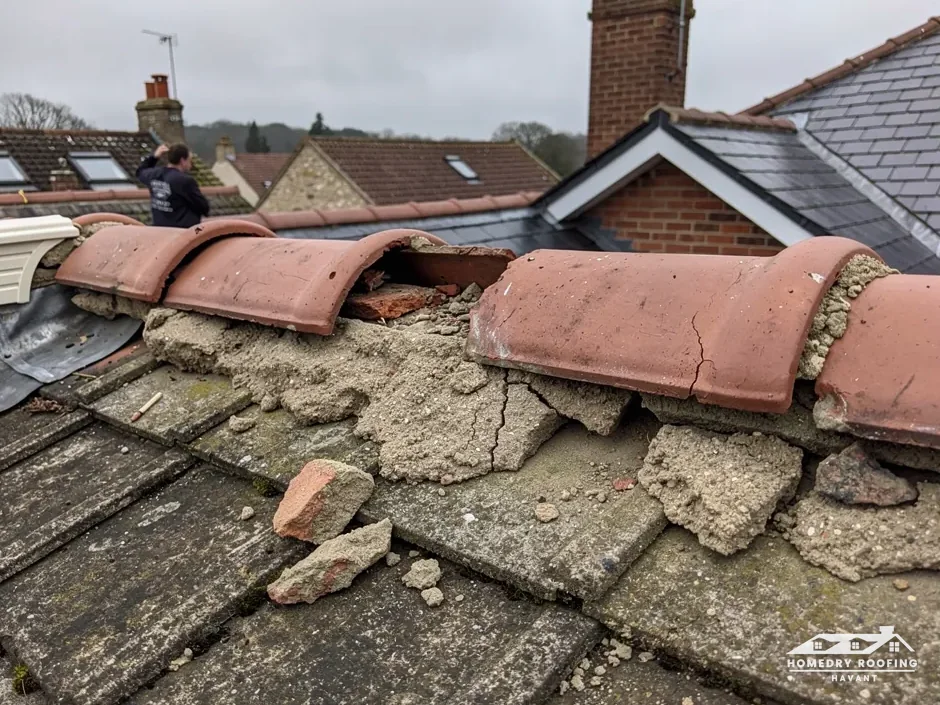
Gables
At the side of the house, where verge tiles overhang the gable brickwork and its pointing.
Crumbled pointing along that edge lets wind push rain beneath the last row of tiles.
Roof repairs and re-roofs in North End, a district of Portsmouth, read first from the pavement and then from the ladder, with one written total price.
10-year workmanship guarantee, in writing
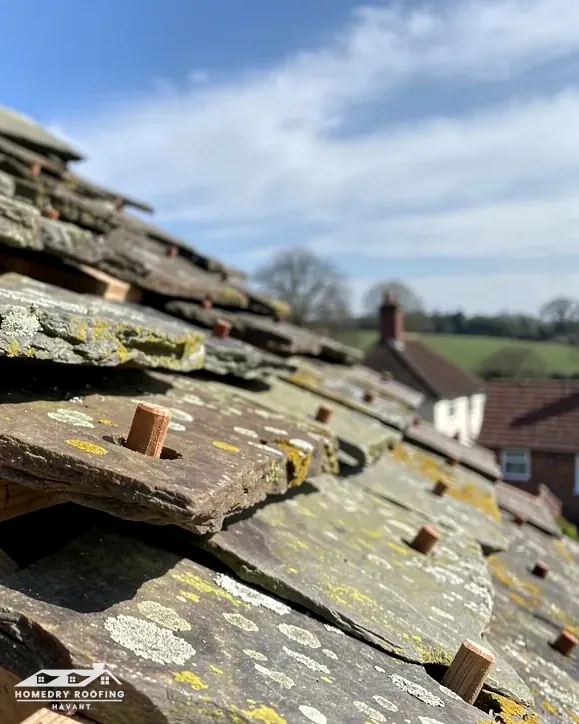
At the side of the house, where verge tiles overhang the gable brickwork and its pointing.
Crumbled pointing along that edge lets wind push rain beneath the last row of tiles.

Where the stack pierces the slope, the flashing hugs each of its four sides.
A gap in the lead or the fillet there gives rain a direct route into the loft.
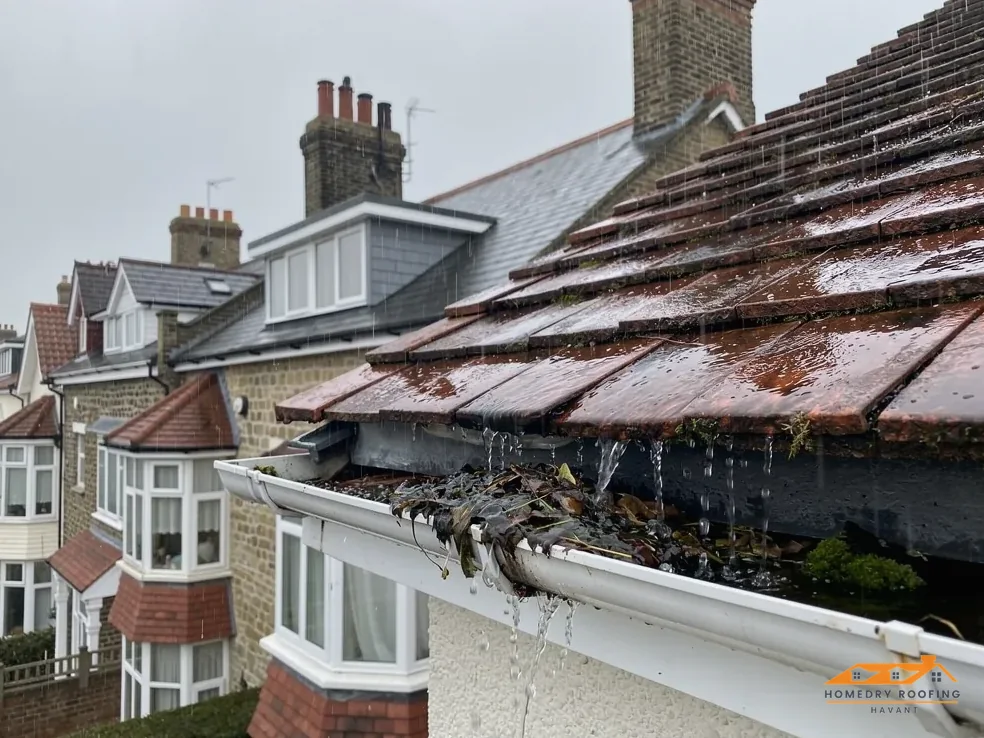
Where the gutter's water drops from the eaves into a gully at ground level.
A cracked joint on the way down soaks the wall and shows up as damp inside.
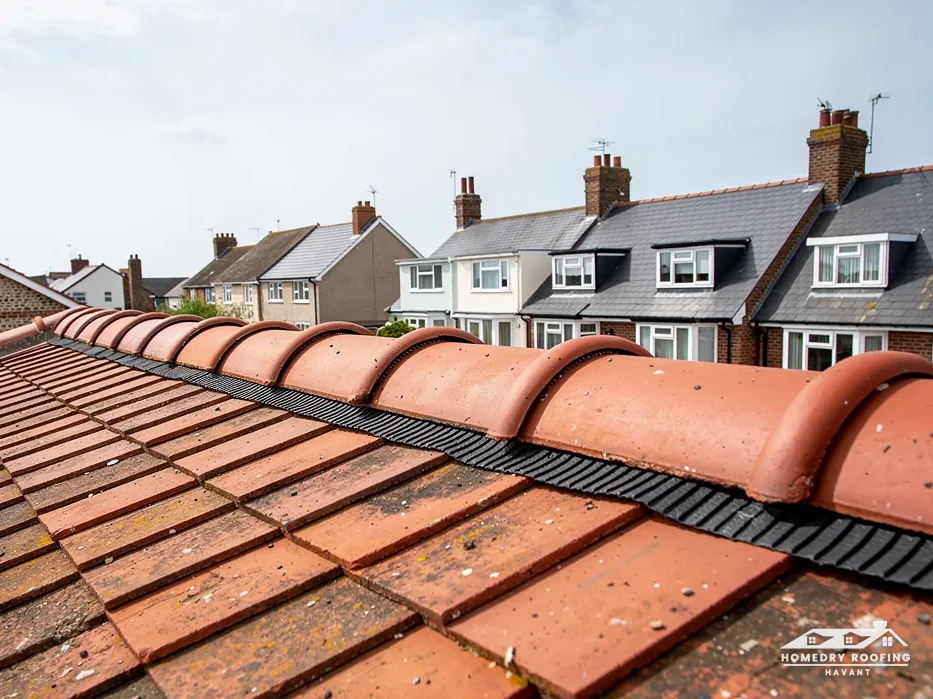
Some faults are visible from the kerb long before anyone climbs up.
Before a ladder goes up, we read the roof from the pavement. Across a North End street, a ridge line that dips, a gable edge that has pulled away from the wall or a chimney stack that leans all show up from a distance. Then comes the close work at the top: ridge, hips and verges, followed by the slopes row by row, noting tiles that are slipped, cracked or missing. Under the covering, the loft hatch lets us inspect the underlay and the rafters. A roof repair depends on tying what we saw outside to what we saw inside, so the cause is named before any price is.
One listed building is recorded on the National Heritage List close to the centre of North End. Whether that touches a particular house is an address-by-address question. Work that would change a listed home's character needs listed building consent under section 7 of the Listed Buildings Act 1990, though the home keeps its permitted development rights for roof work, and the entry page on the list shows the grade. A house with no entry has no consent of that kind to obtain.
Portsmouth City Council is the authority for planning here. Among the nearest conservation areas to North End are Hilsea Lines; Mile End, Landport; St Mary's Churchyard, Fratton; and Guildhall and Victoria Park, and the council can confirm whether your road sits inside any one of them. Taking off the old covering and laying a new one on a house is normally permitted development, inside a conservation area as outside it, though an Article 4 direction can withdraw more rights. Its directions name particular addresses, the closest being in Old Commercial Road in the Mile End area, so check with Portsmouth City Council for yours. Dormers and other changes are covered in our planning guide for roof work.
A roofline seen from across the road tells us things a close view hides: a ridge that sags between two points, a slope that has bellied, a chimney out of plumb. Where a problem is plain from the pavement, we point it out and show you, and where it needs the ladder, we climb first and report afterwards, with the findings written down for you to keep.
A tile lying on the lawn once a blustery night has passed, or a bare patch of batten visible on a slope.
A slipped or snapped tile that has left the underlay exposed, so rain reaches the timber beneath.

A drip along a run points to an open joint, a split in the section, or a gutter that has sagged between brackets. Each has its own remedy, from resealing to replacing a length, so we trace the drip before choosing.
What the slopes shed has to be carried away, and the gutter is the first part of that job. Along each North End run we look for slight sags, open joints, bent brackets and a surface furred with moss, then watch where the water goes when it reaches the outlet. A gutter set level but choked with silt gives the same stain on a wall, so clearing it comes first and can cost the least. The downpipe follows: its joints, its fixings to the wall and the shoe where it empties. Fascias and soffits are checked for soft spots and flaking, because they show how long a gutter has been overflowing. Where a clean and a refix does the job, that is the quote; bigger repairs sit under gutters, soffits and fascias.
A rear extension, or a garage whose roof is flat, gets a survey of its own. We examine the covering at the point it rises up the house wall, the lap joints, any blisters, and whether rain drains to the outlet instead of lingering in a hollow. A flat covering and a pitched one fail in different places, so the advice differs too, and the choice between repair and a new covering is set out with the reason beside it. Read about flat roofing if you are weighing options.
North End counts as a coastal district. For roofing the consequence is narrow and specific: exposure is graded higher, so the fixings are calculated to suit the site, and nothing else on this page rests on that fact. Last, we walk to the base of each downpipe to see where its water ends up, since a wet wall or a blocked gully is a separate fault we would report to you. We leave the site clean, and one written total price follows the survey.
Where a roof's water lands decides whether the wall stays dry.
For roofs in a coastal district, Cupa, the slate maker, applies a higher exposure grading. Marley lists wind uplift formulas and a means of calculating fixing specifications among the contents of BS 5534, so the fixing for this site is worked out and not assumed. Each fixing method is written into our quote, which lets you compare like with like when you hold several.
It lets us judge the whole roofline at once, which a close view cannot do, and it takes only minutes. A ridge that dips, a slope that has bellied, a gable edge pulling away from its wall or a chimney leaning slightly are easier to see from across the road than from a ladder. We note them, then confirm each one up close, together with the valleys, flashings and gutters. Inside, the loft hatch shows the underlay and timbers. By the end we can say where the rain gets in, and whether mending that spot will do or the roof wants replacing, with the reason given in writing and the price alongside it.
According to the Planning Portal, re-roofing normally needs no building regulations application as long as the work touches under 25 per cent of the building envelope and under 50 per cent of the roof. Approval comes into it for a covering 15 per cent or more heavier, and a surveyor or engineer can check the load for you. In North End, building control sits with the Building Control Partnership (01329 824823), and we speak to them before starting a job near those limits. That saves you from finding the boundary the hard way, with a stopped job, a delay and an unplanned extra visit.
The highway authority for the road outside is Portsmouth City Council, and scaffolding on the highway needs a hoarding and scaffolding permit, which goes through Colas at £100.00 + VAT per month on its form. We arrange the licence with our scaffolder, so there is no paperwork for you to complete. What matters to you is timing, and we discuss it at the survey, since a scaffold over a pavement or beside parked cars needs a little notice to the neighbours, so we plan it with you and agree the date in writing.
Not unless your own house is the listed one. One listed building near the centre of North End is entered on the National Heritage List; a listing covers that single building, not the street around it. If your address does have an entry, work that would alter the building's character needs listed building consent, and we would go through the options with you before a tile moves, in writing if you prefer. The entry page on the list tells you the grade, and searching it by address takes a minute.
Among the nearest are Hilsea Lines; Mile End, Landport; St Mary's Churchyard, Fratton; and Guildhall and Victoria Park, and Portsmouth City Council holds the maps and the rules. Laying a fresh covering over a house roof is normally permitted development, inside a conservation area too, though an Article 4 direction can withdraw more rights. Ring Portsmouth City Council about your road before you book anyone, ourselves included. Our planning guide covers dormers and similar changes in detail, so we leave that there and keep this answer to the first question: which area, if any, is yours.
North End counts as coastal, and Cupa, the slate maker, says coastal areas take a higher exposure grade. Marley lists batten selection, methods of fixing, wind uplift formulas and a means of calculating fixing specifications among BS 5534's contents, which is why we calculate a specification for each site instead of copying a stock detail from the last job. We write down the fixing used for tiles, ridges and verges, so that you can set that detail beside any other quote and see what each one assumes.
It should leave through the shoe into a clear gully and travel away from the building. When a downpipe empties against masonry, or the gully beneath is silted, the water lingers near the wall and the damp can show indoors, which is sometimes taken for a roof leak. During a survey we follow every downpipe to its end and report what is there. A drainage fault is reported on its own, so it never muddies the recommendation about the roof, and you can pass it to whoever looks after drains or to the council if the gully is public.
You see one written total price after the survey, never before, covering the whole job. It describes both the work and the covering, and a sensible check is to ask each firm to confirm that VAT and the scaffolding are counted in the figure, since quotes vary on that point. Where a repair is sound we recommend it, and where a roof is past repair we explain the evidence behind that view, so the decision stays yours. The site is tidy when we go, and the price is set to be good and fair, with no extras appearing later and nothing left for you to clear.
You'll get one written total price.
Fill in what you like. It opens WhatsApp with your message ready to send.