
Upstands
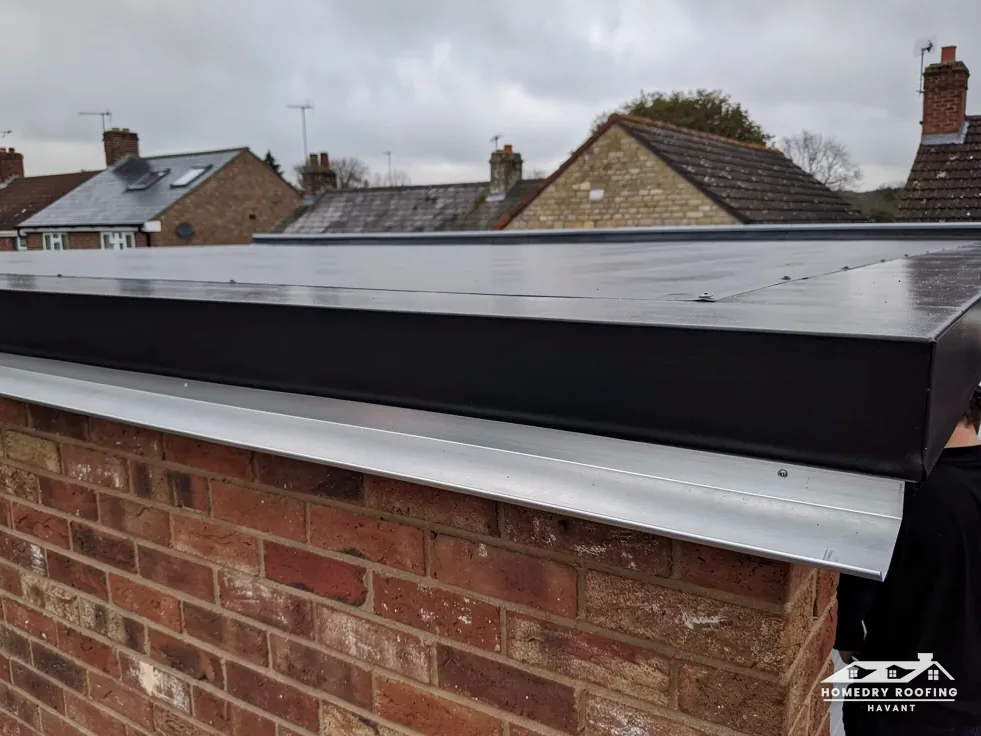
Where a flat covering turns up a wall and its top edge is tucked under a flashing.
A lifted edge there lets rain slip behind the membrane and travel sideways.
Fareham sits 10.5 road miles west of Havant; its flat roofs, chimney stacks and the flashings around them are looked at first, and one written total price comes after.
10-year workmanship guarantee, in writing
Where a flat covering turns up a wall and its top edge is tucked under a flashing.
A lifted edge there lets rain slip behind the membrane and travel sideways.
Where a rainwater head takes the run-off and passes it into a downpipe.
Grit and leaves pile in the box, and the water backs up onto the roof.
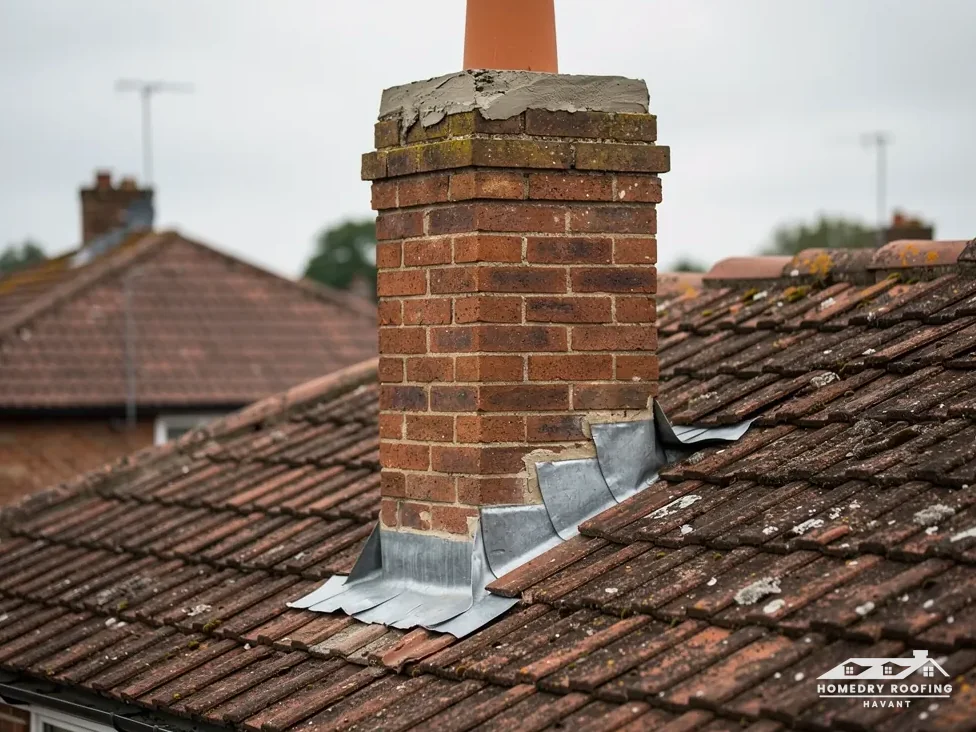
Where a cap of sloping mortar fixes each chimney pot to the top of a stack.
Cracks in that cap carry rain down the inside of the brickwork.
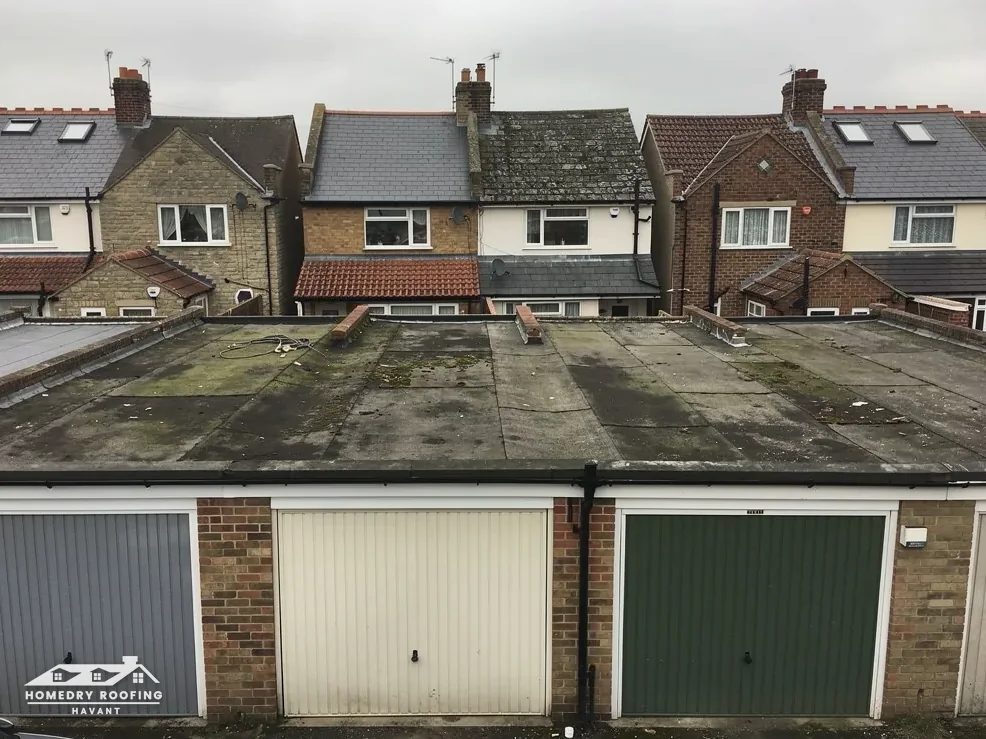
Water still lying long after rain means either the slope towards the outlet is lost or the outlet is choked, and the longer it stands the more strain the covering carries. Send us a photograph, or ask for a survey, so the cause is found before the next wet spell.
A flat roof is laid to a slight fall so that water travels to an outlet, and a Fareham survey follows that journey from end to end. We look for pools still lying on the surface the morning after rain, for blisters and splits in the covering, for the upstand along any wall the covering climbs, and for the outlet itself, whether that is a hopper, a gully or a gutter edge. BS 6229:2025 sets a minimum finished fall of 1:80 for membrane flat roofs, so the roof is designed to a steeper fall to allow for tolerances; IKO adds that the code of practice calls for a design fall of 1:40. A roof that holds a pool has lost either its fall or its outlet, and the repair differs for each. Our flat roofing page describes the coverings we fit.
Upstands and edges come next. At a wall, the top edge of the upturned covering is held by a flashing or a chase; where it ends at the roof's edge, a trim or a drip bar holds it. We press along both for lift, because a loose edge lets rain run behind the covering and travel sideways, well away from the place where the stain appears indoors. Then the outlet: leaves, grit and seed pods settle in it, and the hopper and downpipe have to be clear and firmly fixed. We lift the debris, run water through if it is safe, and say whether you need a clear-out or a new fall.
Roofs over shops, offices and workshops call for planned access, and the scaffold or edge protection is settled before a date is offered. On a shop, office or workshop roof the same checks apply at a larger scale, and every part of the roof is walked before anything is priced.
A flat roof is a gentle slope, and the water knows it.
Standing water makes a roof look defective when the covering may be perfectly sound. A pool can come from a hollow in the deck, from an outlet set too high, or from a gutter that has sagged. We measure the depth of the pool, compare the level of the outlet with the lowest part of the roof, and report which of those it is. A hollow needs a new fall; a high outlet needs resetting.
A stain spreading across a ceiling below the extension, or a pool still lying on the roof the morning after rain.
A split along the upturned edge at the wall, or an outlet silted shut with grit.

Yes, where the brick is sound and the fault is the pointing, the mortar cap or the flashing. Removing a chimney breast is a separate job altogether, and Planning Portal guidance says building regulations approval will always apply to it.
A chimney stack takes rain on every face, and the point where it rises through the slope is a join that has to stay sealed. We check the pointing and the courses of brick, the sloping mortar cap that holds the pots, the pots themselves, and the lead flashing dressed into the brickwork at the base. MyJobQuote says correctly installed lead flashing can last for over 80 years, so a flashing that has lifted points to how it was fixed as much as to its age. Our chimney repairs and leadwork pages describe the work in more detail. A stack that no longer serves a fire still has to shed water, so it is capped and checked in the same way as a working one. From the loft we follow the stack down through the roof space, looking at the timber around it and at the breast below for staining, because the inside of the house tells us which face of the stack has been taking the rain.
The centre of Fareham has 5 conservation areas close by: Cams Hall, Fareham High Street, Osborn Road, Town Quay and Wallington. Fareham Borough Council publishes an Article 4 direction for the Wallington conservation area, and an Article 4 direction can strip further rights from a house, so Fareham Borough Council can say whether a given address is covered, and the question is worth putting before a quote is accepted.
Historic England lists the Church of the Holy Trinity, Kintyre House and Fareham and County Club, each at Grade II*. Holy Trinity is a working Church of England church, which puts its repairs under the faculty system instead of the council's listed building consent. A private house with its own entry does need that consent for work affecting its character. Our planning guide for roof work lays out the national position for houses, and we leave it there.
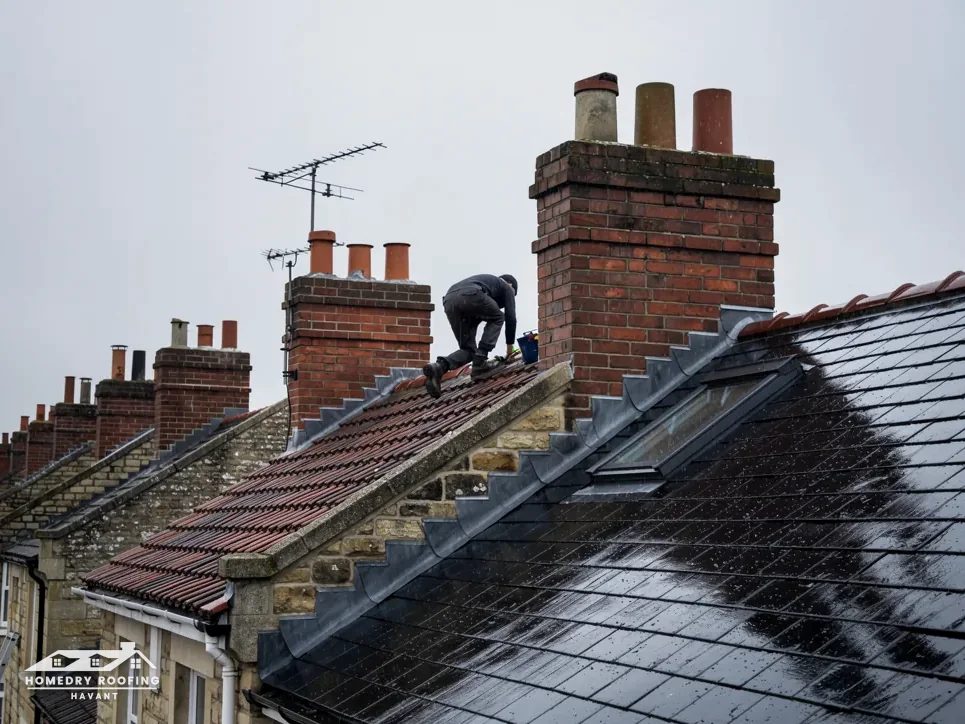
Rain has four faces of a stack to work on.
A stain beside a chimney breast may come from two different places. Rain can enter through open joints in the brickwork, or it can run behind a flashing that has pulled away from the stack. We examine both, photograph whichever has failed, and say so in the notes. If only the lead has gone, the stack stays as it is and the flashing is renewed; if the brickwork has loosened, the work goes into the stack.
Map of Fareham and the places around it, with the dashed line of our 30-mile service area from Havant. The same places are listed below the map.
Water on a flat roof has one way off, and that is the outlet. If the hopper is silted or the gully is partly shut, rain backs up across the surface and looks for the weakest point in the covering, which may be a seam, a corner or the foot of an upstand. So we clear the opening first, then look at the fall around it and at the downpipe below. Pools, algae lines and tide marks show where the water has been standing. The findings say whether the roof needs the outlet cleared, a fall corrected or the covering renewed, and the reasons come with photographs of the places we mean.
That turns on the size of the job. According to the Planning Portal, a new covering over less than 25 per cent of the building envelope and under 50 per cent of the roof normally proceeds without a building regulations application, but one that adds 15 per cent or more in weight needs approval whatever the extent. Fareham building control is the Building Control Partnership, on 01329 824823. We ring the Partnership before work begins and give you its answer in everyday language, leaving the decision with you.
Section 169 of the Highways Act 1980 makes a licence compulsory for scaffolding that obstructs a Fareham pavement or road. Hampshire County Council grants it, at £211.90 on application for the first 2 weeks and £72 for each additional 2-week period, and it wants applications ten clear working days before the poles are erected. Hampshire County Council also says: "Scaffolding companies must apply on behalf of their customers." We arrange it with our scaffolder. You hear the proposed dates first, and only then is anything sent to the council.
Not from the council. Historic England lists the Church of the Holy Trinity at Grade II*, and because it is a working Church of England church, repairs follow the faculty system and not listed building consent. That route lasts while the building is used for worship. A listed private home is another matter: anything altering its character calls for listed building consent from Fareham Borough Council. Kintyre House and Fareham and County Club are also Grade II*, so look up the entry for your own property and read it through.
Fareham has 5 conservation areas close to its centre, named Cams Hall, Fareham High Street, Osborn Road, Town Quay and Wallington, and Fareham Borough Council holds the boundaries. Within a conservation area a straightforward re-cover normally stays permitted development, though an Article 4 direction can withdraw specified permitted development rights, and the council publishes one for Wallington. Whether it touches your house is for the council to say, so check with Fareham Borough Council before you plan the work. Our planning guide covers what the national rules say, and the survey notes can hold the council's reply.
Three places matter: the pointing between the bricks, the mortar cap that holds the pots, and the flashing low on the stack, where it meets the slope. Open joints let rain into the brickwork, a cracked cap lets it down beside the flue, and a lifted flashing lets it run behind the lead; each leaves a different mark on the breast inside. We look at all three from a ladder and then from the loft, where staining on the chimney breast shows which one has failed. Findings are photographed, and a small repair is put forward first where the stack is otherwise sound.
Coastal homes are graded for higher exposure, so the fixing specification is calculated for the site under BS 5534. In Fareham the fixings are chosen for the building and its position, not taken from another job. Marley says installing to BS 5534 isn't required by law; it is a code of practice, and it says mortar alone "could no longer be relied upon" to hold a covering in place. We state the method plainly in the survey notes, so you can see what was decided and why, and a different roofer can read it and check the working.
After the survey you receive one total price in writing, with the findings alongside. It states what the work is and which covering goes on, and it states if the figure includes VAT and scaffold. Repair leads the quote wherever the existing roof can sensibly take one. If another quote omits scaffold or VAT, ask for that omission in writing before the totals are compared. Prices are set at good and fair levels, and the figure written down belongs to the work described, with the survey findings printed next to it so it can be checked.
You'll get one written total price.
Fill in what you like. It opens WhatsApp with your message ready to send.