
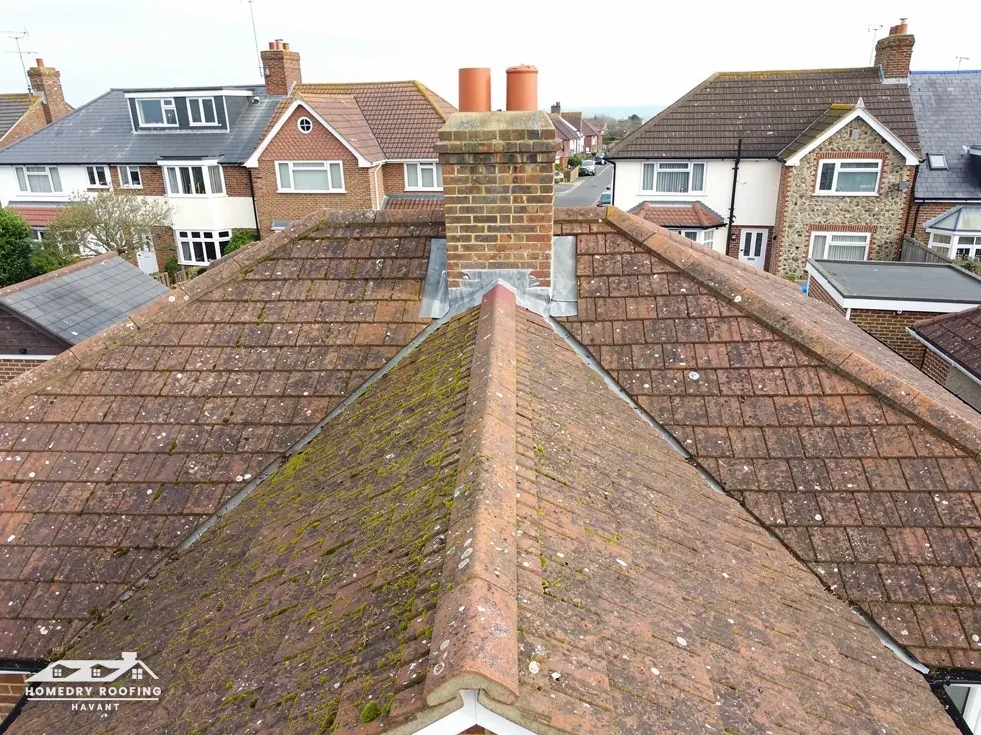
Flaunching
Where a sloped collar of mortar sits around the chimney pots and holds them in place.
A collar that has cracked or crumbled lets rain run down inside the stack.
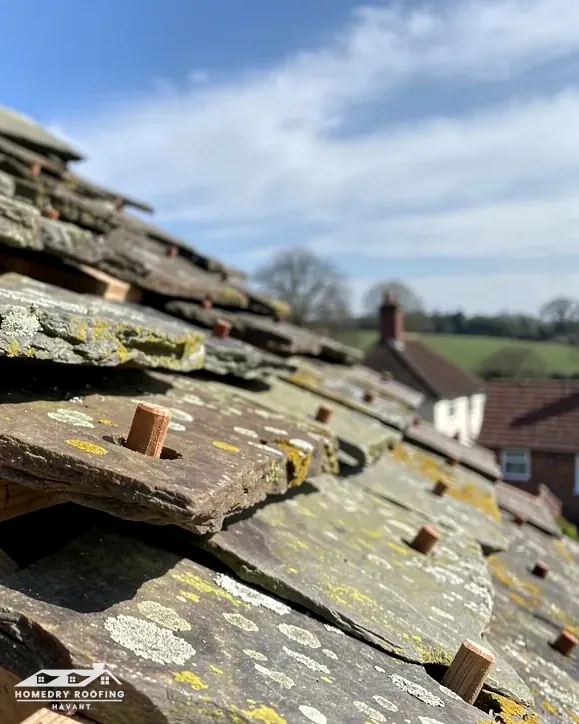
On Knowle roofs, 12.9 road miles west of Havant, chimney stacks, flashings and gable edges are examined before anything else, and a price in writing follows.
10-year workmanship guarantee, in writing
Where a sloped collar of mortar sits around the chimney pots and holds them in place.
A collar that has cracked or crumbled lets rain run down inside the stack.
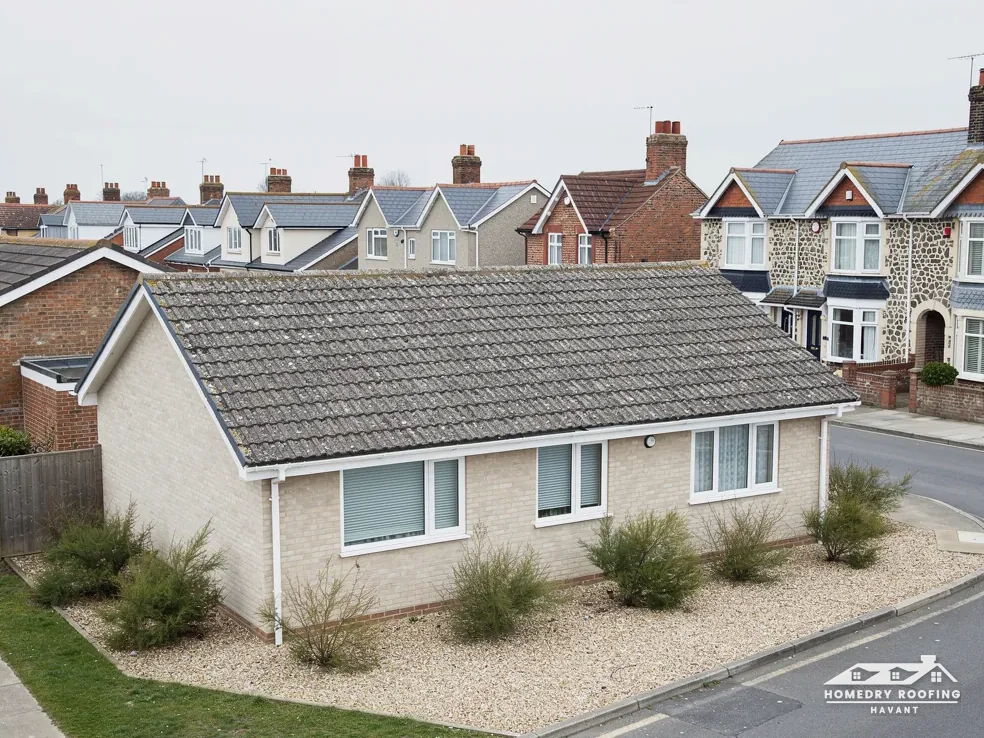
Where the covering ends beside a gable wall and the final row of tiles meets the sky.
A loose edge tile or a soft board beneath it lets the weather reach the wall top.
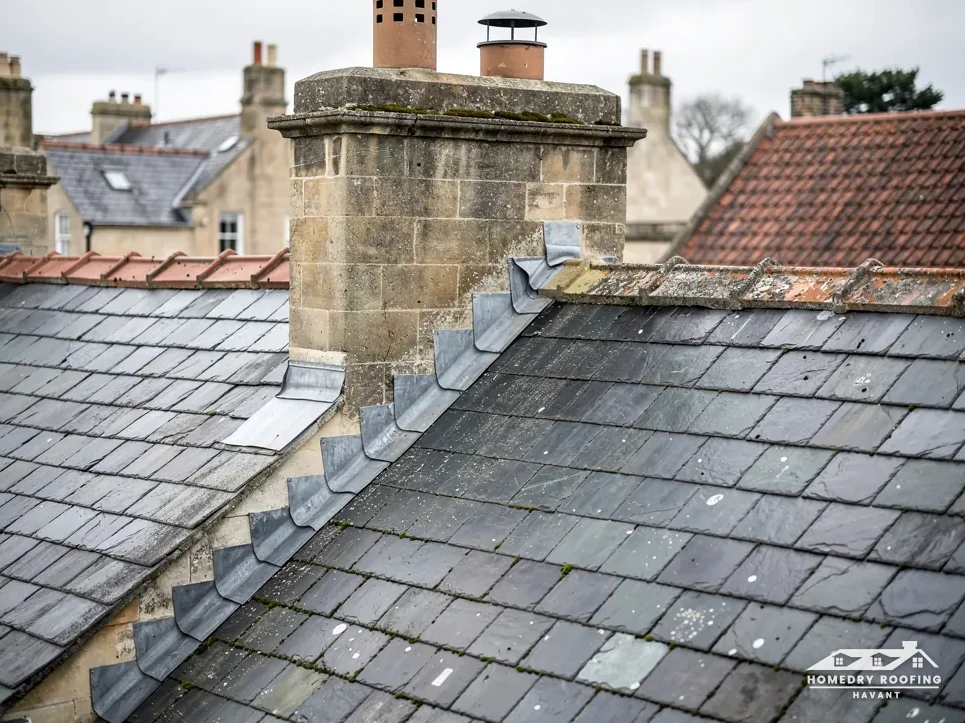
Where a stack comes up through the slope and a band of lead is pressed into its bricks.
When that band lifts, rain tracks behind it and shows up on the breast indoors.

Rain meets a chimney from every side, so every side gets looked at.
A chimney stack meets the weather on every side, so it gets its own inspection at survey. From a ladder at the eaves we look at the brickwork for open joints and loose courses, at the flaunching, which is the sloped mortar collar that holds the pots in place, and at the pots themselves. Lower down, the flashing at the stack's exit through the slope takes the rain that runs down the brickwork. Correctly installed lead flashing can last for over 80 years, according to MyJobQuote, which means a lifted flashing says as much about its fixing and its edges as it does about its age.
Up in the loft we trace the stack from the roofline downward. Staining on the chimney breast, damp timber around it and a tide mark on the plaster each tell us whether the brickwork or the flashing is letting rain in. An unused stack still sheds rain onto whatever lies below it, so it gets a cap and a check like any other. Taking out a chimney breast is a different job: the Planning Portal says building regulations approval will always apply, because the breast is part of the structure, and a breast shared with a neighbour brings a party wall notice as well. Our chimney repairs page lists the work, and our leadwork page explains how a flashing is dressed into the brick.
Knowle appears on the Historic England list through Knowle Hospital Chapel, Knowle Hospital, Former County Pauper Asylum, and Farm Cottages, each Grade II. A private house with its own list entry needs consent before anything touching its character is altered. Conservation areas mapped around Knowle include Wickham, under Winchester City Council, and Titchfield Abbey, under Fareham Borough Council, and Winchester City Council can confirm if your own address sits inside one. Our planning guide for roof work holds the rules, so they stay there.
A wet chimney breast has two usual suspects. Rain can get in at gaps between the bricks, or run in behind lead that has pulled clear of the stack. Each is checked before a repair is suggested, and the joint or the edge is photographed so that you can see it. A failed flashing alone means the stack stays put and the lead is replaced; loosened brickwork puts the repair into the stack.
A brown ring on the ceiling near the chimney breast, or loose wallpaper low down on the breast itself.
A crumbled collar of mortar around the pots, or a flashing edge that has pulled clear of the brick.

Yes, where the tiles and the board beneath are sound. We lift the edge course, check the bedding or clips, and refix or re-bed it. If the board has rotted, it is replaced first, and you see the rotted timber before it goes.
Where a pitched roof ends at a gable wall, the edge of the covering is the verge. That edge takes rain from the side, so we check the line of tiles along it, the bedding or fixings that hold them down, and the board under the edge, the bargeboard, which can soften if water runs into it. Marley, the tile maker, says installing to BS 5534 "isn't required by law", yet it adds that mortar "could no longer be relied upon as the only means of securing the roof covering". Our dry ridge and verge page covers dry-fixed edges, which BS 8612:2018 specifies for ridge, hip and verge alike.
A verge repair and a full re-roof are separate questions for the rules. The Planning Portal sets two limits within which a re-cover does not normally need a building regulations application: less than 25 per cent of the building envelope, and less than 50 per cent of the roof. Weight has a test of its own: a covering that adds 15 per cent or more needs approval. For a Knowle address the route runs through Winchester City Council's building control team (01962 848 176), and we put the question to the team before work starts, and the reply reaches you without jargon.
Edge work calls for scaffold, and in a street that can mean scaffold on the pavement. Hampshire County Council licenses scaffolding on the highway at £211.90 on application for the first 2 weeks and £72 for each additional 2-week period, needs ten clear working days' notice, and says scaffolding companies must apply on behalf of their customers; we arrange it with our scaffolder. You agree dates with us first. Once the verge is finished and the scaffold is down, we sweep the drive and path.
Only a verge takes the rain broadside, with nothing above to catch it.
The board that runs under a verge hides its own damage. Paint can look sound over timber that has gone soft behind it, so we press the timber in several places and look from the loft for light or staining along the wall plate. Where rot has started, we show it to you before the tiles come off, because renewing a board is a smaller job when it is planned than when it turns up halfway through.
Map of Knowle and the places around it, with the dashed line of our 30-mile service area from Havant. The same places are listed below the map.
The stack is read from two sides. Outside, the pointing, the brick courses, the flaunching around the pots and the lead round the stack's foot are each examined in turn. Inside the loft, we look for staining on the breast, damp timber and daylight. MyJobQuote says correctly installed lead flashing can last for over 80 years, so a flashing that has failed points to how it was fixed or what has happened to its edges. Findings and photographs are written up, and a small repair is a real possibility when the stack is otherwise sound: a cap, a re-pointed joint or a new flashing may be all it needs.
The answer depends on the share of the building the work touches. The Planning Portal puts the line at two measures: a re-cover that touches less than 25 per cent of the building envelope and less than 50 per cent of the roof can go ahead without a building regulations application in the normal run. Approval is needed on its own account where a new covering's weight is 15 per cent or more above the old one's. For a Knowle address, the body to ask is Winchester City Council's building control team (01962 848 176). We raise the question before the first tile comes off and relay the reply in ordinary words.
A scaffold that stands on the highway falls under section 169 of the Highways Act 1980, and in Knowle the licensing body is Hampshire County Council. Hampshire County Council's page says scaffolding companies must apply on behalf of their customers. Hampshire County Council's fee is £211.90 on application for the first 2 weeks and £72 for each additional 2-week period, and a notice period of ten clear working days applies before the intended start. Extensions are not offered by Hampshire County Council, so the one application must take in the whole stay on the highway. We arrange it with our scaffolder, and you approve the dates before anything goes in.
Wickham falls to Winchester City Council and Titchfield Abbey to Fareham Borough Council, and both are mapped around Knowle. Whether a particular Knowle address sits inside any conservation area is something Winchester City Council can answer, so ask there before work is planned. Put the Article 4 question to it as well, because a direction can withdraw rights that normally attach to an ordinary house. Our planning guide for roof work holds the rules, and we raise your address with the council before we price.
Section 7 of the Planning (Listed Buildings and Conservation Areas) Act 1990 requires listed building consent for any works affecting a listed building's character as one of special architectural or historic interest. Historic England's list includes Knowle Hospital Chapel, Knowle Hospital, Former County Pauper Asylum, and Farm Cottages, each at Grade II. Search for your address in the list, then ask Winchester City Council before anything is booked, and have its reply put in writing. Consent is needed once the work reaches its character, so settle that before a date is fixed.
Yes, where the brickwork is sound enough to take a new flashing. We check the pointing along the line where the lead is pressed in, and rake out and re-point that joint if it has crumbled. The old flashing comes off, and a new one is dressed over the slope and into the brick. If the stack has loosened or leans, rebuilding is the straight finding, and photographs of the courses concerned go with it. Either way you receive the reasoning in writing before you decide anything, and the old flashing is shown to you before it goes in the skip.
We start at the edge tiles and work inwards. A verge that has only lost some bedding can be refixed or re-bedded in place. One where the bargeboard has rotted, or where the wall top below stands open to the weather, needs more work than that. We press the timber, look along the wall plate from the loft, and photograph what we find. Marley notes that mortar alone "could no longer be relied upon" to secure the covering, so how the edge is held down is something we write up, whichever repair is chosen, and the written findings say which method suits the edge.
Whether the total takes in both, to begin with, and the date someone last climbed up and looked at the roof. Our quote is one written total price after the survey, set beside the findings, and a repair that would hold is named before any replacement is. When a different quote says nothing about scaffold or VAT, request the position in writing; only then are two figures measuring the same job. A lower-looking total may leave out costs that reach you afterwards. The good and fair price here is the figure you pay.
You'll get one written total price.
Fill in what you like. It opens WhatsApp with your message ready to send.