
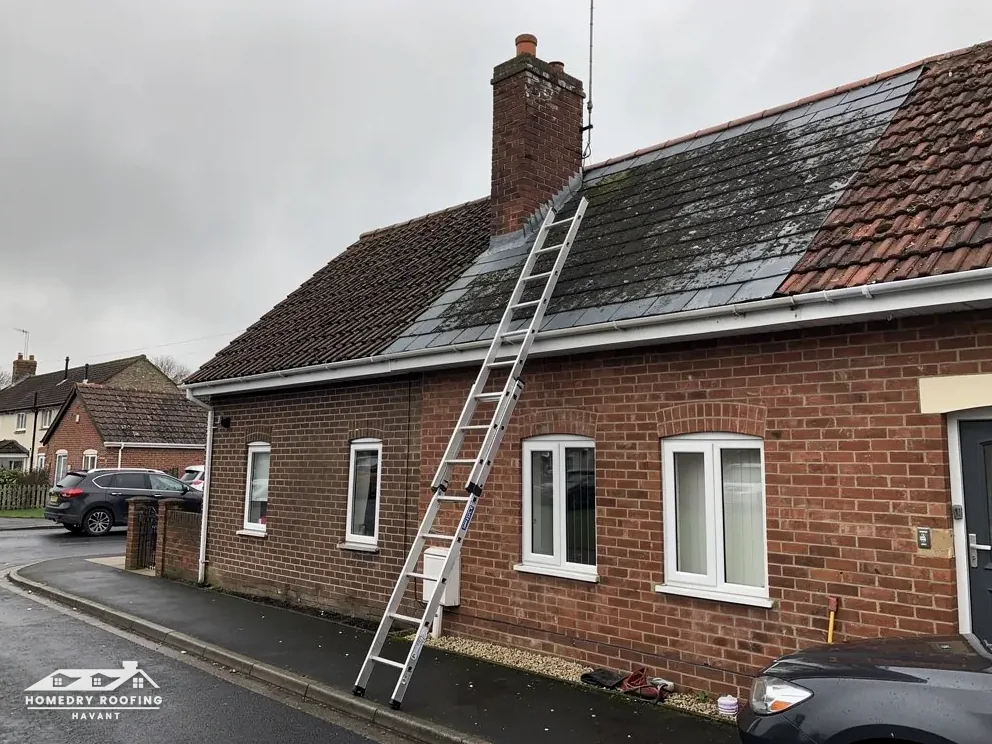
Vents
Where small slots in the soffit let loft air out at the bottom edge of the slope.
Painted shut or stuffed with insulation, they leave moisture sitting in the timber.

Catisfield lies 12 road miles west of Havant; its eaves, soffits and the slopes above them are examined first, and a written total price waits until the survey is done and the findings are in your hands.
10-year workmanship guarantee, in writing
Where small slots in the soffit let loft air out at the bottom edge of the slope.
Painted shut or stuffed with insulation, they leave moisture sitting in the timber.
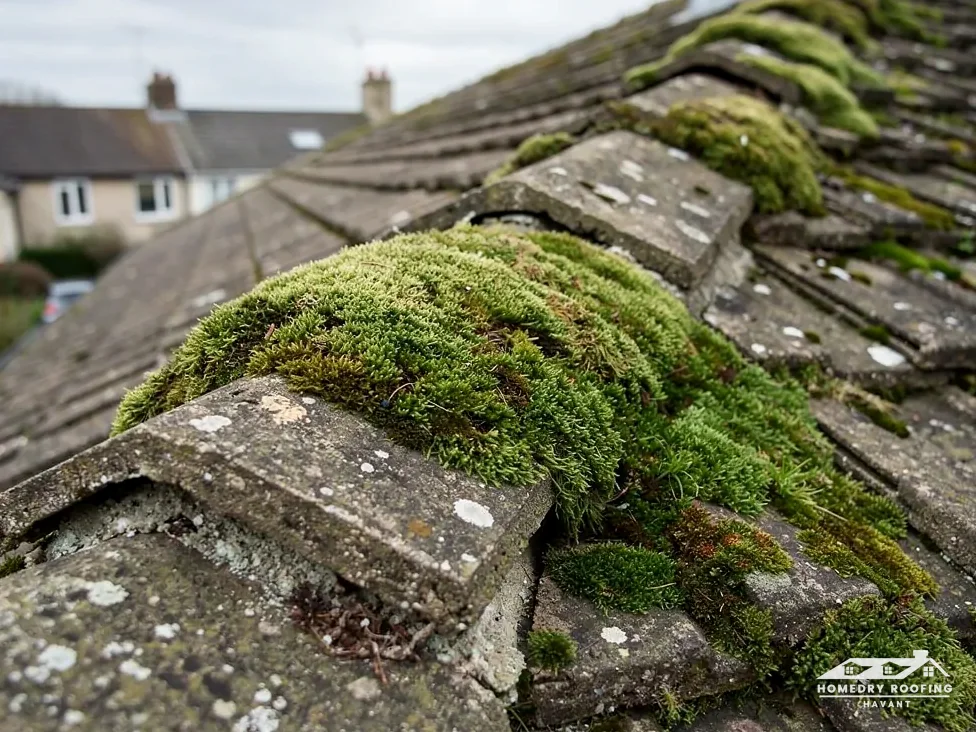
Where each row of tiles or slates sits over the top of the row below it.
A cracked or slipped piece breaks that overlap and lets rain reach the felt.
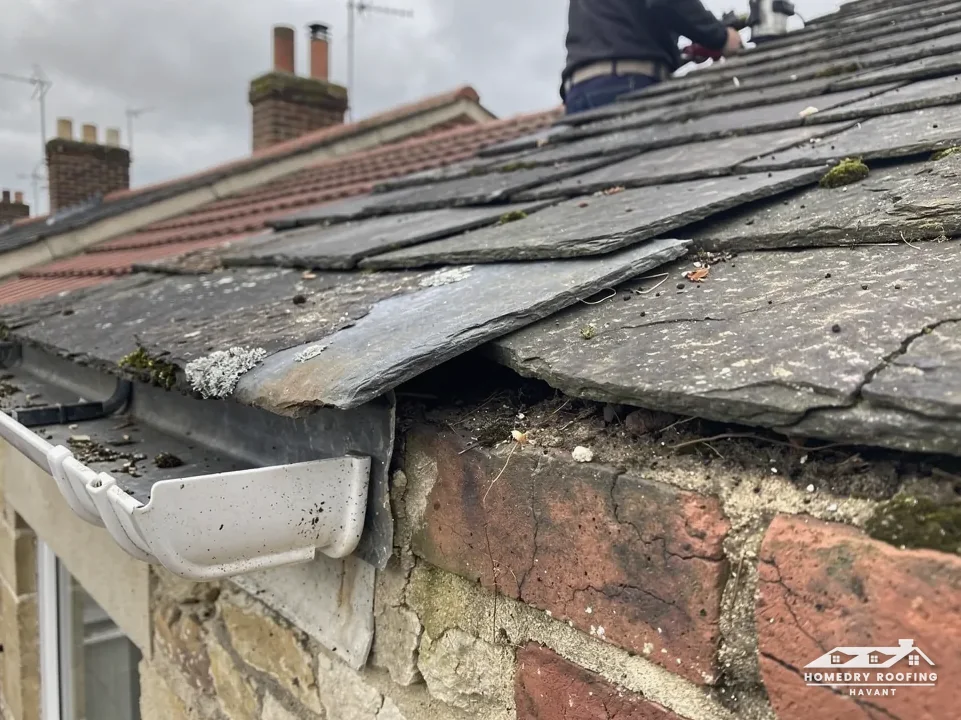
Where a nail or clip pins each slate or tile to its batten.
When a fixing corrodes or a batten softens, the piece above it drops out of line.
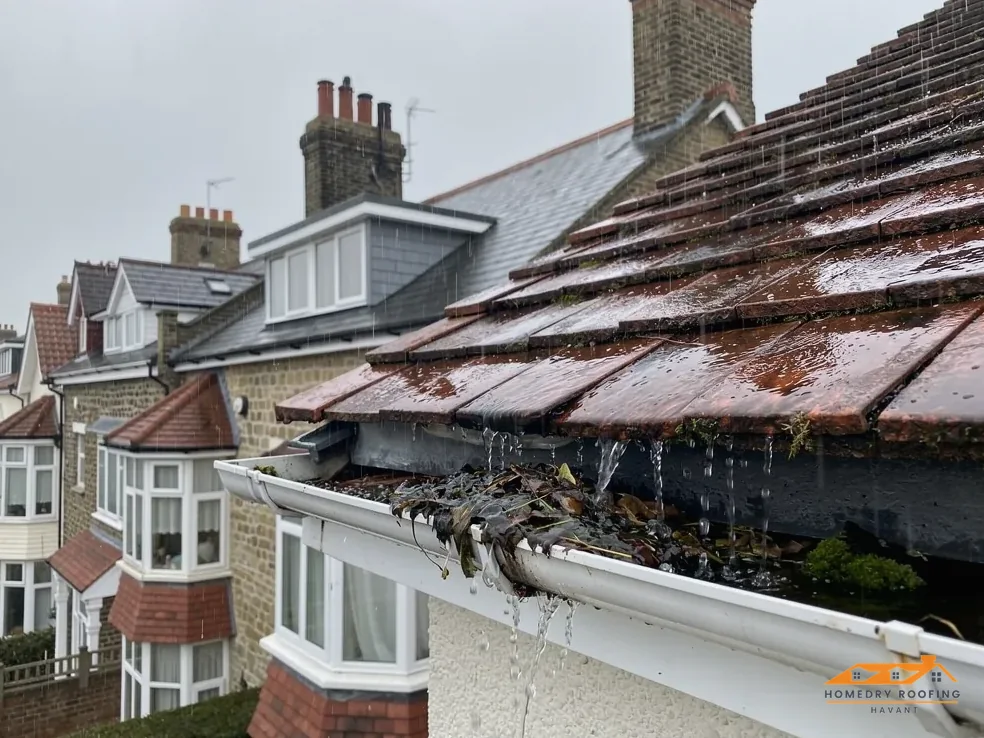
The bottom edge of the roof has to breathe as well as shed water.
The eaves are where the roof ends and the wall begins, and three parts of the roof meet there: the fascia board, the soffit beneath the overhang, and the lowest course of tiles. At survey in Catisfield we look at all three. The fascia is pressed for softness, the soffit is checked for stains, sagging boards and open joints, and the bottom course is read to see where its water lands in the gutter. Our gutters, soffits and fascias page lists the repairs and replacements.
Air has to move through the eaves as well. Marley's figures for a cold roof with a high-resistance underlay are 25 mm of eaves ventilation for pitches of 15° or less and 10 mm above 15°, and that kind of underlay is not vapour-permeable, so it relies on the opening. A soffit vent that has been painted over, or a loft edge packed solid with insulation, shuts that opening off. Damp air then lingers in the roof space, and the timber and the underside of the felt stay wet in the cold months. We look from the loft side for a blocked vent, for condensation on the felt and for a darkened batten,, and each one found goes into the notes with a photograph.
None of this depends on the age of the house, because the check is the same for every roof. A tidy eaves line also gives a gutter something solid to hang from, so a fascia that has softened is dealt with before a new gutter is hung on it, and a downpipe emptying straight against the brickwork is pointed at a proper outlet during the same visit. The notes say plainly which items are repairs and which are replacements, so you can judge each one.
Staining on a bedroom ceiling near an outside wall can be read as a roof leak, and sometimes it is one. It can also be condensation, where damp air has nowhere to leave the loft and settles on the cold timber at the eaves. Our survey goes into the loft as well as up the ladder, because the repair for a leak and the repair for trapped air are not the same job.
Black spotting on the timber near the loft edge, or a ceiling stain that appears in cold weather rather than after a storm.
A soffit vent sealed with paint or insulation, so damp air has nowhere to go and settles on the cold timber.
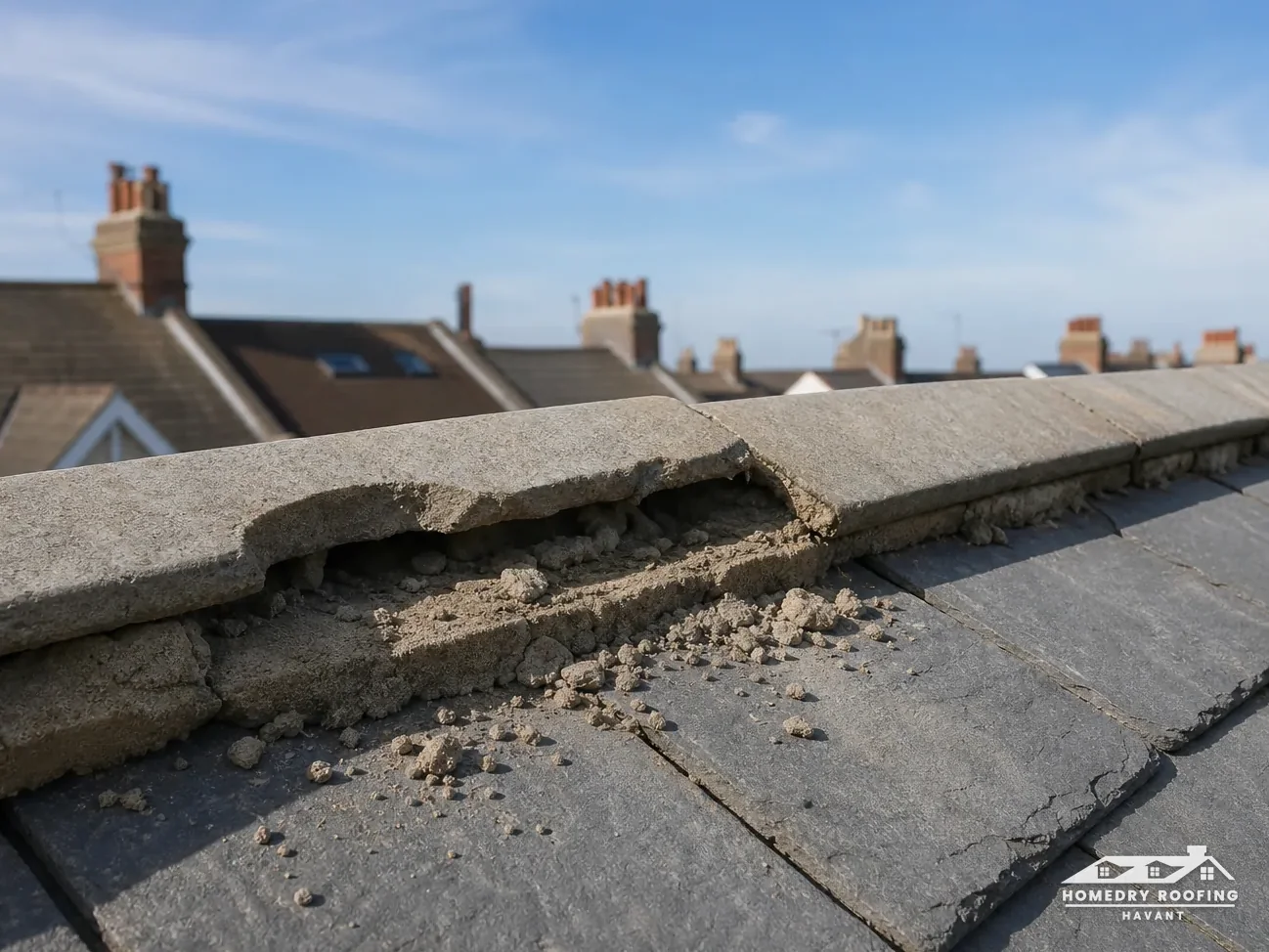
Count how widely the damage is spread and look at the battens under it. A few failed pieces over dry, firm timber suggest repair. Failures across the whole slope, or battens that crumble, call for a fuller job, and the notes show which applies.
A slope is a series of overlaps, and each overlap depends on the piece above it being whole and held down. On a Catisfield survey we go over the slope in lines, looking for slipped, cracked and missing pieces, for lifted lines where a fixing has let go, and for bare patches where a nail has worked loose. Individual pieces are replaced one at a time where the surrounding roof is sound, with new fixings and a proper lap under the course above. Our slate roofing page and our pitched roofing page describe how a re-cover differs from a repair.
Knowing where repair stops needs some idea of how long a covering can be expected to last. HomeBuilding gives approximate lifespans of 100+ years for Welsh slate, 60-80 years for clay tiles and 40-50 years for plain concrete tiles, and these are ranges, not promises, so the condition of the roof in front of us counts for more than the figure. When many pieces have failed across a slope, or the battens beneath have gone soft, a re-cover can cost less over time than a string of repairs, and we explain that in the notes with photographs of the worst places. Where a repair is the better course, it is offered first.
A re-cover has its own rules. Under the Planning Portal's guide, a building regulations application is not normally needed when the work stays below 25 per cent of the building envelope and below 50 per cent of the roof, while a covering 15 per cent or more heavier needs approval. Catisfield has Grade II listings in the Post Office, Meoncross Boys School and Catisfield Cottage, and consent is needed for work affecting a listed house's character. The planning guide for roof work covers what applies to a house.
One missing tile is a repair; a tired slope is a different conversation.
Where only a few pieces have failed and the timber beneath is dry and firm, repair comes first, and the price covers only that. Where a slope is failing along its whole length, the notes state it, show you the photographs and set out what a re-cover involves. The decision is yours either way, and the notes give the reasons in everyday language so you can compare them with any other quote.
Map of Catisfield and the places around it, with the dashed line of our 30-mile service area from Havant. The same places are listed below the map.
Three things share the eaves of a house: the fascia, the soffit and the bottom course of tiles. The fascia is pressed in several places for soft timber. The soffit is checked for stains, sagging boards and open joints, and for any vent that has been painted shut. The bottom course is read to see whether it delivers its water into the gutter or over the back of it. From the loft we add a look at the felt and the timber near the wall plate, which show whether the edge of the roof is dry. All of it is photographed and written up in the notes.
Scale decides it. The Planning Portal's tests are 25 per cent of the building envelope and 50 per cent of the roof: below both, a re-cover normally needs no building regulations application. A covering 15 per cent or more heavier does need one, whatever the area. For a Catisfield address, building control is the Building Control Partnership, on 01329 824823. The Partnership is asked before anything is ordered, and what it says is passed to you without jargon, then filed with the survey, so any later question about the route has an answer on paper.
A licence under section 169 of the Highways Act 1980 is compulsory when scaffolding blocks a road or pavement, and in Catisfield Hampshire County Council issues it. Hampshire County Council's fees are £211.90 on application for the first 2 weeks and £72 for each additional 2-week period, and the application must reach the council ten clear working days before work on the pavement begins. Hampshire County Council adds that "Scaffolding companies must apply on behalf of their customers." We arrange it with our scaffolder. You will have the proposed dates in advance, so nobody is surprised by a scaffold on the pavement.
They are two of the Grade II entries on Historic England's list for Catisfield, along with Catisfield Cottage. Listed building consent under section 7 of the Planning (Listed Buildings and Conservation Areas) Act 1990 applies to work that would affect a listed building's character, and Fareham Borough Council is the body that decides. Listing leaves permitted development rights for roof work in place, but consent is needed as well. Read the entry for your own address in full before booking anything, and put questions about it to the council early, since a reply can take time and the work should not wait on an assumption.
Catisfield has 3 conservation areas close to its centre: Catisfield, Titchfield and Titchfield Abbey. Fareham Borough Council holds the boundaries and decides whether a given address falls inside one. In a conservation area a straightforward re-cover normally remains permitted development, and nothing in the survey changes that, but an Article 4 direction can take further rights away from a house, so check with Fareham Borough Council whether one applies to your road. The national rules sit in our planning guide, and anything the council tells you about your road can go into the survey file, so the answer is kept with the roof it concerns.
Roof timber and felt cool quickly in cold weather, and damp air from kitchens and bathrooms that cannot leave the loft settles on them as moisture. The stain then appears after a cold, still spell and not after rain. We look for a blocked soffit vent, for condensation on the underside of the felt and for darkened batten ends. Marley's ventilation figures for a cold roof with a high-resistance underlay are 25 mm of eaves opening at 15° or less and 10 mm above 15°, so we check that the opening is there and clear, and if it is not, we show you where it has been closed.
The covering's age is a clue, not a verdict. HomeBuilding's approximate lifespans are 100+ years for Welsh slate, 60-80 years for clay tiles and 40-50 years for plain concrete tiles, and the condition of the roof in front of us outweighs any figure. Failures spread across a slope, or battens that crumble, suggest a re-cover. A handful of pieces over dry, firm timber suggest repair. The notes explain which case your roof is, and why, in everyday language, with photographs to show the places, and a repair is offered first wherever the roof will hold it.
Look for one total price, written after a proper look at the roof, with the findings beside it. It should name the work and the covering and state if the figure counts VAT and scaffold. If a rival quote leaves out either, ask for that in writing, so that the two figures mean the same thing. A repair is offered first where the roof can be repaired. We aim for prices that are good and fair, and the figure on the page covers the work described, and it can be checked against the survey notes.
You'll get one written total price.
Fill in what you like. It opens WhatsApp with your message ready to send.