
Garage Roof Replacement in Havant
Felt, EPDM, GRP or old corrugated sheets: we find where rain gets into your garage, then say whether to repair or replace.
10-year workmanship guarantee, in writing
Garage roof guides
All guides- Asbestos garage roofs: how to tell, and what to do about itGuide
- Felt, EPDM or GRP: choosing a new garage roofGuide
- The cheapest way to replace a garage roof, and when cheap costs morePost
- Can you legally remove an asbestos garage roof yourself?Post
- Where to take cement-bonded asbestos in HampshirePost
- Do you have to declare asbestos when selling a house?Post
- What is the average price to replace a garage roof?Answer
- How much does it cost to have an asbestos roof removed?Answer
- How can you tell if a garage roof is asbestos?Answer
- Do you need an asbestos survey for a garage roof?Answer
- Is it worth repairing an old felt garage roof?Answer
- How do you know a garage roof needs attention?Answer
- Why does asbestos need a lockable skip?Answer
- Can you take asbestos sheets to a West Sussex recycling centre?Answer
- Can you walk on an asbestos cement garage roof?Answer
- How long does a felt garage roof last?Answer
How rain gets into a garage roof
Felt, EPDM, GRP and corrugated sheets let rain in at different points. Six of them, from the house wall down to the gutter.
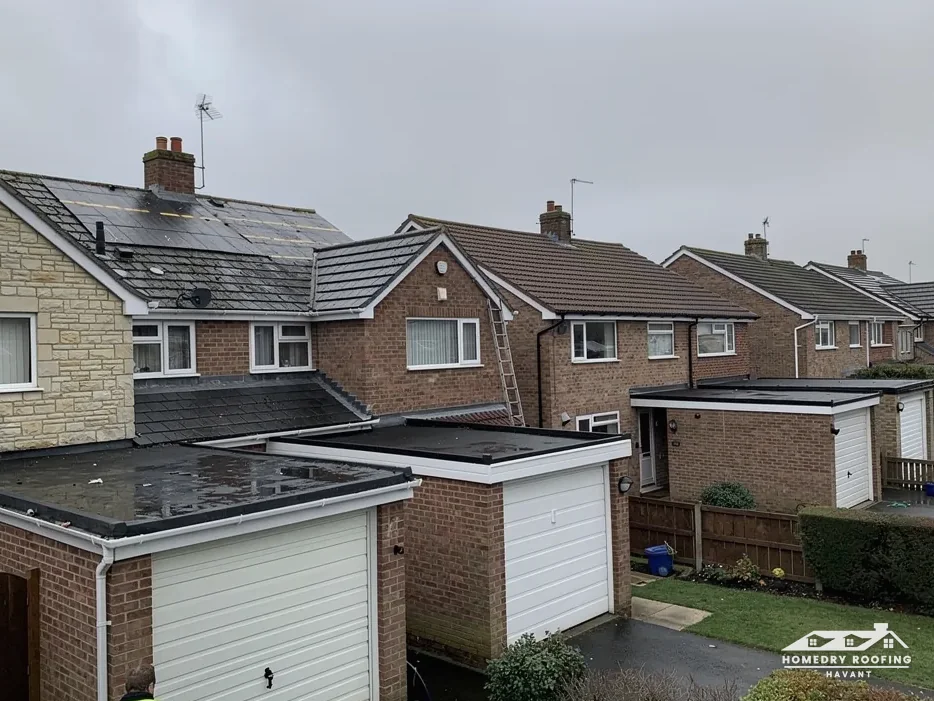
A stain inside the house can start on the garage roof beside it.
AbutmentsWhere an attached garage meets the house wall
Start at the top of the route. On an attached garage, that is the line where the roof meets the house wall, a joint called an abutment. Rain running down the brickwork lands on it, along with whatever the slope above sends over. A strip of flashing, tucked into the brickwork at a mortar line and folded down across the covering, sheds that water clear. If the strip has come away, or the covering was only stuck to the wall with mastic, water can slip behind it and run along the top of the boards.
A stain inside the house can turn out to be a garage roof fault, because a room beside the garage shares that wall. A detached garage has no house wall, though one built against a boundary wall or a neighbour's garage has the same joint, so we check who shares it before anything is lifted.
Garage roof repairs at the wall
Where the covering is sound and only the flashing has failed, that is a repair, and it is what we quote for. We rake out the old joint, let a new strip in and dress it down. Where the covering along the wall has perished too, we look at the whole roof before saying more, since new flashing over tired felt buys little time. Sheet roofs meet a wall in the same way, and old corrugated sheets raise the asbestos question before anyone cuts or drills, as the chapters below explain.
What we check
- Flashing
- Lifted, split or missing
- Joint
- Open mortar above it
- Covering
- How far up the wall
- Neighbour
- Who shares the joint
Seen from indoors
If the garage has a ceiling, shine a torch along its top edge next to the house wall. A dark line there, or a tide mark on the blockwork, points to the joint above rather than the middle of the roof. Take a photo, note the date and send it over by WhatsApp. If old sheets are up there, leave them undisturbed and do not brush them down for a better picture.
Where it shows
A damp line along the garage ceiling beside the house, or a mark on the wall of the room next door.
Where it gets in
Behind a flashing pulled out of its mortar joint, or past mastic that has cracked away from the brick.
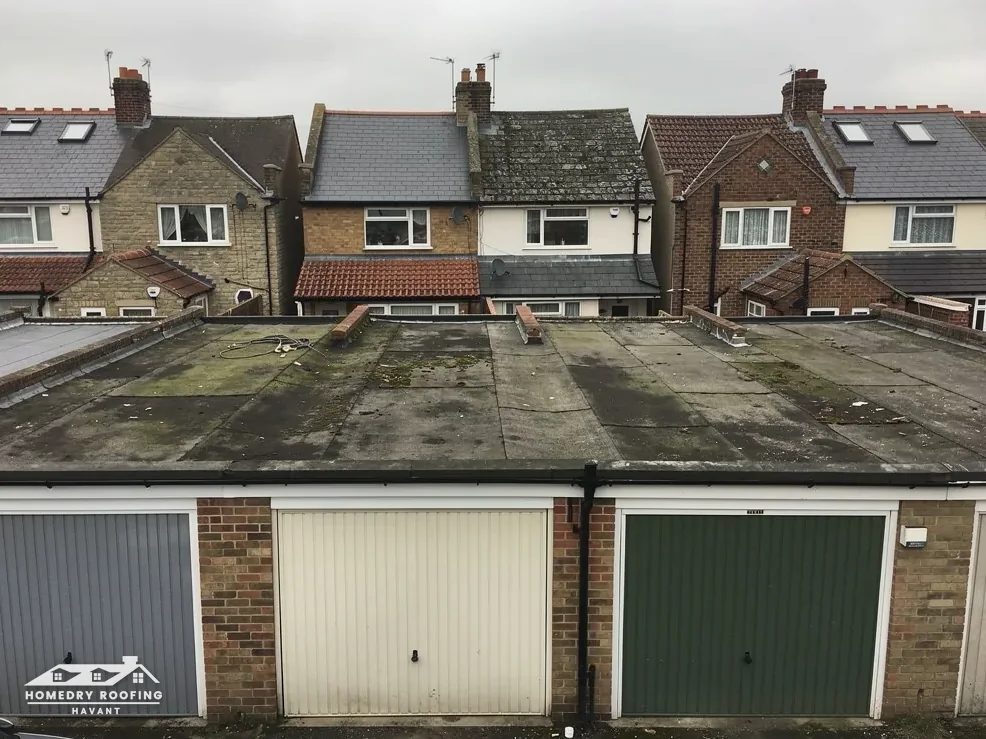
Can new felt go straight over old felt?
Only if what lies below passes a check, meaning the earlier felt and the boards it sits on. A second layer covers up the fault as well as the roof, so we lift a corner and show you what sits beneath it.
LapsFelt, EPDM and GRP on a flat garage
Past the wall, rain crosses the main covering. A flat garage roof is a small flat roof, and the three systems we lay on one differ in where their joins fall. Our flat roofing page deals with extensions and dormers; a garage brings plainer questions, such as how long it needs to run and how much it is worth spending.
| Covering | What it is | Where rain can enter |
|---|---|---|
| Felt | Bitumen sheets bonded in layers | Laps and surface splits |
| EPDM | One sheet of synthetic rubber | Corners and edge bonds |
| GRP | Glass matting and resin, topcoated | Cracks at board joints |
Garage roof felt in Havant: repair or replace?
A lap is where one layer of felt overlaps the next. A split lap or a single blister on a sound roof can be repaired at that spot. Felt that has cracked across its surface, with laps opening in several places, is where patching stops making sense, and our guide on repairing an old felt garage roof shows how we weigh it. For a new covering, felt, EPDM or GRP on a garage sets out the three in more depth. Torch-on felt means a flame near timber, so a timber garage or a fence close by goes into that choice as well. On a plain rectangle of roof, EPDM goes down with very few joins and GRP cures into one skin with none across the middle, so each has less to open up than felt.
The split you can see is only one of the laps worth checking.
A garage in use
What the garage is for changes the answer. A lock-up holding a lawnmower can live with a tidy repair for a while longer, and that may be the sensible call. A garage turned into a workshop, with power and shelving, has more to lose from a drip, so a new covering earns its place sooner. Tell us how you use yours, and we can weigh that against what we find on the roof.
Felt faults
- Laps
- Open or lifting edges
- Surface
- Cracks and lost chippings
- Blisters
- Raised pockets in the sheet
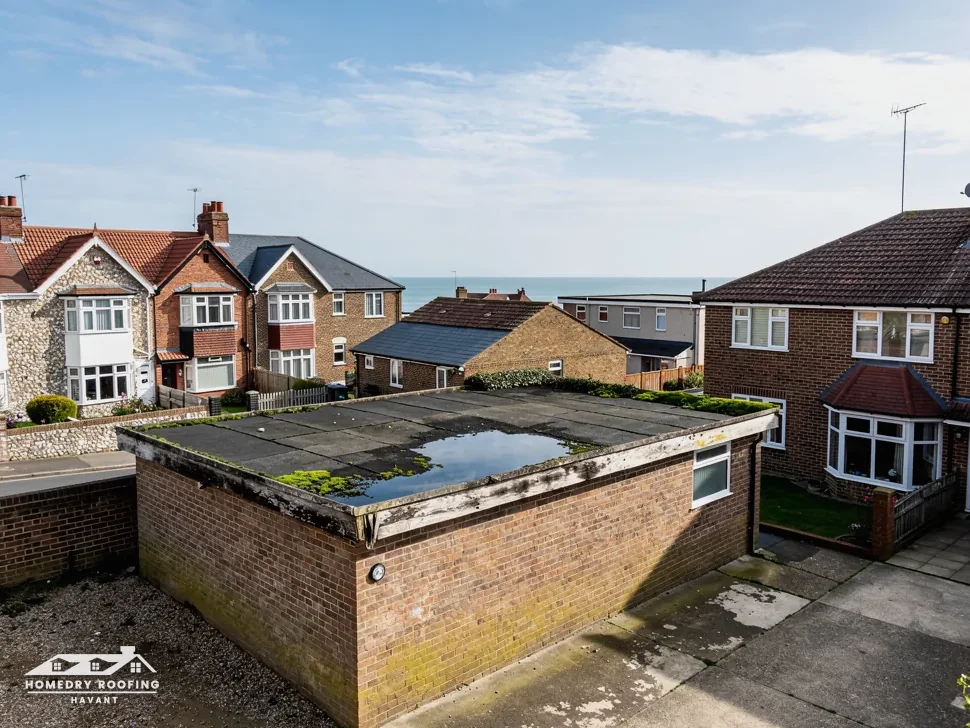
Can rotten boards be replaced without a whole new roof?
In part, yes. The covering over the soft area comes off first, then gets let back in. On a small garage, that can come close to the price of stripping the lot, so we tell you which is the better spend.
BoardsThe deck, the fall and standing rain
Once rain is past the covering, it reaches the deck, meaning the boards fixed across the joists. Where a garage has no ceiling, you can stand inside and look straight at the underside. Dark staining and sagging between joists tell us how long water has been getting in. Soft boards will not hold a new covering, so they come out as part of a replacement. Where the boards are sound and dry, they stay.
Then there is the shape of the roof, since even a roof we call flat has to slope. BS 6229:2025 sets a minimum finished fall of 1:80 for membrane flat roofs, so the roof is designed to a steeper fall to allow for tolerances. That figure means one unit of drop in every 80 along the roof. A garage deck that has dropped between its joists holds pools after the rest has dried, known as ponding, and each pool sits against every lap inside it.
Problems a patch cannot fix
You can seal a split inside a pool with a patch, but the deck keeps its shape. Getting the fall back means tapered timbers called firrings laid over the joists, or new joists where the old ones have sagged too far, and that belongs with a full roof replacement. We note which way the fall runs as well. A garage roof draining towards the house wall or a neighbour's fence needs more thought than one draining to a gutter, so the new fall is settled before the boards go down.
A patch closes a split, but it never lifts a sagging deck back to level.
Looking up from inside
Stand inside just after rain and look up with a torch. Drips are easy to spot, but dark rings on the boards say more about how long this has gone on. Note where each mark sits against the door or the back wall. Please stay off the roof itself: HSE says all roofs should be treated as fragile until a competent person has confirmed they are not, yours included.
Where it shows
Water still lying on the roof a day after rain, and a dark ring on the boards seen from inside.
Where it gets in
Through a lap or split inside that pool, where rain sits against the join between one shower and the next.
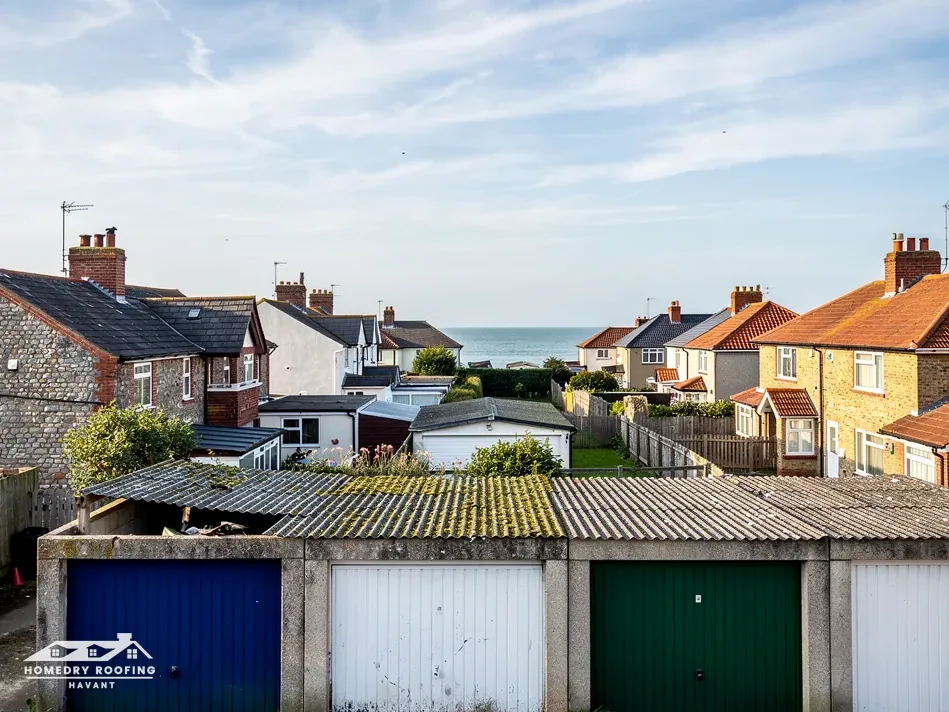
Can you tell asbestos cement just by looking?
No, not as a promise. Age and appearance raise the question, but a look cannot settle it, so the answer comes from an asbestos survey. Until then, we treat the sheets as if they contain it.
SheetsCorrugated garage sheets and the asbestos question
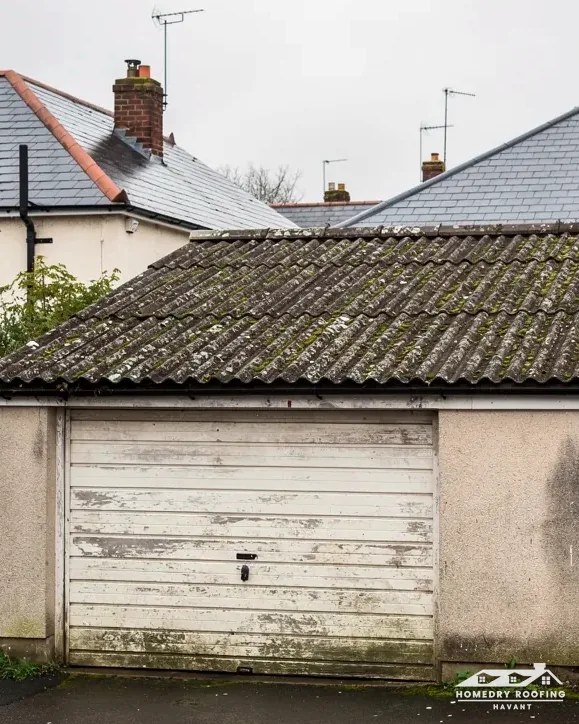
Some garages have no deck at all. The roof is a run of corrugated sheets bolted to purlins, the rails running across the garage, with rain following the troughs and passing from one sheet onto the next. It gets in where a lap has lifted, at a cracked corner or round a fixing. Those sheets may be metal, plastic or fibre cement, and on an older garage they may be asbestos cement.
That last possibility changes how everything is done, so it comes first. HSE's advice is plain: "If the building was built or refurbished before 2000, assume that there is asbestos in it." We work from that. A weathered grey sheet cannot be cleared by looking at it, so we treat it as asbestos cement until an asbestos survey says otherwise. Our guide to asbestos garage roofs and what to do takes you through it in order.
Asbestos garage roof in Havant: stay off it
HSE's sheet A14 is blunt: "AC roofs are always fragile", AC being asbestos cement. A separate HSE line says never to trust a sheeted roof of any material with a person's weight. So nobody should climb up to clear a gutter or fetch a ball, and our note on walking on asbestos cement sheets explains why. We read these roofs from a ladder at the eaves and from inside the garage, which shows us the laps, the fixings and the purlins without putting weight on a sheet.
Treat an old grey sheet as asbestos cement until a survey says otherwise.
Before anything is touched
Please leave suspect sheets undisturbed until someone has looked at them. That means no pressure washer, no wire brush, no drilling for a new bracket and no pulling at a corner that has come loose. If a falling branch or strong wind has damaged a sheet, keep children and pets clear of the pieces and send us a photo. We can then tell you what happens next.
On a sheet roof
- Sheets
- Type, age and condition
- Laps
- Lifted or open
- Fixings
- Bolts and their washers
- Purlins
- Rails under the sheets
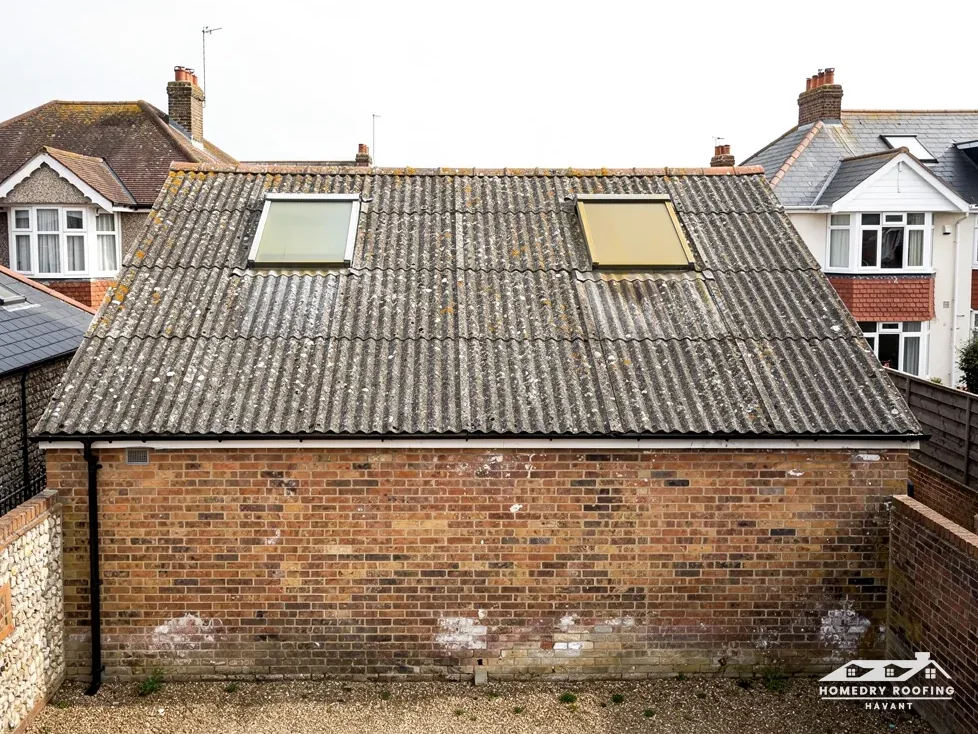
Whole sheets keep the job simple; broken sheets change what kind of job it is.
CracksWhat happens when cement sheets have to go
A cracked cement sheet lets rain through at the crack and the lap below it. Once a roof reaches that point, the question becomes how it comes off, and the way it comes off decides what kind of job it is. HSE sorts the work by the state of the cement and what happens to it on the way down.
| The sheets | Type of work |
|---|---|
| Removed carefully without breaking up, weathered ones included | Non-licensed |
| Substantially damaged, as by fire or flood | Notifiable non-licensed (NNLW) |
| Dropped, creating significant quantities of dust and debris | Notifiable non-licensed (NNLW) |
HSE's sheet A14 covers dismantling a small asbestos cement structure such as a garage as long as the cement stays intact; if it starts to break up creating significant dust, the work becomes notifiable non-licensed work. You can read those terms on HSE's non-licensed work page. So the job is planned around lifting sheets whole: fixings get undone rather than smashed through, and each sheet comes down by hand instead of being slid or thrown.
Where the old sheets go
Asbestos goes in a lockable skip, never an open one, and our answer on why the skip has to lock gives the reason. A roofer's load is trade waste moved on a consignment note. Householders' own small amounts have a separate route, covered in where to take cement-bonded asbestos in Hampshire; Hampshire County Council's list of sites for it leaves out both Havant and Hayling Island.
How we plan it
- Sheets
- Lifted whole, never dropped
- Fixings
- Undone with care
- Waste
- Lockable skip, consignment note
What goes back on
Once the sheets are off, the frame decides what goes back. Sound purlins can take new corrugated sheets of fibre cement or metal. Where the timbers are tired, or you want a dry lining overhead, boards and a flat covering of felt, EPDM or GRP may suit better, if the walls and the fall allow it. We tell you which would work, and the quote covers removal and the new roof together.
Where it shows
A crack across a sheet or a missing corner, with daylight or a drip showing from inside the garage.
Where it gets in
Through that crack and the lap below it, or round fixings where a washer has perished or a bolt has loosened.
Can a landlord's row of lock-up garages be done together?
Yes. We survey the row, then say which roofs need a repair and which need replacing. On non-domestic premises, the Control of Asbestos Regulations 2012 place a duty to manage asbestos on whoever holds the maintenance or repair obligation or controls the premises.
EavesTrims, gutters and soffits at the low edge
The route ends at the low edge of the roof, the eaves, where the covering has to throw rain clear and into a gutter. On a flat garage that job falls to the drip trim, an edge strip in aluminium or plastic whose lip hangs over the fascia, which is the board running under the roof edge. Once a trim lifts, wind can drive rain back under the covering, and the fascia behind it goes soft. On a sheet roof the troughs empty straight into the gutter, so a bracket that has slipped can send the water down the wall.
Maintenance here is modest. Have the gutter cleared and check that the downpipe runs free, working from a ladder at the eaves and never from the roof. Our guttering, soffits and fascias page covers the rest of the roofline if the boards behind the gutter need attention.
Soffit panels under old eaves
Look under the eaves before anyone takes that edge apart. HSE's list of asbestos locations includes "AIB white soffit panels to underside of roof eaves". AIB is asbestos insulating board, a different material from cement sheet under HSE's rules: work on it is licensed unless the risk assessment shows it will be of short duration. That makes it a separate decision from the roof above, and we raise it before anything is touched. A soffit is the flat panel closing the underside of the overhang, and a look from the ground shows whether your garage has one.
Look under the eaves before anyone takes the edge of the roof apart.
A walk round after rain
Walk round the garage after heavy rain. Water spilling over the front of the gutter, green streaks down the brickwork and lifting paint on a fascia all point to this low edge. Those signs can mean no more than a blockage or a slipped bracket, and that may be a short job. On a row of lock-ups, look along the whole run, because one blocked length can hold water against its neighbours.
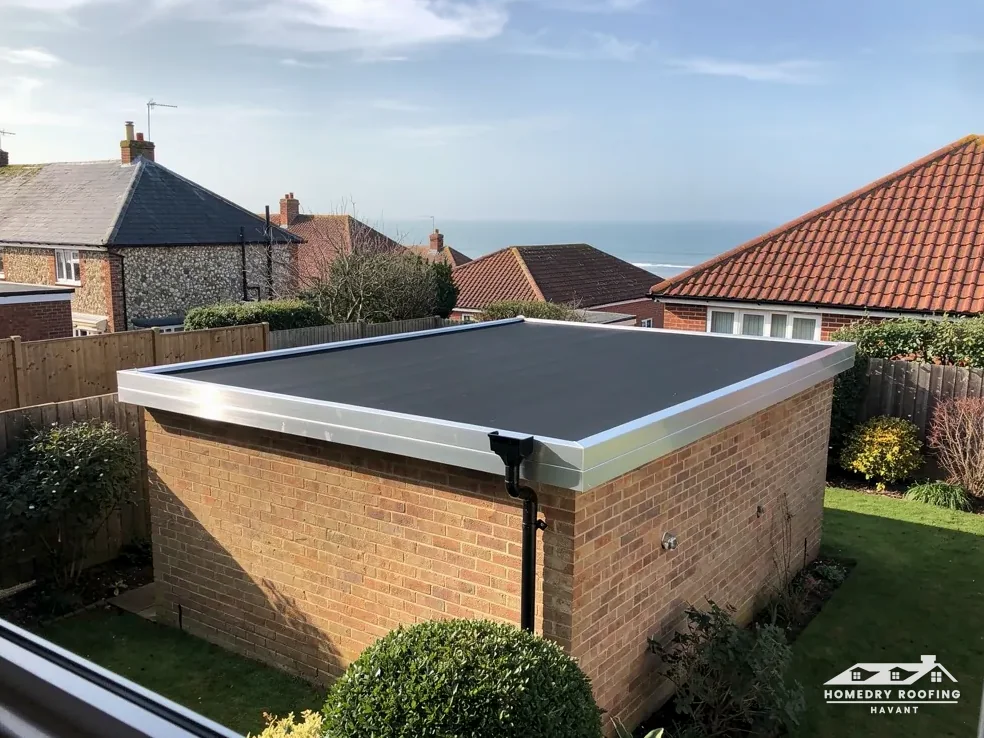
In this photograph EPDM · Aluminium trim
Start with what covers your garage
Tell us what is up there and what shows from your garden.
Garage roof questions
Straight answers on prices, felt, lifespans, old cement sheets and where they can go.
What does replacing a garage roof cost on average?
Published figures give you a starting point rather than a quote. MyJobQuote says "In 2026, the average garage roof replacement costs between £750 and £3,500." Which? Trusted Traders put felt on "a typical single garage (6m x 3m)" at £1,400 to £3,500, while their row for PVC or rubber EPDM, new boards included, runs from £1,950 to £4,000, both excluding VAT (November 2025) and likely to be at the upper end in the South East. Size, access, the state of the boards and whether old sheets have to come off first all move the figure. Those are other people's numbers, never ours. Your own figure is a single total, in writing, once we have surveyed the roof, and it pays to check whether any number you compare includes VAT.
How much does an asbestos cement garage roof add to the job?
MyJobQuote says "The average asbestos removal cost for a roof in the UK is around £2,750" and "The average cost of an asbestos survey is around £325 in 2026". Those averages are for roofs in general rather than garages, so read them as a rough guide. On a garage, the things that move the price are how many sheets there are, whether they can come off whole, how close the garage sits to fences and neighbours, and the lockable skip and consignment note the waste calls for. The new roof that follows is a separate cost in the published figures, though not in ours: removal and the new covering go into the same quote, once we have looked at the sheets and what holds them up.
What is the lowest-cost way to replace a garage roof?
Check first whether it needs replacing at all, because a sound roof with one failed lap or flashing wants a repair. Where a new roof is the answer, the Which? Trusted Traders figures start lower for felt than for EPDM on a single garage, though HomeBuilding gives torch-on felt an approximate lifespan of 10 to 15 years against 25 to 30 for EPDM. So the lower price can mean an earlier second job. Leaving soft boards in place may shave the first bill, but a new covering on them has nothing firm to hold. Dropping old cement sheets to save time is false economy as well, since broken sheets turn the job into notifiable non-licensed work. We set out the options at the survey and say which we would choose.
How long does a new garage roof covering last?
Published lifespans disagree, so here are both sets. HomeBuilding's approximate figures are 10 to 15 years for torch-on felt, 25 to 30 years for EPDM and 25 to 30 years for GRP. Less says "Torch-on felt lasts 10 to 20 years depending on quality and installation", "EPDM rubber membrane typically lasts 30 to 50 years" and "GRP fibreglass lasts 25 to 40 years with minimal maintenance". Those are typical ranges from two sources, never promises about one roof. Neither gives a figure we can pass on for corrugated sheets, so there we judge from the state of the sheets, the laps and the fixings. A garage roof's life also depends on its falls, its gutter and whether the boards underneath were sound when it went on.
Should an ageing felt garage roof be repaired or stripped off?
Judge it by condition rather than age. One split, a lifted lap or a blister on firm boards is a repair, and that is what we would quote for. Cracks across the surface, laps open along several runs, soft boards or pools that never quite clear point towards stripping it and starting again, because each patch then sits next to the following failure. A garage's use counts too: a little-used lock-up can sensibly take a repair that a workshop full of tools should not. Before you commit, we tell you which way your roof points and why, with what we found on it. If patching will hold up, the job stops there, and the rest of the felt stays put. Plans to sell or extend soon can change which choice makes sense.
What do small garage roof repairs cost?
Checkatrade publishes repair rates for two of the coverings: EPDM rubber repairs at £120 to £170 per m² and GRP fibreglass repairs at £130 to £180 per m². Those rates are for an area up to a maximum of 3 m², exclude VAT and access equipment, and were last updated in June 2026, so they cannot be stretched over a whole roof. MyJobQuote says "The average roof repair cost is around £650 in 2026", for roofs in general, and that "extensive storm damage repairs can cost £1,200 or more". If a storm has torn your covering open, the first steps are on our emergency roof repairs page. Felt and sheet repairs are priced once we have seen the roof. Check whether any repair price you are given includes VAT and access.
How would I know my garage roof needs attention?
Look inside first. Drips on whatever is stored there, stained or bowed boards and a musty smell are the plain signs of a leak. From outside, look for a pool that outlasts the rain, an edge that dips in the middle, moss along the laps, a trim standing away from its board or streaks down the brickwork. On a sheet roof, the damage shows as cracks, a broken corner or a lap that has lifted. Any one of these is only a place to check, not a ruling on everything else up there. Several together, with soft boards underneath, make a new roof likely rather than another patch. Keep off the roof and send a photo, then we can say whether it needs a survey.
Can I take old garage sheets to a recycling centre in Hampshire?
Your own DIY amounts, yes, under limits. Hampshire County Council accepts cement-bonded asbestos at only five household waste recycling centres (Andover, Basingstoke, Efford, Netley and Portsmouth), by phone booking in advance, up to 15 sheets and no larger than 1200mm by 600mm; work by a tradesperson cannot count towards a household's DIY allowance. No other type of asbestos is accepted. The allowance is "up to eight 50-litre rubble sacks" or "four single items per 4-week period", and over it the council charges "£12 per sheet or part sheet." Havant and Hayling Island are not on its list. At a West Sussex address, the county council takes householders' own cement-bonded asbestos up to 200kg, double wrapped or double bagged in clear 1,000-gauge polythene sealed with tape, at Burgess Hill, Chichester, Crawley and Worthing only.
Is removing asbestos cement garage sheets licensed work?
HSE treats it by condition. Asbestos cement products such as roof sheeting are non-licensed work "provided the material is carefully handled/removed without breaking up", and that includes weathered cement that is not otherwise substantially damaged. Sheets that are substantially damaged or broken up, or a roof that is dropped so it creates significant quantities of dust and debris, make it notifiable non-licensed work, shortened to NNLW. Asbestos insulating board is a separate case: work on it is licensed unless the risk assessment shows it will be of short duration. The waste rules follow the sheets too, as household asbestos is not covered by the consignment-note exemption. We look at the condition of your sheets and tell you which of these applies before any work is agreed.
Where around Havant do you replace garage roofs, and how do quotes work?
HomeDry is a local Havant roofer, and garage work goes out to 30 road miles: Leigh Park, Bedhampton, Cowplain and Waterlooville close by, Hayling Island and Emsworth on the coast, and further off Portsmouth, Southsea, Fareham and, across the county line, Chichester in West Sussex. Coastal homes are graded for higher exposure, so where a garage at a coastal address has a tiled slope, the fixing specification is calculated for the site under BS 5534. For a quote, ring 023 9396 0313, use WhatsApp to send a picture or fill in the form on this page. We survey the roof, trace the leak back to its entry point and tell you whether it needs a repair or a replacement. The price then comes in writing as one total, and we leave the site clean.
Where's the water showing?
You'll get one written total price.