
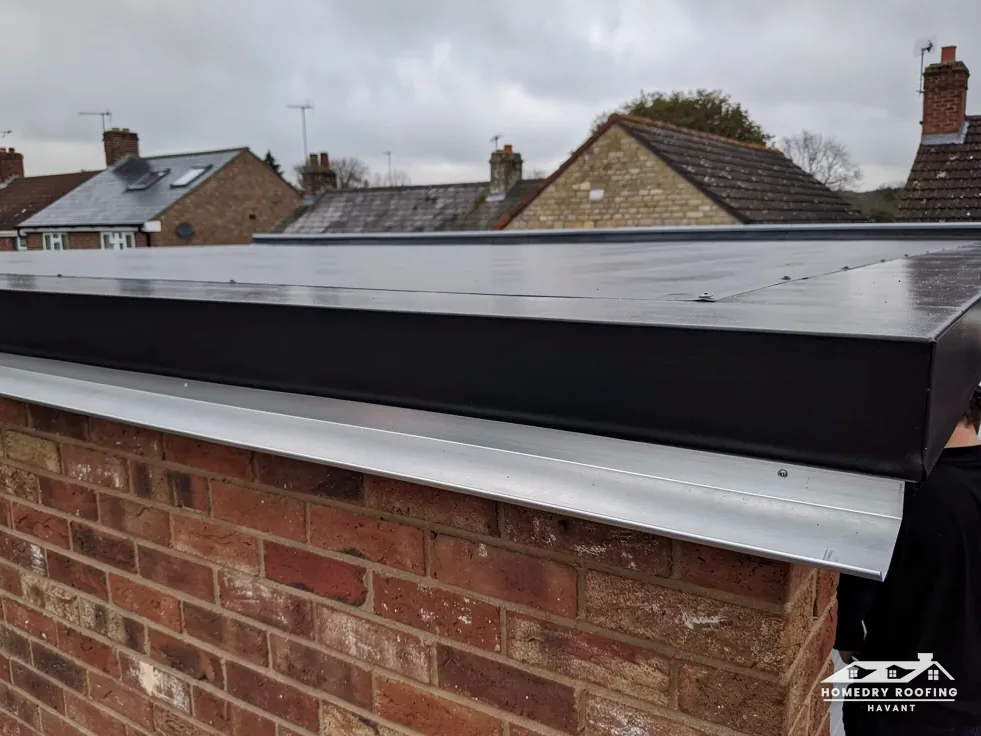
The faults a repair can close
A repair earns its place when the roof is sound apart from one defined fault. On felt, these are the faults a repair can close:
- a split in the surface, well away from any joint
- a lap, the overlap between two strips, that has lifted at one point
- a blister that has opened
- a loose edge strip pulling away from its board
- a wall joint where the flashing has come clear, on a garage attached to the house
The repair belongs at the point of entry, which can sit some way from the stain. Moisture can run along the underside of the boards before it drops, so a mark inside the garage tells you which direction to look in and not the exact spot. The surveyor follows the water back and closes that point and nothing else.
The boards matter as much as the felt. A repair laid over firm boards has something solid to bond to. One laid over soft or stained boards only borrows time.
Where the fault is local and the deck is firm, a repair is what we quote, and repair comes first wherever a repair is sound. Anything beyond the defect is left as it is, so you are not paying to renew felt that is still doing its job.
When a new roof is the better route
Patching stops making sense once the faults outnumber the repairs. A roof that has failed as a whole shows different signs from a roof with one weak spot.
- fine cracking over the whole surface, not a single split
- laps open on more than one side of the roof
- boards that have gone soft, dark with damp or bowed, which the felt cannot hold flat
- water lying on the roof after the rain has gone, which suggests the fall to the gutter has been lost
- patches already laid next to earlier patches
In those cases a repair holds one fault while the next waits beside it. The better route is to strip the felt and re-cover the roof, renewing any boards that have failed. Our guide to felt, EPDM or GRP garage roofs compares what goes back on.
How the garage is used enters the choice too. A store for garden chairs and one that holds a motorbike or a workshop bench ask different things of a roof, and the second is a poor place to rely on a patch. If the garage is likely to be sold or extended soon, that can also shift which route makes sense.
Where age comes into it
Age informs the choice and never settles it. Two sources publish lifespans for torch-on felt. HomeBuilding's approximate figure is 10 to 15 years, and Less says "Torch-on felt lasts 10 to 20 years depending on quality and installation." They disagree, and neither is a promise about a particular roof.
A roof inside the range with one fault is a candidate for repair. A roof beyond it, with a crazed surface and lifting laps, is close to spent, and money put into patches there buys less. A roof of unknown age is judged on what it is doing now.
For that reason the survey covers the surface, the laps, the edges and the boards, and does not simply ask for a date. Our answer on how long a felt garage roof lasts sets out both sources in full.
If the garage roof is corrugated sheets and not felt, the question changes, because the sheets may be asbestos cement. The first step is to leave the roof alone and have it checked.
What the survey and the price look like
The survey covers the surface, the boards from inside the garage and the path the water takes to the gutter. You hear which route your roof points to, with the reasons and what was found on it. A sound repair ends the job, and the felt around it stays as it is.
Published figures show scale, but they are other people's numbers and none prices your garage. MyJobQuote says "The average roof repair cost is around £650 in 2026", which covers roofs of every kind. For a full replacement, Which? Trusted Traders price felt for "a typical single garage (6m x 3m)" at £1,400 to £3,500, excluding VAT (November 2025).
The distance between those two is a reason to have the roof inspected before choosing. After the inspection, a figure for your garage is put in writing as a single sum. The garage roofs page explains how a quote works.
Before you decide on either route, our answer on how you know a garage roof needs attention lists what to look for yourself.