
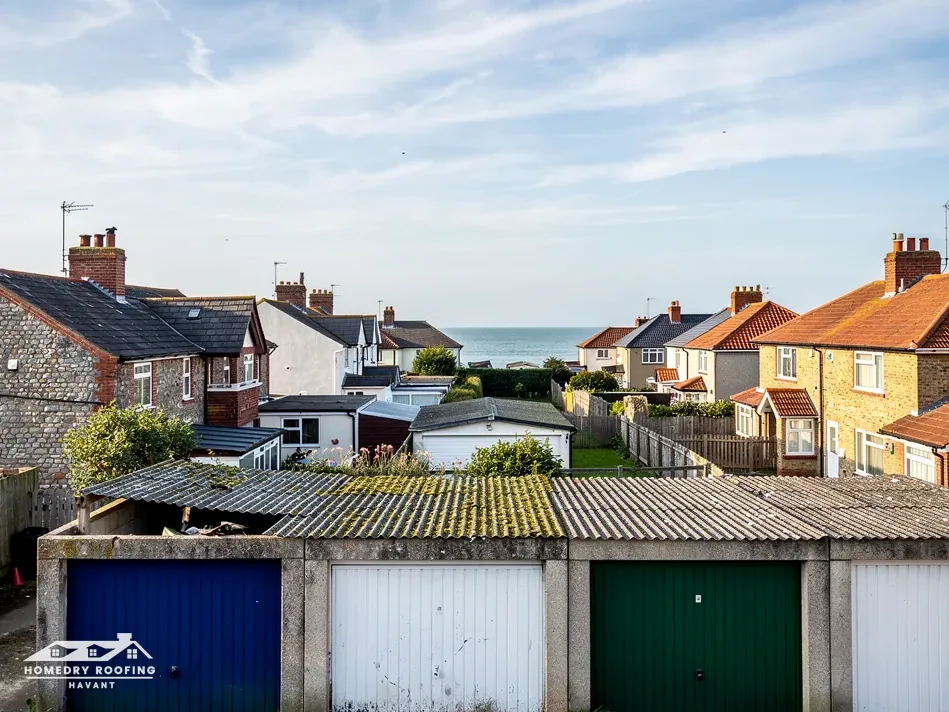
An older garage may carry a roof of grey corrugated sheets, and if the garage is old enough those sheets may be asbestos cement. HSE's rules turn on the sheets staying whole, so breaking, drilling, scrubbing or dropping them is what to avoid until they have been checked.
The Health and Safety Executive (HSE) gives plain advice for a building of this age: "If the building was built or refurbished before 2000, assume that there is asbestos in it." The question for a garage owner is therefore not how to prove asbestos is there but what to do while it is assumed to be.
This guide runs in the order the decisions arrive: how to tell, why to leave the roof alone, how removal is classed, where the waste goes and what it costs. It sits under our garage roofs page, and it describes the rules as HSE and the councils publish them.
Why an old garage roof is treated as asbestos
The HSE wording turns on two words, built and refurbished. A garage put up before 2000 falls under it, and so does one that was re-roofed or altered before 2000, whatever the year it was first built. The advice is to assume, which means a garage with no paperwork and no test result gets treated as though the material is present.
Roof sheets are not the only place on a garage. HSE lists "asbestos cement products, (eg roof sheeting and rainwater goods)" among its non-licensed materials, so gutters and downpipes in the same grey material are covered by the same advice. West Sussex County Council says cement bonded asbestos may be found in items such as garage roofing sheets or down pipes. The same garage can also have asbestos insulating board, which HSE lists among soffit materials, under the eaves.
What this means in practice:
- Grey corrugated sheets on an older garage are presumed to be asbestos cement, and they stay that way in the plan until a test shows differently.
- Gutters, downpipes and soffit boards in the same age and colour are assumed too.
- A flat felt, EPDM or GRP roof over a timber deck is a different case, but a garage that has had a roof added over old sheets can still hide them.
If a garage has been re-roofed more than once, ask the previous owner what lies beneath the visible layer. None of that is a reason to rush at the roof, and nothing here asks you to touch or disturb the sheets. What matters is not to treat it as ordinary roofing, and to find out before work begins.
Telling by eye, and what a survey adds
You cannot be sure by looking. Old asbestos cement can be a weathered grey, streaked with moss, corrugated and bolted to rails called purlins. Several modern and older sheet materials look much the same from the ground, so the appearance is a clue and never proof. Our short answer on how to tell if a garage roof is asbestos covers the clues in more detail.
A survey is how the question is settled. A surveyor looks at the sheets, the age of the building and any paperwork, and takes a small sample where one is needed so that it can be analysed. The result is a written answer instead of an assumption, and it tells whoever removes the sheets how the job should be planned.
What to gather before a survey
- Any paperwork for the garage, such as the date it was built or re-roofed.
- Photographs of the sheets, the gutters and the eaves from the ground.
- A note of any damage, such as a cracked sheet, a missing corner or a patch where a branch has fallen.
MyJobQuote gives an average asbestos survey cost of around £325 in 2026. It is a figure for surveys generally and not for one garage, and it is a third party's number, not ours.
Until the result is back, keep to one rule: nothing on the roof gets touched. Photographs from the ground are enough for a first conversation with a roofer.
Nobody can clear a grey cement sheet by eye, so the survey comes before any quote for the work.
Leave it alone, and stay off the roof
The first thing to do about a suspect garage roof is to do very little. HSE's non-licensed class depends on the cement staying whole, so nobody should disturb the sheets. A calm, unhurried approach is the safest one.
Do not do any of the following until the sheets have been checked:
- Pressure wash, scrub or brush the sheets to remove moss.
- Drill or screw into them to fit a bracket, a light or a satellite dish.
- Cut, snap or lift a corner that has come loose.
- Paint them, since preparation involves scraping.
- Move broken pieces by hand into a bag or a bin.
If a branch or a gust has already damaged a sheet, make sure children and animals stay clear of the pieces and photograph the damage from a distance. If a sheet has come loose and moves in the wind, say so when you ring, because that changes what the first visit has to deal with.
Why nobody should climb on it
HSE's sheet A14 says: "AC roofs are always fragile", where AC means asbestos cement. HSE's line is to handle a roof as fragile until someone competent has looked at it and confirmed otherwise, and it adds that no sheeted roof, whatever the material, should be trusted to bear a person. A sheet that gives way drops the person through the roof and breaks the sheet at the same moment.
So the ladder stays on the ground, and gutter clearing and ball retrieval wait. Our note on walking on asbestos cement sheets explains the reasoning.
Careful removal and how HSE classes the work
The method of removal sets the class of the work. HSE sorts asbestos work into three classes, and the sheets' condition and the way they come down decide which one applies.
- Non-licensed work covers roof sheeting made of asbestos cement, "provided the material is carefully handled/removed without breaking up", and HSE includes cement that is weathered but not otherwise substantially damaged.
- Notifiable non-licensed work (NNLW) applies where asbestos cement has been substantially damaged or broken up, for example by fire or flood damage, or where the roof is dropped and makes significant quantities of dust and debris.
- Licensed work applies to asbestos insulating board where the risk assessment indicates that it will not be of short duration.
HSE's sheet A14 covers dismantling a small asbestos cement structure such as a garage as long as the cement stays intact; if it starts to break up creating significant dust, the work becomes notifiable non-licensed work. In practice that means fixings are undone and each sheet is lifted down whole. It is the reverse of smashing a roof out.
Soffit boards need their own assessment. HSE names insulating board among soffit materials, and work on that board is licensed unless the risk assessment finds the job short in duration.
Whoever you hire, ask them to say in writing which class they think applies, how the sheets will come off and where they will go. A clear answer to those three questions is a good sign, and a vague answer is a reason to look elsewhere.
Where the waste goes: skip, paperwork and recycling centres
HSE's guidance says to use a lockable skip for asbestos, and that "it is not good enough to throw sheeting over a standard skip". Our answer on why the skip must lock sets out the reasoning. On paperwork, the household exemption from consignment notes covers domestic hazardous waste "other than asbestos waste", so asbestos is not within it. A roofer's asbestos is trade waste and travels on a consignment note.
Householders dealing with their own small amounts follow a different route, which varies by county. Check the rules for your address before any trip, and do not put broken pieces in an ordinary household bin.
| County | Where it is accepted | Limits |
|---|---|---|
| Hampshire | Andover, Basingstoke, Efford, Netley and Portsmouth only | Phone ahead; up to 15 sheets; nothing larger than 1200mm by 600mm |
| West Sussex | Four sites only: Burgess Hill, Chichester, Crawley, Worthing | Up to 200kg; double wrapped in clear 1,000-gauge polythene, sealed with tape |
The size limit matters because a corrugated garage sheet can be longer than that, so measure one before planning a trip. Hampshire County Council also says that work by a tradesperson cannot count towards a household's DIY allowance, and that no other type of asbestos is accepted. Havant and Hayling Island are not among the five centres. West Sussex says the only type of asbestos accepted at its centres is cement bonded asbestos. Each county's rules apply only to its own addresses.
Third-party costs and how the written price follows
Cost guides give a feel for the market, and each carries its own wording. None of these is our price.
- MyJobQuote: "The average asbestos removal cost for a roof in the UK is around £2,750."
- MyJobQuote: "In 2026, the average garage roof replacement costs between £750 and £3,500."
- MyJobQuote: "The average cost of an asbestos survey is around £325 in 2026."
- Which? Trusted Traders: felt on "a typical single garage (6m x 3m)" at £1,400 to £3,500, excluding VAT (November 2025), with Which? expecting prices towards the top of the range in the South East.
The removal figure is for roofs in general and not for garages in particular, so read it as a rough marker. On a garage, the number of sheets, whether they can come off whole, the space beside the walls, the skip and the paperwork all move a price. The guides do not say whether these figures overlap, so do not add them up; here, one written quote covers the removal and the replacement together.
What follows the sheets depends on what is underneath. Sound purlins can take new sheets. Where the timbers are tired, a deck with a flat covering may suit better, and our guide to flat roof repair or replacement sets out that decision.
The written price comes after a survey and is one total. Check whether any figure you are comparing includes VAT, the skip and the scaffold.