
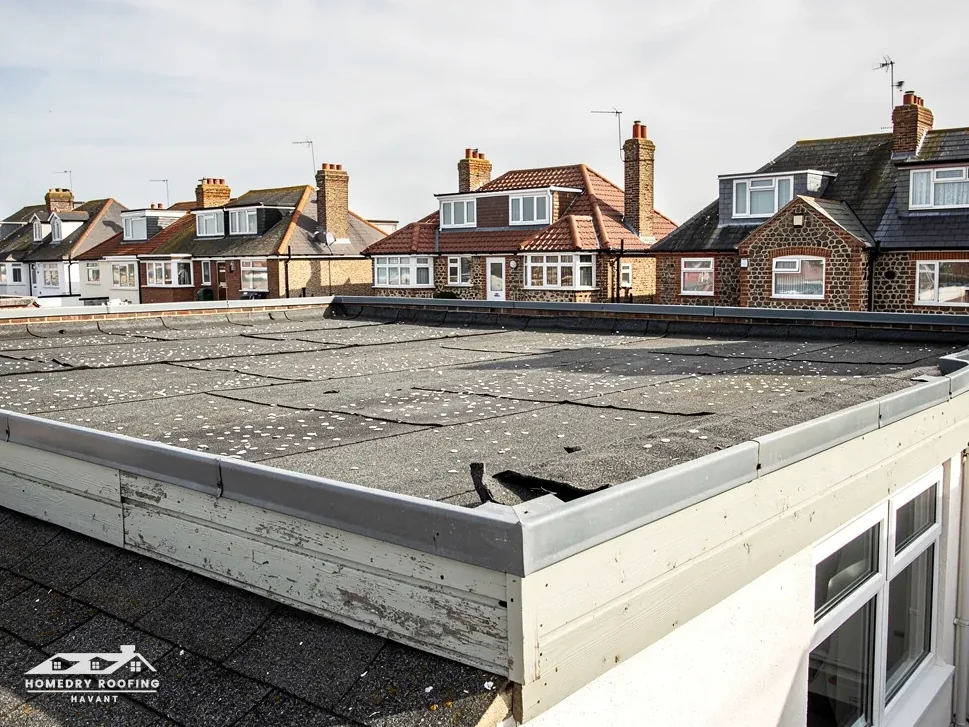
A flat roof that leaks puts its owner in front of two roads. One is a repair, which is cheaper on the day but only worth doing if the roof beneath it is sound. The other is a replacement, which costs more on the day and settles the question for a long while. Choosing between them wrongly is expensive either way: a repair on a failing roof is money spent on something that will be stripped off within a short time, and stripping a roof that needed only a small mend is a bill that never had to be paid.
The decision rests on three things: where the water is getting in, what condition the layers below the covering are in, and what the covering is made of. Felt, EPDM rubber and GRP fibreglass fail in different ways and carry different lifespans, and the published figures for each do not agree.
The rest of this guide takes those questions in order. The wider picture of coverings, upstands and outlets is on our flat roofing page.
Find where the water gets in first
Before anyone can say repair or replace, the route of the rain has to be traced. On a flat roof the stain on the ceiling can be some way from the fault, because water runs along the deck or the boards before it drops. A leak at an upstand can show up in the middle of the room, and a split at an outlet can show up beneath the next wall.
A survey looks at the places where a flat roof can let water through. Those are the places where one surface meets another or where the covering is cut:
- Upstands, where the covering climbs a wall or a chimney.
- Laps and seams in the covering itself.
- Outlets, gutters and the trim at the roof edge.
- Penetrations, such as rooflights, pipes and vents.
- Hollows and low spots where water stands.
If the cause is one of these and the layers below are dry, a repair is a real option. If the cause is a covering that has failed across its whole surface, or the deck is wet, the answer changes. Our short answer on finding a flat roof leak sets out how the search is done.
Note when the roof was last laid and by whom, if you know, and keep any paperwork. A date on an invoice narrows the range in the table below, and a record of earlier patches shows whether one spot keeps failing.
One caution on DIY mastic and bitumen paint: a coat of paint over a split can conceal the defect from whoever inspects next, and it can trap water under the covering. Photographs taken before any patch go on help a surveyor read the roof as it was.
What felt, EPDM and GRP lifespans tell you
Age is a guide, not a verdict. A roof that is within its expected life is likely to be repairable, and a roof that has passed it is likely to be worth replacing. The trouble is that the two published sources do not agree on how long each covering lasts, so both are given here.
| Covering | HomeBuilding (approx) | Less |
|---|---|---|
| Torch-on felt | 10 to 15 years | 10 to 20 years |
| EPDM rubber | 25 to 30 years | 30 to 50 years |
| GRP fibreglass | 25 to 30 years | 25 to 40 years |
Less qualifies its felt figure with "depending on quality and installation" and its GRP figure with "with minimal maintenance". Those qualifiers matter, because a lifespan is a typical range for a well-laid roof, never a promise about yours.
Read the table as a prompt to ask questions rather than as a countdown. A felt roof of 12 years is in the zone where both sources overlap, and the condition of the laps and the deck tells you more than the date does. An EPDM roof of 20 years could sit comfortably in either range. Where the paperwork shows a covering is still inside the range in the table, a failure at one spot can be a local fault, and a repair gets a fair hearing. Where it is beyond even the longer figure, the same split can be the first of several. Our answer on how long a flat roof lasts gives the same figures in short form.
Two sources, two ranges: a lifespan figure describes the material, and only a survey describes your roof.
When a repair is the sound choice
A repair is sensible when the defect is confined to one spot and the surrounding roof is in good order. Where a mend is sound we propose that first, and these signs point the same way:
- A single split, an open lap or one blister, with boards that feel firm from inside the roof space.
- A failed upstand or a lead-and-covering joint at a single wall.
- A damaged section round a rooflight or a pipe, with the surrounding covering flat and well bonded.
- A blocked or broken outlet, where the roof itself has been working properly.
A repair on EPDM or GRP is often a small area, because rubber and fibreglass can be patched, and a covering that is otherwise sound can be spot-mended. The cost guides reflect that. Checkatrade gives "EPDM rubber repairs: £120 to £170 per m²" and "GRP fibreglass repairs: £130 to £180 per m²", on rates "based on a m² rate up to a maximum of 3m²", exclusive of VAT, without access equipment, last updated June 2026. They are a way to see how repairs are priced, and they cannot be stretched into a total for a whole roof.
The condition that matters is the layer under the covering. A patch on wet boards has nothing to hold it, so a repair is only worth doing where the deck is dry and firm. Where one patch has already been made and the water has returned beside it, that history is worth passing to the surveyor.
When replacement is the answer
Replacement is the answer when the fault is not local. That means a covering that has split or crazed across its surface, laps that have opened along several runs, boards that have gone soft, or a roof that has been patched more than once and keeps failing next to the old patch.
Pools that do not clear are a separate signal. A hollow can only be corrected by changing the surface beneath the covering, which means taking the covering off. BS 6229:2025 sets a minimum finished fall of 1:80 for membrane flat roofs, and a roof is drawn steeper than that to absorb tolerances, so a re-cover is the moment to correct the slope. The reasoning is set out in our guide to flat roof falls and standing water.
A leak does not have to be dramatic to justify replacement. A ceiling stain that comes back after each patch is as good a reason as a hole.
What replacement brings with it
Approved Document L, para 11.2(d), lists a new waterproof layer on a flat roof as renovation. A renovated roof is expected to reach the improved U-value of 0.16 in Table 4.3, against a threshold figure of 0.35, wherever that is workable in practice and repays itself within 15 years. Where the full standard cannot be reached, the roof is upgraded as far as is practical, and the document's general ceiling for an upgraded element is a U-value of 0.7.
The covering you choose is then a separate decision, and the lifespans in the table above are the place to start.
What published cost guides give
Treat these ranges as a rough guide to the market, never as a quote. They are for other people's roofs and for the dates shown, and each says what it covers.
| Source | What it covers | Figure |
|---|---|---|
| Which? Trusted Traders | Felt on a single garage, 6m x 3m | £1,400 to £3,500 excluding VAT |
| Which? Trusted Traders | Rubber EPDM with new boards | £1,950 to £4,000 excluding VAT |
| MyJobQuote | Average flat roof replacement | £1,500 to £6,000 |
The Which? figures come from a survey of 11 Which? Trusted Traders in November 2025, include labour and materials and are likely to be at the upper end of the scale in London or the South East. MyJobQuote's page gives no VAT basis, so neither inclusion nor exclusion can be assumed.
MyJobQuote also says that "typical rubber roofing prices of around £60 per square metre mean the average rubber roof costs £1,050 fully installed". The per-metre figure is a rate, not a price for your roof, and multiplying it across a roof gives a total that nobody has quoted.
What moves a price is the size of the roof, the access, the state of the boards, whether the insulation is coming out and the scaffold. Compare like with like by asking whether each price includes VAT and the scaffold, and whether the old covering is being stripped or left in place.
What the survey checks and how the price follows
The survey is the point at which repair or replacement stops being a guess. We look at the covering from edge to edge, at every upstand and outlet, at the fall in the direction the water runs, and at the underside where the roof space can be reached. We note where the deck is stained, soft or dark and whether the insulation is wet.
We then tell you the way your roof points, and the evidence behind it, and a sound mend comes before a new roof. If we say the roof needs replacing, the reasons are listed, and you can ask us to show the photographs. The published ranges are in the table above.
The price follows the survey and is one total, in writing. It covers the work we describe, including the scaffold where one is needed, and the work area is cleared and left clean when we finish. If your roof is a good candidate for a repair, that is the quote you receive, and if it needs replacing, the reasons are written in the same plain terms.
Two practical points remain. If you plan to sell, a clear record of what was done and why helps the next owner. And if the roof is above a conservatory, a garage or an extension, tell us at the start, because the structure beneath can change what the roof is asked to carry.