
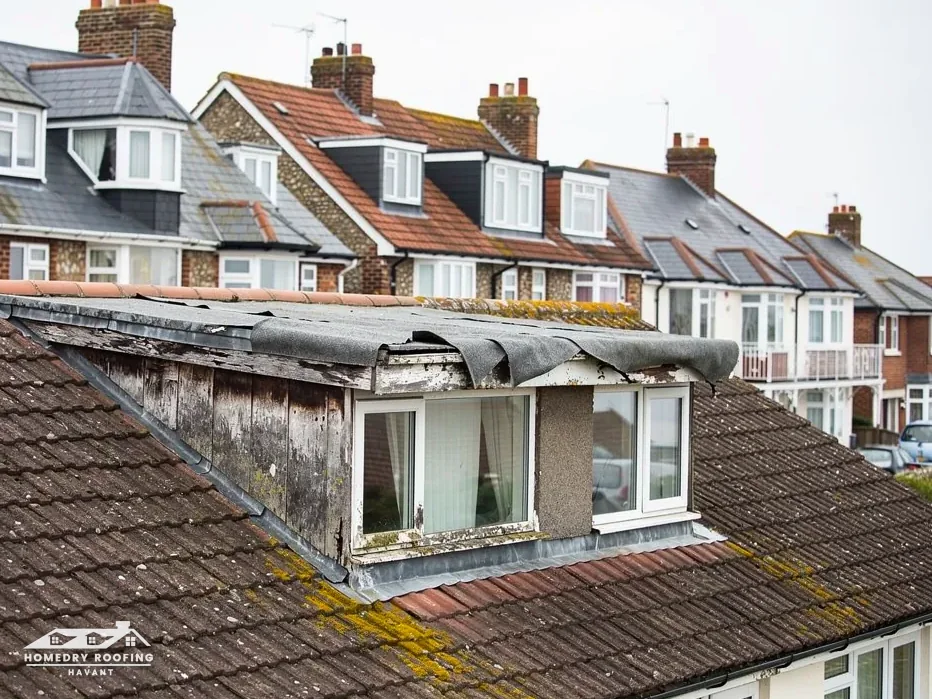
Felt, torch-on or otherwise
Felt is the covering with the shortest published range. HomeBuilding's cost guide (last updated 30 September 2025) gives approximately 10 to 15 years. Less, on a flat roof cost page last updated on 27 October 2026, says torch-on felt lasts 10 to 20 years depending on quality and installation.
The Less figure carries a condition, and the condition is the point. A felt roof's life is tied to how well it was laid, so the same material can sit at either end of a range or outside it. A felt roof that ponds, or blisters, is a prompt for a survey whichever source you read. Open laps and splits at an upstand are others.
Neither source says how a roof was used or how often it was kept clear, which is why a survey of your own roof outranks both figures.
| Source | Torch-on felt | Hedge kept |
|---|---|---|
| HomeBuilding | 10 to 15 years | Approximate |
| Less | 10 to 20 years | Depending on quality and installation |
Our post on blisters in felt covers one way a felt surface shows its age.
EPDM rubber and GRP fibreglass
These two coverings have the widest gaps between sources, which is why both are named side by side:
- EPDM rubber: HomeBuilding gives 25 to 30 years. Less says EPDM rubber membrane typically lasts 30 to 50 years.
- GRP fibreglass: HomeBuilding gives 25 to 30 years. Less says GRP fibreglass lasts 25 to 40 years with minimal maintenance.
Neither figure is a guarantee. Because both sources hedge, a roof near the low end of one range is not automatically failing, and one near the high end is not automatically sound. Neither explains the difference, so the reason stays an open question here. Less attaches a hedge to each: typically for EPDM, minimal maintenance for GRP. The GRP figure assumes a roof kept in order, and its outlets and edges are part of that.
When two figures disagree this much, neither can be averaged into a promise, and each one tells you about the material, not the roof you own. A GRP roof on a sound deck and an EPDM sheet laid over soft boards will not age the same way. Our guide to GRP fibreglass flat roofs goes further on one of the two.
Lead and zinc on a flat roof
Metal roofs sit at the long end of the published figures, and each source keeps its own hedge:
- For a lead flat roof, HomeBuilding gives 60 to 100 years, and Less says lead is the longest-lasting option at 50 to 100 years.
- MyJobQuote says lead flashing that is correctly installed can last for over 80 years.
- VMZinc, the maker, says: "When correctly designed and installed a zinc roof can last in excess of 100 years."
The MyJobQuote and VMZinc claims both carry conditions, correctly installed and correctly designed. The flashing figure and the whole-roof figures are different things, so keep them apart. A maker's figure describes its own product under its own conditions, so read it as the maker's view. Lead on a flat roof is sheet laid on a deck, and the same boards and falls decide how well it ages.
BS 6229:2025 covers continuously supported flexible membranes, not lead, so a metal roof follows its own specification. A roofer can tell you which applies to a metal roof you already own.
What shortens or extends a flat roof's life
A published range cannot see the details that decide whether a particular roof reaches its figure. These are the ones a survey checks:
- Falls: standing water works on a covering every day it stays. BS 6229:2025 sets a minimum finished fall of 1:80, which our answer on flat roof falls explains.
- Outlets and gutters, kept clear so the roof can empty.
- Upstands and trims, where the covering turns up or over an edge.
- The deck beneath, because soft boards shorten the life of a new covering.
- Earlier repairs, since a patch and the covering around it do not share a start date.
None of these appears in a published range, so a roof can sit above or below its source's figure without anything being wrong with the source.
For this reason a roof's age is a prompt for a survey, never the verdict. At the survey we say whether a repair makes sense or the roof has reached the end of what repair can do, and give the reasons, and the price then arrives as a single written figure.
Our flat roofing page covers the choice, and the post on how roofers price a job covers the cost.