
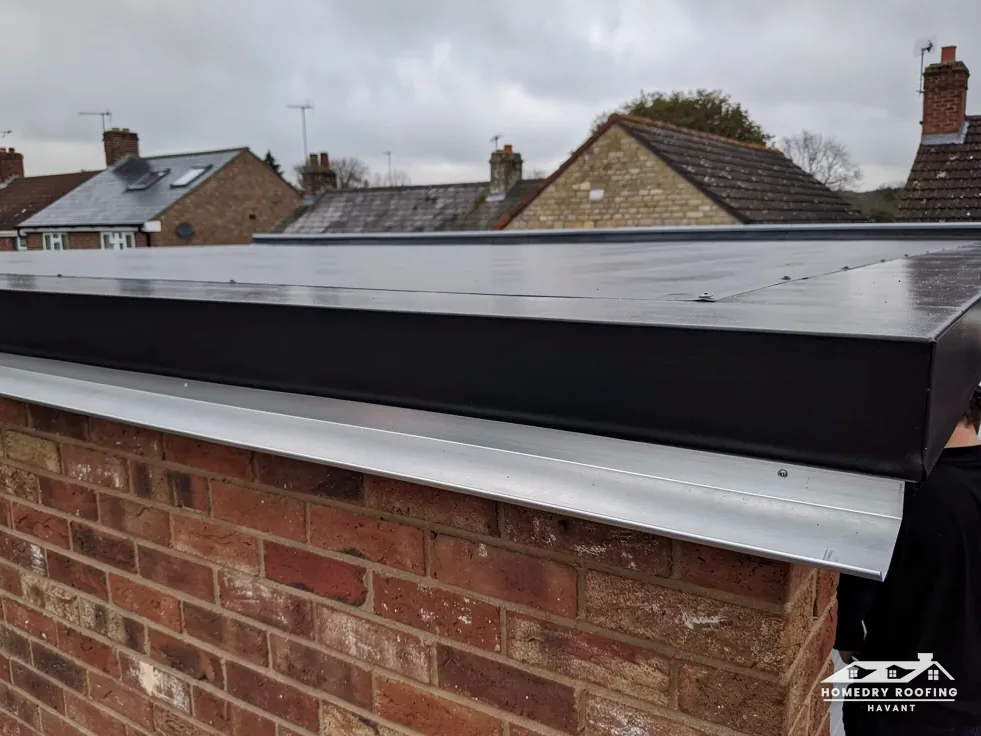
GRP stands for glass-reinforced plastic, and on a roof it is usually just called fibreglass. Rather than arriving as a roll or a sheet, it is made on the roof itself: glass matting is laid on the deck, resin is worked into it, and a coloured topcoat finishes the surface. When the resin sets, the covering is a single hard skin, instead of a set of sheets with laps between them.
That one fact explains where GRP suits and where it does not. A skin made in place can follow a small, awkward roof around its edges, its upstands and its rooflights. It also depends heavily on the deck beneath, which has to be dry, firm and sloped before any resin goes on.
This guide sets out how a GRP roof is built, which roofs it suits, how its published lifespan compares with EPDM and felt, and what repairs and replacement involve. The wider choice of coverings sits on our flat roofing page.
What a GRP roof is made of
A GRP roof is built in layers, each doing its own job, and the quality of the whole depends on every layer being done in the right order.
- The deck: boards, usually timber, that are dry, flat and firmly fixed, with the fall already formed in them.
- Trims and edge details: the pieces that finish the roof edge and carry water away into the gutter.
- The laminate: glass matting laid over the deck and soaked in resin until it is saturated and flat against the board.
- The topcoat: a pigmented layer that gives the finished colour and protects the laminate beneath.
Because the laminate is laid wet, the surface takes the shape of what is beneath it. That is a strength where the shape is awkward, since the covering runs up an upstand, around a rooflight kerb and across a corner without a join. It is also a risk where the deck is poor, because a bump, a dip or a loose board will show through, and a board that moves later can crack the skin above it.
The finished roof is a thin, hard, continuous surface. It is not a membrane that stretches like rubber. The word continuous is about the lack of laps, not about the lack of joins: every edge, trim and wall junction is still a place where the covering stops and another surface begins, and those are the places a survey looks at first.
Where a GRP roof suits
GRP can suit roofs that are small, simple in plan and awkward at the edges. That describes a number of ordinary house roofs:
- A flat-roofed garage or outbuilding, where there is a single plane and a few details.
- A dormer cheek or a small extension roof with upstands on two or three sides.
- A porch or bay roof, where the covering has to turn corners.
- A balcony or walkway roof, where a hard surface is wanted and the area is modest.
A roof in any of these groups still needs its deck inspected first, because the covering relies on what it is bonded to. In each of them the main advantage is the same. The covering runs up and around the details without a lap, so the places where a roll covering would be cut and overlapped are formed as one piece.
A GRP roof also needs the underlying structure to be right before the resin goes on. The fall has to be set so that water leaves the roof, and the guidance for membrane roofs is a minimum finished fall of 1:80 under BS 6229:2025, which is why a roof is designed steeper. Our guide to flat roof falls and standing water gives the reasons. If the deck has a hollow, the right answer is to correct the surface first, not to rely on the topcoat to hide it.
A skin made in place follows the roof around every corner, and it needs a sound deck beneath.
Where another covering may suit better
GRP is not the answer to every flat roof, and a survey will say so where it is not. There are three common reasons to look at something else.
A deck that moves
A hard skin does not forgive movement. A timber deck that flexes, a roof that carries regular foot traffic over weak boards, or a structure that is expected to shift will put the laminate under strain, and strain at a joint shows as a crack. Where the deck cannot be made stable, a covering that stretches, such as EPDM, may be the better choice.
A large, plain roof
On a wide, simple roof, the advantage of a continuous skin is smaller, since there are few details to form. Roll coverings are sometimes chosen for large areas, and the decision rests on the deck, the access and the budget rather than a rule.
A roof you plan to alter
If an extension, a rooflight or a solar mounting is planned, the covering will be cut and patched. GRP can be repaired, but a repair has to bond to the existing laminate, and a roof that will be altered soon may suit a covering that is easier to work around.
None of these rules out GRP. They are the questions we ask on the survey before a covering is named, and our answer is the one the roof supports. For garage roofs in particular, the comparison has its own page: felt, EPDM or GRP on a garage.
Where a roof sits close to trees, the answer can change again. Leaves and debris block outlets, and a hard skin with a blocked outlet behind it holds water against the trims. Keeping the outlet clear matters on every covering, and it deserves a closer look where the fall is already shallow.
GRP beside EPDM and felt: published lifespans
Lifespan is one of the first questions asked about any covering, and the published answers do not agree. Two sources are named below, and neither describes your roof.
| Covering | HomeBuilding (approx) | Less |
|---|---|---|
| GRP fibreglass | 25 to 30 years | 25 to 40 years |
| EPDM rubber | 25 to 30 years | 30 to 50 years |
| Torch-on felt | 10 to 15 years | 10 to 20 years |
Less says "GRP fibreglass lasts 25 to 40 years with minimal maintenance", and that qualifier is part of the figure. It describes a roof that has been looked after, which means checking the trims and keeping outlets clear.
Age alone never settles repair or replacement. GRP and EPDM are measured in decades by both sources, so a roof of either that is 15 years old is not yet old, while felt reaches the end of its range sooner by both measures, and that is the main reason owners weigh the other two against it. Condition decides, and the survey records it.
Read across the rows and the pattern is clear enough: both sources put GRP and EPDM well above torch-on felt, and the two disagree about how far EPDM can go. Those are typical ranges, so a roof with a poor deck or a damaged edge may fall short of them, and a well-kept roof may pass them.
Our short answer on how long a flat roof lasts sets out the same figures for every covering.
Repairing GRP, and what a new roof brings with it
GRP can be repaired, because new laminate can be bonded to old. The usual faults are a hairline crack at a trim or a corner, a failed joint where the covering meets a wall, or damage from something dropped on the roof. A survey finds the cause before anyone works on the crack, because a crack that keeps returning is often telling you that the deck beneath is moving.
Checkatrade gives "GRP fibreglass repairs: £130 to £180 per m²" as a rate. Its rates are "based on a m² rate up to a maximum of 3m²", exclusive of VAT, with access equipment left out, and the table carries a June 2026 update. Read that as a sign of how small repairs are priced, not as a rate for the roof, and never as something to multiply.
Replacing a GRP roof is a different matter. Taking a roof back to the deck and laying a new covering counts as renovation under para 11.2(d) of Approved Document L, because it replaces the waterproof membrane on a flat roof. Table 4.3 sets an improved U-value of 0.16 for a renovated roof, with 0.35 as the threshold, so long as that can be achieved in practice and recovers its cost within 15 years. We ask your building control body which route applies to your roof before work starts.
The structure of the roof decides what insulation can go in, and the survey sets that out before a price is written. A flat roof that sits over a living space is judged differently from a garage or a shed, so tell us what is beneath it when you get in touch, and send a photograph of the edge and any wall it meets.
Cost, and how the written price follows
No guide that we draw on gives a replacement price for GRP on its own. The nearest published benchmark is for flat roofs in general. MyJobQuote says "In 2026, the average flat roof replacement costs between £1,500 and £6,000." That page gives no VAT basis and covers every covering, so it is a range for the market rather than a price for GRP.
Which? Trusted Traders publish rows for felt and for rubber EPDM on a single garage, excluding VAT, from a survey of 11 Trusted Traders in November 2025, and says its prices will probably sit towards the top of the scale for homes in London or the South East. They do not publish a GRP row, so it would be wrong to read one across.
- How large the roof is and how many details it carries, such as upstands and rooflights.
- Whether the deck is sound or needs new boards.
- Whether the fall has to be rebuilt first.
- Access, and the scaffold.
Those four things move a price more than the choice between coverings does. Our written quote is a single total in writing after we have surveyed, and the scaffold is included in it. Where an existing GRP roof can be mended soundly, the quote is for the mending, and if the roof needs replacing we say why and name the covering we would choose for it. When you compare prices, check that each says whether VAT is included, and what happens at the edges and the outlet.