
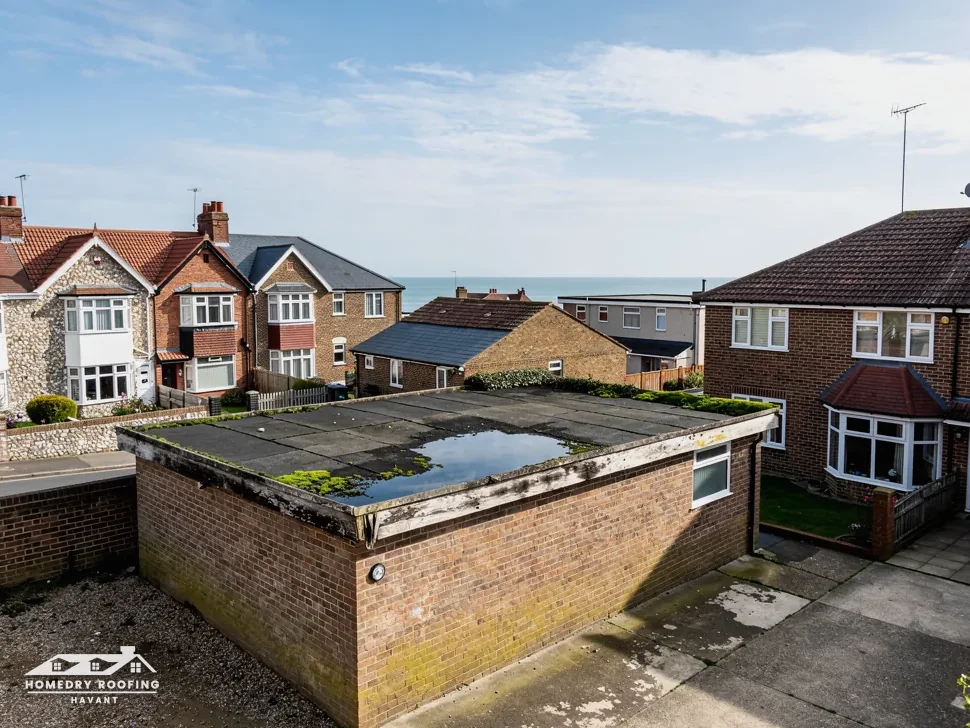
No flat roof is truly flat. If it were, rain would sit where it landed, and the covering would spend its life under water. The slope that carries rain towards the gutter or outlet is called the fall, and it is so gentle that it is invisible from the pavement.
Because the slope is so gentle, small mistakes show up as pools. A deck that has dipped, a covering laid over a hump or an outlet set a touch too high will each leave water standing after the rain has gone. Some of that water is no cause for worry. Some can be a sign of a fault that shortens the roof's life.
This guide sets out how a fall is written and measured, why a roof is designed steeper than the minimum, how to tell ordinary wetness from ponding, and what correcting a fall involves. It belongs with our wider flat roofing page, where the coverings are explained.
What a fall is and how it is written
A fall is written as a ratio. A fall of 1:80 means that for every 80 units along the roof, the surface drops by one unit. Put in millimetres, that is 12.5 mm of drop for each metre of run, so a roof that is 3 metres from the high edge to the gutter needs a drop of 37.5 mm across it.
The figure that matters for membrane roofs comes from BS 6229, the British Standard code of practice for flat roofs with continuously supported flexible waterproof coverings. BS 6229:2025 is the current edition, and the 2018 edition is shown by BSI as withdrawn. Its scope takes in flat roofs, and curved roofs with a pitch of no more than 10 degrees, that use those coverings. It is about membranes, so it does not apply to lead sheet.
The NFRC, the trade body that reported the 2025 update to its members, says the standard sets "a minimum 1:80 finished fall for general roof areas and internal gutters". Two words in that sentence do the work. Finished means the fall as it stands on the completed roof, after the covering, the insulation and the deck have all had their say. Minimum means that is the least that is acceptable, not a target to aim for.
A roof can look level to the eye and still meet that minimum, and a roof can look sloped and still hold water in a hollow. The measurement is taken with a level or a laser between the highest edge and the outlet, and it is checked along the line the water takes.
Why a roof is designed steeper than the minimum
If 1:80 is the least that a finished roof may have, you might expect the design to aim for 1:80. It does not. IKO, the membrane maker, says: "To achieve a 1:80 fall, the code of practice says that the roof should be designed for a fall of 1:40." IKO also gives 1:80 as the recommended minimum for a flat roof.
The reason is tolerance. Timber deck boards sit a little higher or lower than the drawing. Insulation boards are not all the same thickness, and a deck can deflect under load once the covering and the insulation are on it. A design that has no spare fall at the start can end up with a flat spot or a reversed fall in the finished roof. Designing for a steeper fall means the finished roof still reaches the minimum once the real world has had its effect.
| Figure | What it is | Source |
|---|---|---|
| 1:80 | Minimum finished fall | NFRC on BS 6229:2025 |
| 1:80 | Recommended minimum fall | IKO |
| 1:40 | Design fall to achieve 1:80 | IKO, reporting the code of practice |
| 1 mm in 600 mm | Gutter fall towards the outlet | Brett Martin, a gutter maker |
The gutter figure is a different job from the roof fall. Brett Martin advises a fall of 1 mm for every 600 mm along a gutter towards the outlet, which is a gentler slope than the roof, so it should not be mixed up with it. Our short answer on whether a flat roof needs a fall gives the same figures in brief.
A roof that is designed at 1:40 can still finish at 1:80 after every tolerance has taken its share.
Standing water: what is normal and what is not
A flat roof is not meant to be bone dry the moment the rain stops. Some wetness is part of how it behaves, and the roof does not need a repair every time you see it.
Normal for a roof in good order
- A damp surface, or a thin film of water, soon after rain.
- A shallow patch lying at one low point that is gone once the surface has had time to dry.
- Water running across the roof towards the outlet while the rain is falling.
A sign that something is wrong
- Pools that are still there on a dry day, and are still there on the next dry day.
- A pool that is wider or deeper each time you look, which points to a deck that is still sagging.
- A tide line of dirt, algae or silt around a hollow, showing where water stands.
- A water-stained ceiling directly below a pool.
Be careful with the word ponding. It describes standing water that the roof does not clear, and it is the water that does not leave that does the harm. A covering that sits in water for long stretches collects dirt and algae, and a seam at the margin of a pool is a likely place for the covering to give.
We cannot give you a clear time limit for what counts as too long, because it depends on the covering, the weather and the shape of the hollow. A survey looks at where the water stands, how deep it is, what lies beneath it and whether the ceiling below is damp.
Reading the roof from the ground and the loft
Plenty can be learned from an upstairs window or the garden, and staying off the roof is the safer course. Look for the signs below.
- Dark or green stains in a shape that matches a hollow.
- A covering that looks blistered, split or lifted at the edge of a pool.
- A trim, a fascia or an edge that has dropped in the middle, which can mean the deck beneath has dipped.
- Rainwater that runs back along the underside of the roof edge instead of dropping into the gutter.
Indoors, a ceiling stain is not a map of the leak. Water travels along boards and joists before it drops, so the stain only records where it arrived. Look in the loft or roof space, where there is one, for damp, dark timber or insulation that has compacted, and photograph anything you find from a safe spot.
It helps to take a series of photographs over the days after rain. A picture an hour after the rain stops, one the next morning and one the day after tell a roofer far more than a single shot. If the pool is smaller each time, the roof is draining slowly. If it is the same size each time, look next at the outlet and then the fall. Our note on finding a flat roof leak goes through how a leak is traced once the cause is not obvious.
How a fall is put right
A hollow is a shape problem, and a patch does not change a shape. A patch deals with a split, yet the water still lies in the same low place and the repair sits in it. To remove a pool you have to change the surface beneath the covering, so the water has somewhere to go.
There are a few ways to do that, and the right one depends on what the survey finds:
- Re-forming the surface with tapered insulation boards or timber firrings, which are strips laid on the deck to create the slope.
- Replacing a deck that has dipped, if the boards are soft or have lost their stiffness.
- Moving or lowering the outlet so that the lowest point of the roof is where the water leaves.
Any of these means taking the covering off, so correcting a fall and replacing the covering are normally done together. That has a further consequence. Under Part L, stripping and renewing the waterproof layer of a flat roof counts as renovating it, so Table 4.3 of Approved Document L expects the improved U-value of 0.16 (the threshold figure in that table is 0.35) where that is feasible and pays back within 15 years. Renovating more than 50% of a roof's surface brings the entire roof under the same expectation.
We ask your building control body which route applies before work starts, and the new fall is set out in the written price.
Third-party costs and the written price
The cost of correcting a fall depends on whether the deck, the insulation and the covering are all coming off. A whole new flat roof is the nearest benchmark, because rebuilding a fall means lifting the covering first.
- Which? Trusted Traders price felt at £1,400 to £3,500 for "a typical single garage (6m x 3m)", and rubber EPDM with new boards at £1,950 to £4,000, both excluding VAT (November 2025). Which? adds that prices are likely to be at the upper end in London or the South East.
- MyJobQuote says "In 2026, the average flat roof replacement costs between £1,500 and £6,000."
Those are other people's figures for other roofs, never ours, and each covers a whole replacement rather than a single correction to a fall. A bigger roof, a worse hollow, a rotten deck or a difficult edge moves a price a long way.
When we survey a roof, we measure the fall along the line the water takes, check the outlet and the deck and say whether the answer is a repair, a re-formed surface or a new roof. If the existing covering can be mended soundly, we quote for the mending. The written price is then one total for the work, given after the survey, and it includes the scaffold. Check that any quote you compare says whether VAT is included, and ask each firm what its price covers at the edges, the outlet and the deck, since two prices only compare when they describe the same work.