
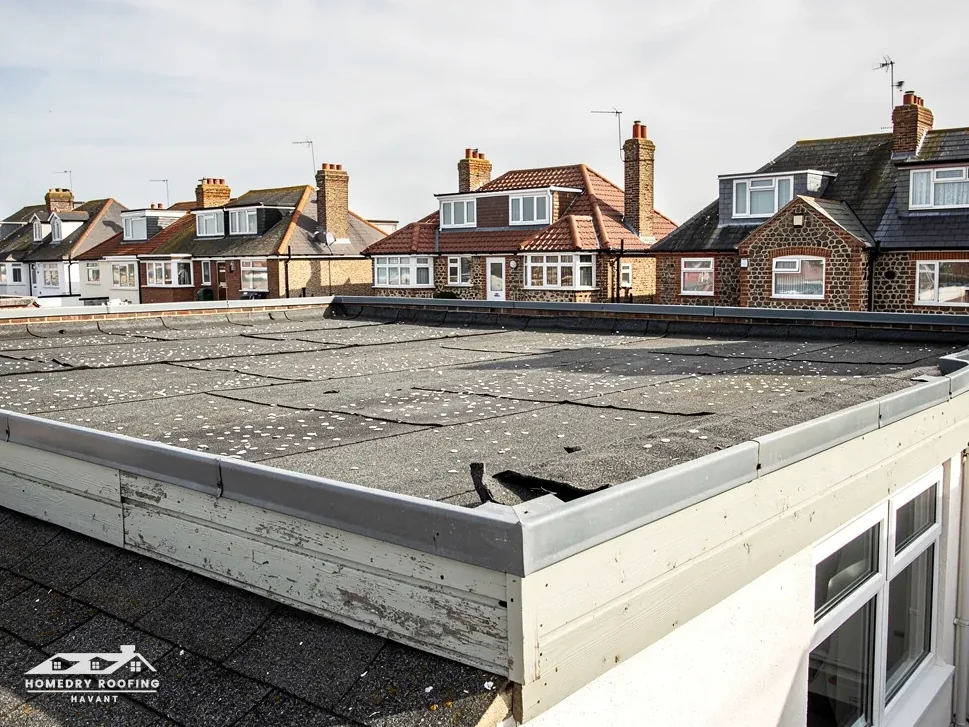
Why the stain can sit away from the hole
A flat roof is a layered build-up: covering, deck, perhaps insulation, a ceiling below. Water that passes the covering lands on the layer beneath and moves along it, following the lowest path it can find. Falls, laps, joists and board joints all steer it, and water can also run along the underside of the deck and drip from a screw or a light fitting a long way from the damp area.
With almost no slope above the deck, the route is shaped by small things. A board joint can carry water a metre sideways before a screw hole or a gap in the ceiling lets it drop. In cold weather, condensation can add damp that has nothing to do with the covering.
That is why a patch put over the stain can miss the entry. A stain that moves from one rainfall to the next is a clue in itself: it says the water is travelling, and the route it takes is the thing to follow. It can also bury the clue, because the entry point can be the only damaged spot on a roof that looks otherwise sound.
Our answer on flat roof ventilation covers how condensation differs from a leak.
Where the route can start
The entry is worked out by following the water, from the top of the roof to the drain. These are the places a survey checks in order:
- Upstands and flashings where the covering runs up a wall, a chimney or a rooflight kerb.
- Laps, seams and joins in the covering, including around pipes and trims.
- Hollows, where standing water meets any small opening.
- The roof edge, where the covering turns over a trim into the gutter.
- Outlets and gutters, which can back up water across the deck when blocked.
- Penetrations, such as pipes, vents and rooflight kerbs, where the covering is cut and closed again.
None of these is a verdict by itself, and the order matters, because the first fault found is not always the one letting water through. Each is a place to check, and a leak can have more than one cause. The roof can show several faults at once, only one of which is letting water through today, and photographs of each detail show you what was found.
Where a flashing is at fault, lead roofing work as well as the membrane may be involved.
What you can note without going on the roof
A few records make the survey faster and the diagnosis more reliable. None needs you on the roof, and HSE's advice on fragile roofs applies, so keep off it.
- Photograph the stain with the date, and again after each heavy shower.
- Note when it appears: during rain, after rain has stopped, or in cold weather without any.
- Look from a window for standing water, a lifted trim or a sagging edge.
- Check that any outlet you can see from a safe place is clear.
- Where there is a loft or void under the roof, look from there with a torch for a darkened board or damp insulation, though not every roof has one.
Ask whoever lives or works below the roof to keep a note of dates as well. Please leave the sealant for later. A bead of sealant over the wrong spot hides the clue and traps water that was already in. If water is coming through now, put a bowl under it and take dated photographs of the damage before any clearing up.
Our guide to walking on a flat roof explains the safety point.
How the survey follows the water
A survey works from the stain outwards and from the wall downwards, checking the ceiling from below and the roof from a safe position. It records where water is present, where the deck feels soft and where the covering is open. We then say what that detail needs, and whether a repair is sound or the roof has reached the point of replacement, with the reasons.
Published figures give a sense of what a survey costs. MyJobQuote says the average cost of a roof inspection in the UK is between £150 and £400 (page updated 22 September 2026), and that a standard roof inspection costs between £200 and £300. These are third-party figures, not ours.
Repair, when it is the answer, goes at the entry point alone where the rest of the covering is sound, and the area is checked again after rain to confirm the stain has stopped growing. If the survey finds a failed roof, the price for the work reaches you as one written total. Our repair or replace guide covers that decision, and flat roofing has the wider work.