
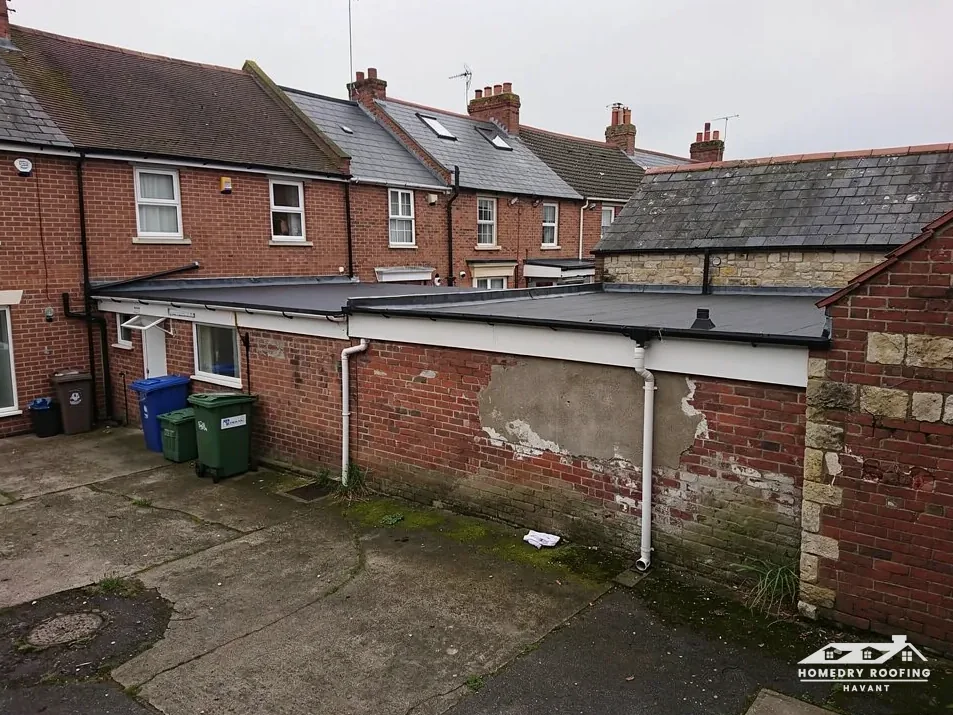
What HSE says about roofs and weight
HSE's roofwork guidance is plain on the starting point: "all roofs should be treated as fragile until a competent person has confirmed they are not." Its guidance adds that sheeted roofs cannot be relied on to bear anyone's weight, whatever they are made of. A flat roof with a rooflight, a conservatory section or a sheeted garage roof falls under that warning, and so does any roof that has not been looked at by someone qualified to judge it.
HSE also reports that "almost one in five deaths in construction work involve roof work. Some are specialist roofers, but many are just repairing and cleaning roofs."
That second point is the reason a short trip up to clear leaves or look at a stain is not a small job. The edge of a flat roof can be a clean drop with nothing to hold, and the surface may be wet, mossy or loose underfoot. A roof that has never given trouble can still have a soft patch in the deck that cannot be seen from above.
Our page on why roofs are treated as fragile goes further into the reasoning.
What foot traffic does to the covering
Felt, EPDM rubber sheet and GRP fibreglass are waterproof skins, not flooring. Each has its own weak points, and all of them can be harmed by ordinary use:
- Grit under a boot or a ladder foot can scuff, scrape or cut the surface.
- A dropped tool or a heavy load can puncture a thin covering.
- Walking on a blistered or soft area can break open a laid seam.
- Repeated foot traffic along one line, such as a path to a loft hatch or aerial, wears the same strip each time.
Damage of this kind can be invisible at first. A scuff or a small puncture can sit unnoticed until rain gets in, and the stain indoors may then appear well away from the spot where the foot went down.
A roof designed as a terrace or walkway has a deck and a finish made for the load, which is a different build from the roof over a garage or a kitchen extension. If you are unsure which yours is, assume it is not made for walking.
A roof over an extension also carries vent pipes and rooflights, and each of those is a weak point where a footstep bends the covering at its joint.
Looking from the ground and from inside
A flat roof shows a good deal without anyone standing on it. Try these in order, from safest to least safe:
- From inside, check ceilings and the wall beneath the roof for stains, lifting paint or a musty smell.
- From an upstairs window, look across the roof for standing water after rain has stopped, a sagging edge or a trim standing proud.
- From the ground with binoculars, look along the edge and at the gutter for debris or streaks down the fascia.
- Photograph what you see, with the date, so the survey can compare it with the roof as it was before.
Our guide to inspecting a roof from the ground shows what each view can and cannot tell you, and what it needs a ladder or a survey to settle.
The signs point to a place worth checking, not a verdict on the roof. Water that stays on the surface for days after the rest has dried is worth a note and a photograph, and so is a stain that grows. Neither needs a foot on the roof to record.
When someone does have to go up
Sometimes the roof has to be walked: to clear an outlet, to trace a leak or to fit equipment. Access then needs planning, and that is the work of someone trained for it. The access need not be elaborate on a small job, but it is matched to the roof, the edge and the task, and it is set up before anyone steps off the ladder. We look at the roof from safe positions first and set up access equipment when the work needs it, with scaffold included in the written quote.
Access is a real part of any roof job, so ask whatever quote you receive to say what it covers and whether VAT is included. A figure that leaves out the means of getting onto the roof is not the whole price.
If the roof is asbestos cement, as an older garage roof may be, HSE says such roofs are always fragile. Our page on walking on asbestos cement sheets covers that case. For the wider job, see flat roofing, and for the tracing step, the page on finding a flat roof leak.