
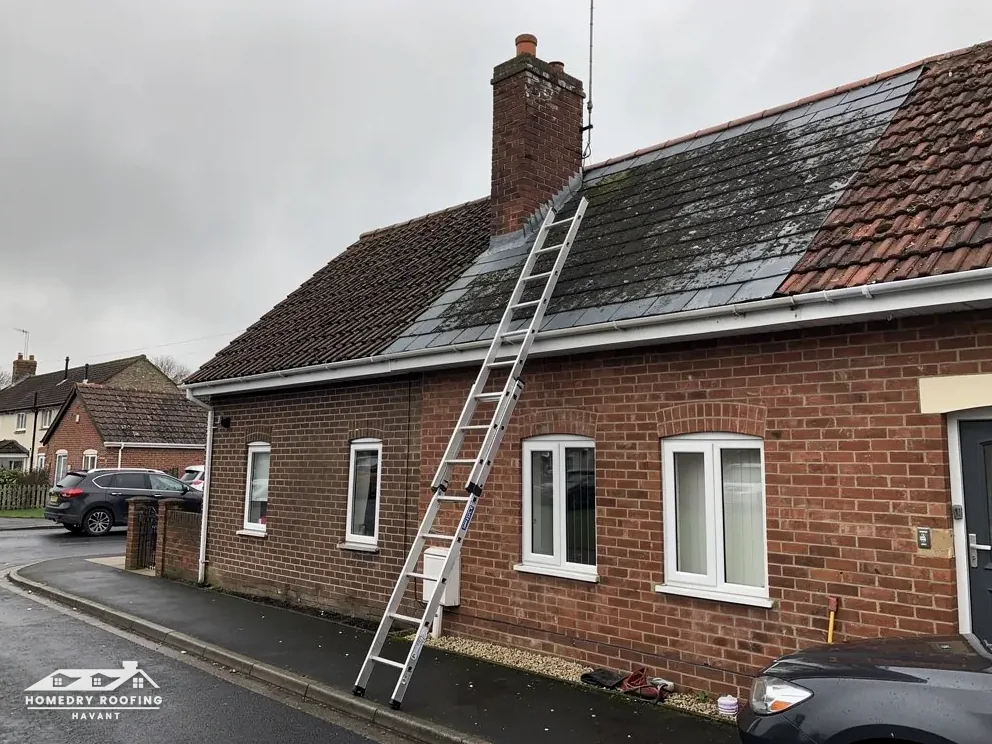
What the garden and the pavement show
Start with the plainest view. Stand well back from the house, on the pavement or at the end of the garden, and read the roof from the top down, the way rain meets it. Binoculars, or the zoom on a phone camera, bring the detail closer without leaving the ground.
- The ridge, the line along the top: it should run straight, with no dip and no gap.
- Tiles or slates that sit out of line, show a bright broken edge or have slipped down the slope.
- Patches of moss or dark streaking, worth a note and a photograph.
- The chimney stack, for crumbling mortar or a lean.
- Gutters and downpipes, for sagging runs, plants growing in them and stains on the wall below.
Check the lower edge of each slope as well, where the covering meets the gutter, for tiles that have slid or a fascia board that has stained. Look from more than one side. The street shows the front slope and the garden shows the back, and a fault can be visible from only one of them. Photograph anything odd with the date, and note which slope it is on. A dated picture lets whoever inspects the roof later see whether the problem has changed.
What the loft and the ceilings add
Inside the house you see the roof's record rather than its surface. Rain that has got in leaves marks, and they are easier to spot from a loft hatch with a torch than from the street. Do not step off the joists or onto bare ceiling boards. Lean in from the hatch, or from a boarded area built for walking on.
- Brown or yellow stains on ceilings and on the walls under the roof, and paint that is lifting or flaking.
- Damp or darkened timber, and insulation that is wet, flattened or stained.
- Daylight showing through the roof covering.
- A musty smell in the roof space or in the room below.
A stain tells you that water reached that spot. It does not tell you where the water came in, because it can follow the timbers a good way before it drips. The mark on the ceiling and the fault on the roof can sit some distance apart, so treat a stain as the start of the search and show whoever looks at it the room as well as the roof. Our page on what a roofer checks follows that trail up through the roof.
What the ground cannot show
Some parts of a roof are out of sight from every safe position on the ground. The back of a chimney, the inside of a valley, the underside of a lapped flashing and the far side of a ridge all hide behind the shape of the roof itself. A covering can look sound from below and still have a slipped nail, a cracked tile under its neighbour or a soft batten behind it.
Where the roof structure has been sprayed with foam, the limit is stricter. RICS says: "If the timber roof structure is covered with spray foam it cannot be fully seen or inspected."
That is no invitation to climb up for a better look. HSE says "all roofs should be treated as fragile until a competent person has confirmed they are not." It also reports that "almost one in five deaths in construction work involve roof work." Our page on why roofs are treated as fragile sets out what that means for an owner with a ladder.
If the ground view leaves a question, the answer is a closer look from safe access, never a step onto the slope. A roofer can set up a ladder, a tower or a camera pole where it suits the house and the edge.
When to ask for a proper inspection
A ground check is worth doing, and it has an end point. Ask a roofer to inspect when:
- a stain appears on a ceiling, or an old one grows;
- a tile, slate or ridge piece has moved, or turns up in the garden;
- you are buying, selling or letting the house and want the roof on record;
- the roof was repaired lately and you want a record of what the repair found.
An inspection adds the close view from a ladder, the check inside the roof space and a written record with photographs. MyJobQuote's roof inspection page (updated September 2026) says the UK average sits between £150 and £400, and that a standard inspection costs £200 to £300. A price for your own house has to come from someone who has seen the roof close up. Our guide to what an inspection costs sets out what such a figure covers, and the roof inspections page explains how we work. Send your dated photographs with the enquiry and the first visit can start at the problem.