
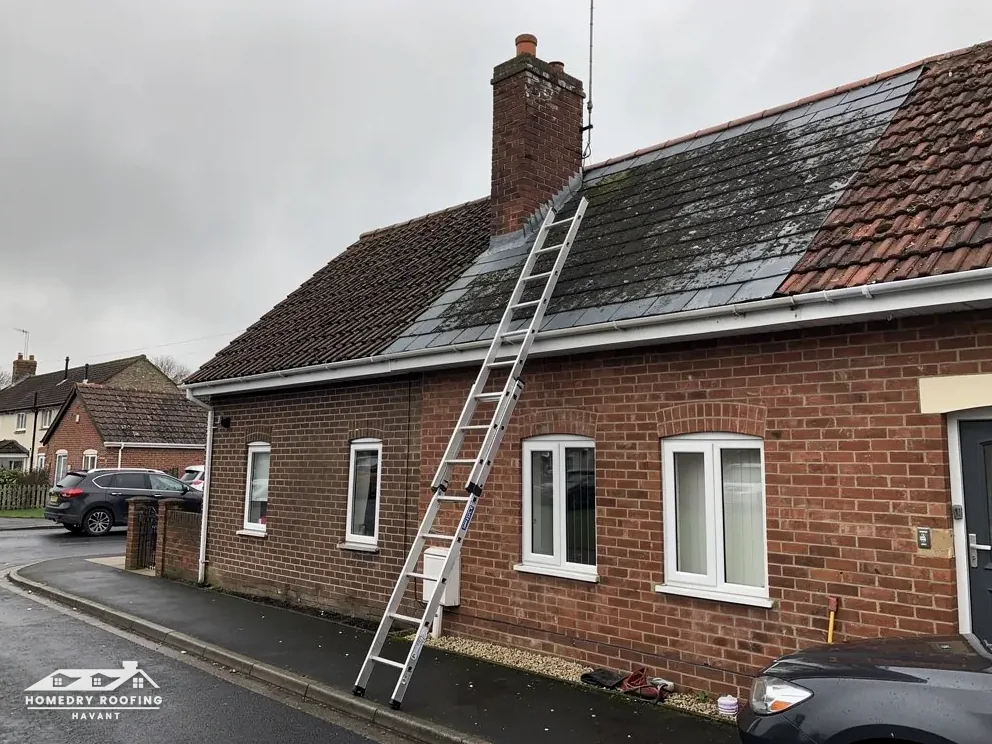
The report lands, you turn to the roof paragraph, and it says the covering is ageing, or that a chimney needs attention, or that further investigation is recommended. A purchase has a clock running, a lender waiting and a lot of money on the table, so a single sentence about tiles can take over the whole week.
That sentence is the start of a question, not the answer to it. A survey is written for the whole house, and the roof is one part of it. What you need is a clearer picture of this particular roof: what is actually wrong, how much of it, what putting it right would involve and what that is likely to cost.
This guide works through that in order. It covers how to read the roof wording, what a survey can and cannot see, how to get a roofer to look before you exchange, what the findings can say, how to use them in a negotiation and what to check before work starts after you move in.
Reading what the survey actually says
Survey wording can sound firmer than the situation is. A line about a roof might describe what the writer saw, voice a worry about what they could not see, or recommend that someone take a closer look, and those three call for different responses. The first job is to read the roof paragraph slowly and sort each sentence into one of them.
Put these questions to the wording.
- Does it name a specific fault, such as slipped tiles, split lead or a sagging section, or does it speak in general terms about age and condition?
- Does it say where on the roof, or leave the position open?
- Does it say how the roof was viewed: from the ground, from a window or through the loft hatch?
- Does it recommend a repair, further investigation or a specialist's opinion, and does it say how soon?
- Does it record anything the writer could not see or reach?
A sentence saying the covering could not be seen is an absence of information, which is different from a report of damage. A sentence naming tiles, a chimney or a leak is a lead to follow. Copy the sentences out on a sheet of paper, with the page number, because a roofer will want the exact wording rather than your summary of it.
If the wording is unclear, phone the surveyor and ask what they meant. A surveyor can explain what was seen and what was assumed, and that answer shapes everything that follows.
What a survey of a roof can and cannot see
A survey report can only describe what the person writing it could see. For a roof, that might mean a view from the ground, from a window and, where there is a hatch, from inside the loft. The covering on top and the structure beneath it are two separate things, and the two can be in very different condition.
Several things limit what can be seen.
- The far slope of a roof, or one hidden behind a neighbouring building.
- A flat roof seen only from a window, where standing water or a worn surface may not show.
- The back of a chimney, and the lead set against the wall beside it.
- A loft with no hatch, or one full of stored belongings.
- A roof frame buried under spray foam.
On spray foam, the RICS consumer guide says a timber roof structure covered with it "cannot be fully seen or inspected". In March 2023 RICS also reported concern in some parts of the lending market, such as equity release mortgages, so raise foam with your lender early rather than late.
If a report says a flat roof could only be viewed from a window, a roofer can go up and look at its surface, joints and outlets from close range.
None of this is a criticism of a survey. It explains why a roof paragraph can end with a recommendation for a closer look from a roofer, which is exactly the next step to take. Our answer on the difference between an inspection and a survey sets the two side by side, and our answer on inspecting a roof with spray foam covers what can still be checked.
Getting a roofer to look before you exchange
A roofer's visit is the quickest way to turn a general warning into a specific one. Roofers work from ladders and from inside the loft, and they can see a covering and its details at close range, which a survey of the whole house may not have done. Our roof inspections page describes how we look at a roof and what the written findings contain.
The route to a visit runs through the seller, because the house is still theirs. The estate agent or the seller's solicitor can arrange access, so ask early and give the reason in one line.
- Send the roofer the exact wording of the roof paragraph and the date of the survey.
- Ask the agent for a time when the roofer can reach the loft hatch and see the outside from the garden.
- Ask for photographs of each fault, a written note of how rain reaches the inside, and a view on whether the job points to repair or to renewal of the covering.
- Ask for one written total for the job, so the figure is known before you decide.
Photographs matter in a purchase, because they let you, the seller and your solicitor look at the same fault instead of three descriptions of it.
Published cost guides give an idea of what a visit costs. MyJobQuote's guide to roof surveys gives around £300 as the average, and its inspection guide gives £150 to £400 as the average range across the UK and £200 to £300 for a standard visit (pages updated in September and October 2026). Ask what any fee covers, and whether the roofer will put findings in writing.
If the seller will not allow a visit, tell your solicitor and ask what that means for your offer.
Repair, renew or watch: what the findings can say
A roofer's findings point to one of four outcomes, and each one reads differently against the asking price.
- A repair, when the covering is in good order and only a few tiles, a flashing or a joint need work.
- Renewal of one part, such as a valley or the lead around a chimney, with the rest left as it is.
- Replacement of the whole covering, where the covering has no useful life left.
- No work now, with items to watch and dated photographs to compare against later.
Our verdict on a roof is repair or replacement, with the reasons, and where the roof can be repaired soundly, that comes first. The size of the problem matters more than the adjective in the report. Published cost guides show the range, and the table below sets out three rows from them, each with its source and date, so that you can see the scale before any roofer has quoted.
| Guide | Work | Figure |
|---|---|---|
| Which? Trusted Traders | Replace one to six broken or missing standard tiles | £75 to £400, excluding VAT, November 2025 |
| MyJobQuote | Roof repair | average around £650 in 2026 |
| Which? Trusted Traders | Whole roof, average three-bedroom house | £7,000 to £21,000, excluding VAT, November 2025 |
Which? adds that for the South East, the upper end of its range is where prices are likely to be. None of these is a price for your roof: our written quote is one total price that includes scaffold, given after a survey.
A survey names the worry. A roofer's visit puts a size on it, and a written price puts a figure on it.
Using the findings when you negotiate
What you do with a roofer's report is a decision about money and risk, and it sits with you and your solicitor. A roofer describes the roof; your solicitor advises on the contract, the timing and what has to be passed on. Ask the solicitor what the sale paperwork needs about the roof and let them handle the form.
The roof findings give you a short list of choices.
- Ask the seller to do the work first. Put the specification in writing, ask for photographs of the finished work and keep the invoice.
- Ask for a lower price. A written total from a roofer for the exact fault is a figure to discuss, which is firmer than a general remark about age.
- Go ahead as agreed. Plan the work yourself after completion, with the quote in hand and the timing under your control.
- Step back. If the findings change your view of the purchase, say so while that is still possible.
Whichever you choose, keep the evidence together: the survey page, the roofer's photographs and the written findings, and the date of each. A seller or an agent is easier to talk to with a clear page of facts than with a worry about tiles.
One caution is that a roofer's report describes the roof on the day of the visit. If a storm comes before exchange, a fresh look is cheaper than a surprise on completion day.
Before the work starts after you move in
Once the roof is yours, the first question is whether the work needs any approval. The Planning Portal sets a test for re-roofing: normally no building regulations application is needed if less than 25 per cent of the building envelope and less than 50 per cent of the roof is affected. A new covering 15 per cent or more heavier needs approval too. Building control is carried out by the council's building control team or by a registered building control approver, and we confirm the route before a re-roof.
Planning permission is a separate question. Re-roofing a house falls under Class C of the permitted development rules, but a listed home needs listed building consent where work would change its character, and an Article 4 direction can remove further rights. Our planning guide for roof work shows where the lines fall, and we check with the council first where the house is listed or lies in a conservation area.
Access is the third item. Scaffold on a public footway or the carriageway needs a licence from the authority responsible for that road, and we arrange the licence with our scaffolder. Check that the quote says what it covers, scaffold and VAT in particular.
Allow time for the visit, the written price and any approvals before you fix a start date, so that the work sits sensibly alongside your move. Do the surveyor's other findings first if they affect the roof. A damp chimney breast, a blocked gutter or a ceiling stain can come from the same route in, so a roofer who sees the whole list can plan one visit. Our guide to what a roof inspection costs sets out what drives the figure.