
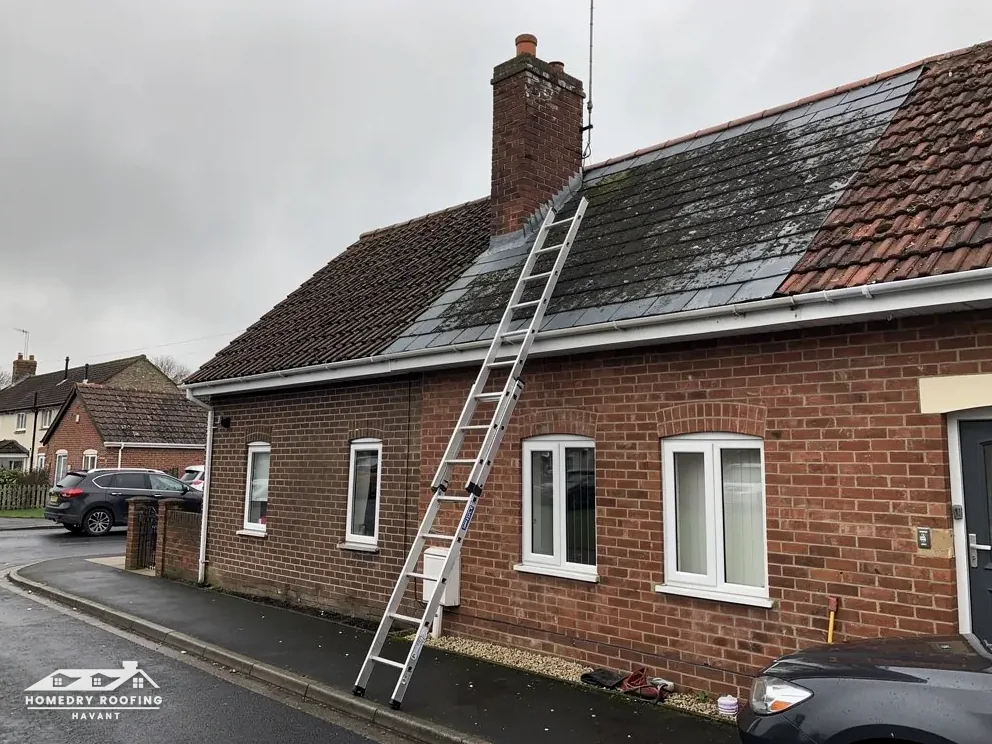
A roof is hard to see and easy to forget. Much of it faces the sky, the view from the street is a thin slice of it, and the loft is somewhere people visit for the suitcases. A short look from the places you can stand safely picks up small faults while they are still small, and gives you something to show a roofer if one turns into a leak.
This checklist is built for the ground, a window and the loft. It never asks you to climb, lean out or walk on a slope. It follows the route rain takes across the house: the ridge first, then the slopes, the chimney and the walls beside them, and last the gutters and the ceilings underneath. For each place it says what to look at, what a sign can mean and what a sensible next step is.
It sets no timetable, because a roof's age, its covering and the weather it has stood through all differ. What matters is looking after a storm, before and after work is done, and whenever something changes inside the house.
Where you can look from without climbing
HSE says all roofs should be treated as fragile until a competent person has confirmed they are not. Take that as rule one for everything below. A tile, a rooflight, a sheet or a patch of moss can give way under a person, and a fall from a roof is a serious price for a look at a ridge. Everything below can be done with both feet on the ground or on the loft floor.
The places to look from are these.
- The pavement or the drive, standing back far enough to take in a whole slope in one view.
- The far side of the road, or the end of the garden, to catch the line of the ridge and the edge of the roof.
- An upstairs window, to see a flat roof over a porch, or a chimney stack, at close range.
- The loft hatch, with a torch, to see the underside of the covering.
A pair of binoculars brings a roof closer than the eye can, and a phone photograph can be enlarged later. Look in good daylight, because low sun and wet slates hide detail. Take the same views from the same spots each time, so that a change shows up when you set the photographs side by side.
If part of the roof cannot be seen from any of these places, that is a reason to ask a roofer to look. It is never a reason to go up and see for yourself. Our answer on inspecting a roof from the ground covers what a ground view can and cannot show.
The ridge, the slopes and the roof's edge
Start at the top and work down, the way rain travels. Along the ridge, the line where two slopes meet, you want to see a straight line. A dip, a bow or a gap between the ridge tiles suggests something underneath has moved. Look too for bedding mortar that has dropped out and left a pale or dark trail down the tiles below.
Across each slope you are looking for anything that breaks the pattern.
- A tile or slate sitting lower than its neighbours, or slid out of line.
- A gap in the covering where a piece is missing, with a dark patch showing the layer beneath.
- A tile with a visible crack or a broken corner.
- Moss or lichen built up in a thick mat, which can hide a cracked tile underneath it.
- Debris resting on the roof, such as a branch or a ball, that holds water against the covering.
Then check the edges. At the verge, the sloping edge at a gable end, see whether the tiles still sit snug against the wall or the barge board and whether any cement along them has cracked or fallen away. At the eaves, the lowest edge, look for tiles that hang over the gutter at an odd angle or have slipped down onto it.
A fault you spot on a slope is not always directly above a stain inside, since rain can run along timber before it shows. Note where you saw the fault and where the stain is, and tell the roofer about both.
Chimneys, walls and the metal around them
Anywhere the roof meets something else deserves a second look, because the covering stops there and a separate detail takes over. The usual meeting points are a chimney stack, a wall rising beside or above a slope, a roof window and a pipe passing through the covering.
Looking at a chimney stack from the pavement or an upstairs window, watch for these signs.
- Mortar missing from the joints between bricks, or bricks with the face flaking off.
- A lean, or a crack running up the brickwork.
- A cracked or crumbling cap of mortar on top, around the base of the pots.
- Pots that tilt, or a cowl that has come loose.
- Staining on the brickwork that runs down from one point.
Brickwork that has lost its joints lets rain into the stack itself, and that damp can travel down the chimney breast inside the house. Binoculars show the cap and the joints of a stack far better than the naked eye does.
The strips of metal set around a stack and along a wall are flashings. Look for any that stand away from the brick, show a split or carry a bead of mastic smeared along the top, which can mean someone has already tried to close a gap. Our guide to chimney flashing leaks shows how those pieces fit together.
If you see a bird's nest in or near a stack, leave it where it is. It is an offence to intentionally take, damage or destroy a wild bird's nest while it is in use or being built, so a roofer plans the work around it.
Gutters, downpipes and the water leaving the roof
The gutters are the last stop on the roof's route, and a fault there can put water against the wall and the fascia board instead of in the drain. The best time to check them is during rain, from a window or a doorway, when you can watch where the water goes.
- Water spilling over the front edge of a gutter, rather than running to the outlet.
- Drips from a seam, or a dark streak down the wall below it.
- A gutter that sags between its brackets, or holds a pool after the rain stops.
- Green growth, leaves or seedlings in the run.
- A downpipe that ends well above the drain, or splashes against the wall.
The overflow marks on a wall are often easiest to see once the rain has stopped and the brick has begun to dry, because the wet line shows up against it.
Fascia boards, the boards the gutters are fixed to, can show their own signs: paint that has lifted, a board that has softened or brackets that have pulled away from it.
Clearing a gutter means a ladder and a reach over the edge of the roof. HSE's figure is that almost one in five deaths in construction work involve roof work. It adds that many of the people affected are simply repairing or cleaning roofs. Leave that part to someone with the right access. Which? Trusted Traders list £75 to £350 (excluding VAT, November 2025) for clearing both the front and rear gutters of a house, and add that South East prices are likely to be at the upper end of that scale.
A gutter ends the route rain takes across the roof, so watch where its water goes.
The loft and the ceilings underneath
The loft shows where rain has been, which the outside cannot. Go up with a torch in daylight and step only on boards or joists. With the light off, look for pin-points of daylight coming through the covering, since a gap that lets light in is a gap that can let rain in.
Then look at the underside of the roof.
- Check the timbers and the underlay for dark patches, tide marks or drips, and follow any wet timber up the slope.
- Press the insulation gently at the eaves and around the chimney, to see whether it is damp.
- Look at the underside of the covering for beads of moisture, which point towards condensation rather than a leak.
- Check the bottom of the chimney breast and the corners of the ceilings below for stains, peeling paint or a ring that has grown since the last time you looked.
The difference between condensation and a leak is worth getting right, and our answer on condensation or a roof leak explains how to tell the two apart.
If the underside of the roof has been covered in spray foam, you cannot do this check properly at all. RICS says that if the timber roof structure is covered with spray foam it cannot be fully seen or inspected. Our answer on inspecting a roof with spray foam explains what can still be checked.
Keeping a record and knowing when to call
A dated set of photographs makes the next check quicker and gives a roofer a starting point. Keep them in one album on your phone, named by place: ridge, left slope, chimney, back gutter, loft. If a storm damages the house, the Financial Ombudsman Service says it will usually look at expert reports and photos of a property's condition, so take photographs of the damage before anything is moved.
| What you see | What it can mean | Next step |
|---|---|---|
| Slipped or missing tile | A gap in the covering | Photograph it, then ask a roofer to look |
| Stain on a ceiling | Water has arrived, perhaps from higher up | Note the room and date, check the loft above |
| Lifted lead at a stack | A route in beside the brickwork | Do not mastic over it; call a roofer |
| Overflowing gutter | A blocked or sagging run | Watch it in rain, then arrange clearing |
Not every sign calls for the same urgency. A single slipped tile on a dry day is a job to book, while water coming through a ceiling is one to report straight away.
MyJobQuote gives the average cost of a roof inspection in the UK as between £150 and £400, and a standard inspection as £200 to £300 (updated September 2026). Our page on roof inspections sets out how we look at a roof. Our answer on how often a roof should be inspected takes the question of timing.