
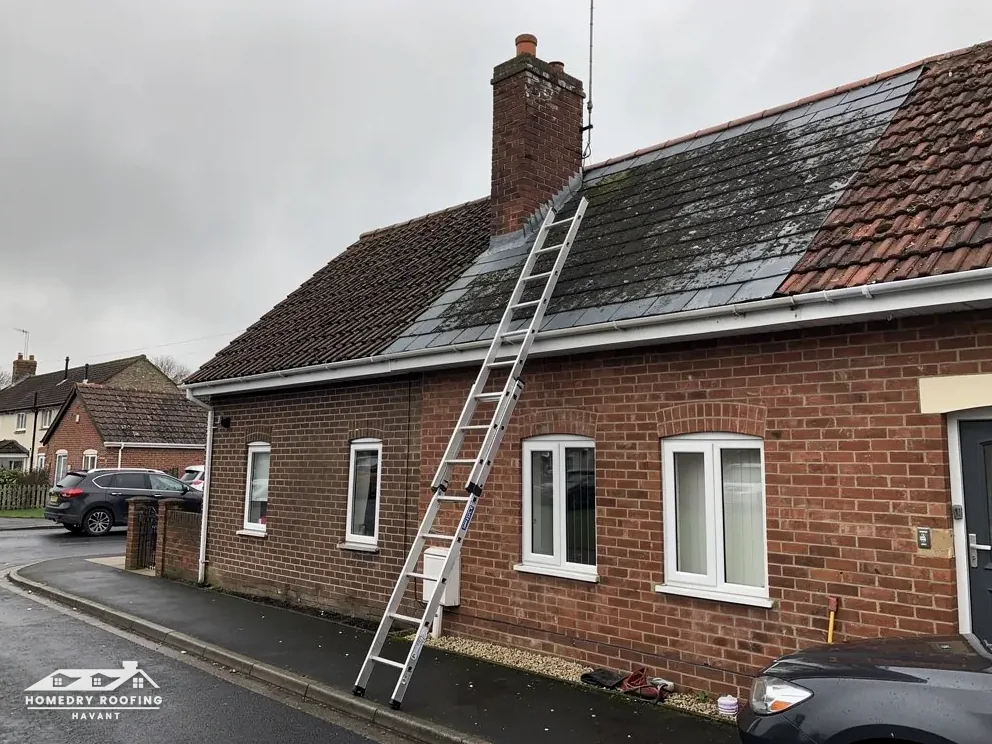
The covering across each slope
The covering is the first thing rain meets, so it comes first. The roofer looks along each slope from the garden and a ladder footed at the eaves, using binoculars or a camera where the eye cannot reach.
- Tiles or slates that are cracked, chipped, displaced or missing.
- Slipped slates, which show as a gap or a longer exposed tail.
- Patches where the covering has lifted or lost its line.
- Moss, lichen and debris, and what they sit on.
- The lower edge of each slope, where the covering meets the gutter.
A covering can look sound from the ground and still be loose, so a ladder view adds a good deal. Where the roof is a flat one, the roofer looks for blistering, splits at seams, standing water and a loose edge trim.
The roofer does not walk the slope to check it. HSE says "all roofs should be treated as fragile until a competent person has confirmed they are not." Safe positions give the view instead, and the report says which ones were used. Anything that looks wrong is written down, even if it seems small, because several small things in one place can add up to the cause.
The joints, where parts of the roof meet
The joints deserve the closest look, because a covering is simple and the places where it stops are not. That covers ridge and hip capping, valley channels, flashings and the chimney stack.
- Ridge and hips: whether the capping pieces are bedded firmly, and how they are held. BS 5534 is a code of practice, not law, and Marley says mortar alone "could no longer be relied upon as the only means of securing the roof covering."
- Valleys: debris, cracks and gaps along the channel where two slopes join.
- Flashings: whether they sit tight to the wall or chimney, and whether the lead has split or lifted.
- Chimney stack: mortar joints, the pots and the lean of the stack.
Lead gets particular attention. MyJobQuote says correctly installed lead flashing can last for over 80 years, so an old flashing is not a bad one by age alone. The roofer is looking at its condition: cracks, gaps and places where it has come away from the masonry. Roof windows and other fittings in a slope have flashings of their own, and these get the same close look.
Gutters, fascias and the edge of the roof
The route of the rain ends at the gutter, and a roof that sheds water well can still cause damage if the gutter beneath it fails. The roofer checks the following:
- Joints in the gutter run, for gaps and signs of drips.
- Brackets and fixings, for sagging and loose lengths. A run full of leaves and standing water weighs on its brackets.
- Outlets and downpipes, for blockages and debris.
- The fall towards the outlet. Brett Martin advises a fall of 1 mm for every 600 mm.
- The fascia boards and soffits behind and beneath the gutter, for staining and softness.
Stains on the wall below a gutter are a clue to where it has been overflowing, and a tide mark on a fascia suggests water has been standing there. Neither proves the cause, but each tells the roofer where to look more closely.
Where the house has a roof window or a flat roof extension, the roofer adds its edge and its seals to the list.
Gutters are normally seen dry, so the owner's account of overflow on a wet day is worth giving: which length spilled, and when.
The roof space, and what goes in the report
The last stage is the loft, where the roof's history shows. The roofer asks questions as well: where the stain is, when it started and whether it grows after rain. With a torch and a camera, the roofer looks at the roof's underside, the felt, the timbers and the insulation for signs that water has been getting in.
- Daylight showing through the covering where it should not.
- Stains, dark patches and damp on rafters, battens and the felt's underside.
- Wet, flattened or stained insulation.
- Rot or insect damage on the timbers, in the form that can be seen.
Where the roof structure is covered, as it is with spray foam, the roofer notes that the timber behind it cannot be seen.
Then the findings go into a written report. Each finding gets a photograph, a position and a plain description, and the report names any part left unseen. The roofer also checks the ceilings below the slope for fresh marks, because the loft shows the roof's side of the story and the ceiling shows the house's. Our guide to what a roof condition report covers shows the layout, and our roof inspections page describes the visit.