
A roof condition report is a dated record of how a roof looked on the day someone examined it. There are different reasons to want one: before buying a house, after a storm, to plan work, to keep a let property in order or to support a conversation with an insurer. The reason matters, because it decides what the report needs to emphasise.
There is no single form that every roofer uses, so two reports on the same roof can look very different. A short report with three vague lines can leave you no wiser than before, and a long one with pages of generic text can bury the one fault that matters. What separates a useful report from a weak one is whether it shows you the roof, follows the route the water takes and says in plain words what should be done.
This guide goes through the parts of a report in that order, then covers what a report cannot tell you and how to use one once you have it.
What a condition report is for
Reports differ in depth too. A quick check from the ground for a single stain is a different job from a full examination before work is planned, and the report should say which one it is.
A report earns its fee by answering questions the owner cannot answer from the pavement. Is the covering sound across the whole roof, or only on the slope you can see from the street? Is a stain on the ceiling coming from a slipped tile, a flashing or a gutter? Is the fault a repair or does it point to a roof that has reached the stage where renewal is the sensible plan?
The common uses each lean on a different part of the report.
- Before a purchase: the faults, how big each one is and what putting them right involves, so the figure can be weighed against the price.
- After a storm: the damage, photographed and located, before anything is moved.
- For a landlord: a dated record of each roof and a list of the items to watch.
- For planning work: the cause of each problem, so the specification fits it.
- For an insurer: evidence of the condition of the property, in photographs and in writing.
A report is not a certificate. It does not approve a roof or promise a remaining life, and a report that sounds as if it does should be read with care. It is a snapshot taken by someone who looked closely, and its value lies in how much that person saw and how clearly they wrote it down. Our answer on what a roofer checks covers the visit that produces it.
How the roof was viewed, and what that leaves unseen
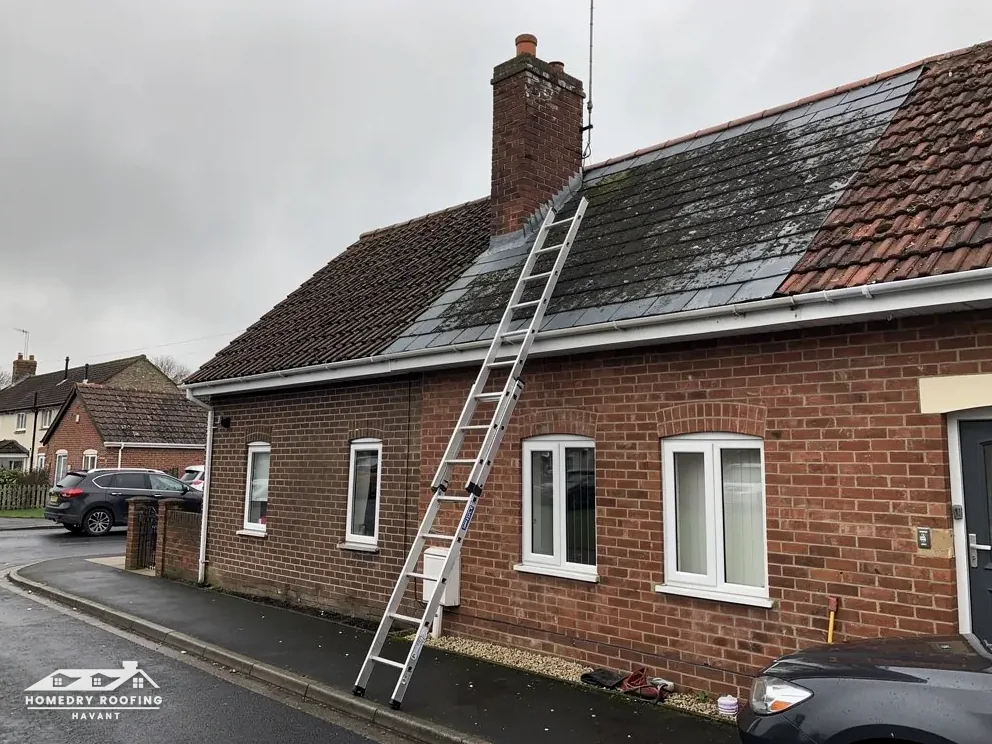
The first thing a report should state is how each part of the roof was viewed, because the view decides what could be found. HSE's rule of thumb is that all roofs should be treated as fragile until a competent person has confirmed they are not. Roofers therefore reach the roof by ladder and through the loft hatch, and decides whether any part can be walked on at all.
| Viewpoint | What it can show | What it can miss |
|---|---|---|
| The ground | The ridge line, tile pattern, chimney, gutters | The far slopes, flashings, anything small |
| A ladder at the eaves | Tiles, edges, gutters and joints close up | The middle of a large slope |
| The loft | Damp, daylight, timber and underlay condition | The outside face of the covering |
A good report names the viewpoint for each finding and lists what was out of reach, such as a slope hidden behind a neighbour's building or a loft with no hatch. That list is not a weakness in the report. It tells you where the risk is not yet known.
Ask whether the roofer went up or wrote from the ground alone. A ground-only report can be perfectly sound if it says so, but its findings are then limited to what a ground view gives, and the report should not describe parts it never saw.
Spray foam on the underside of the roof is a special case. RICS's guidance on spray foam is that a timber roof structure under it "cannot be fully seen or inspected", so a report on such a roof should state that the timbers were not seen. Our answer on inspecting a roof with spray foam goes into it.
The photographs and what each one should show
Photographs are the part of a report an owner can check for themselves, so they should be clear, dated and placed. A set of pictures with no indication of where on the roof each one was taken is little more than decoration.
A usable set contains these.
- A wide view of each slope and of the roof as a whole, taken from the same positions each time.
- A close view of every fault, with a second, wider view that shows where on the roof it sits.
- A view of each junction: the chimney, the walls beside the slopes, the valleys and the roof windows.
- The gutters and the ends of the downpipes.
- The loft: the underside of the covering, any wet timber, and any sign of daylight.
Each picture should carry a short label that places it, for instance the left slope as seen from the front, beside the chimney. A reader with the labels and a pair of eyes can then find the same spot on the roof, or point a second roofer to it. Where a zoom lens was used from the ground, the report should say so, so that the reader knows how close the view really was.
The Financial Ombudsman Service says it will usually look at expert reports and photos of a property's condition, which is one reason a dated, labelled set is worth having. After a storm, photograph the damage yourself before anything is cleared away, and add those pictures to the roofer's.
A picture with no label is a decoration. A labelled one is evidence.
The route of the water, from ridge to drain
A list of faults is not the same as an explanation. The part of a report that adds the most is the account of how water crosses the roof and where it has been let in. Rain runs down a slope, across a valley, along a gutter and out of a downpipe, and a fault anywhere on that path can send it somewhere it should not go.
For each fault, a report should answer three questions.
- Where does the water get in?
- Where does it show, inside or outside the house?
- What closes the route, and is that a repair or a replacement?
The second answer is often some way from the first. A chimney breast can show damp that begins at lifted lead higher up, and a stain on a ceiling can sit beneath a tile that has slipped on the other side of a rafter. A report that gives only the place where the damp is visible has recorded the symptom and left the cause open.
Take a flashing along a wall as an example. The report should say whether the lead is lifted, split or short of its lap, whether the mortar holding it has dropped, and which of those lets the water behind it.
It also helps when the report follows the roof in the order the rain meets it: the ridge first, then each slope, then each junction, then the valleys, then the gutters, and finally the evidence in the loft. A report built that way is easy to follow on the roof itself, and a second roofer can check it against the roof.
If a fault cannot be traced from the visit, the report should say so, and say what would settle it.
Written findings: what each entry should say
The written part is where a report either commits or hedges. Each entry should be short enough to read at a glance and complete enough to act on, and the table below shows the parts it needs.
| Part | What it says | Why it matters |
|---|---|---|
| Position | Where on the roof, matched to a photograph | Lets anyone find it again |
| Description | What is wrong, in plain words | Separates a fault from a worry |
| Cause | How the water gets in | Stops a repair going to the wrong place |
| Action | Repair, renew a part, replace or watch | Makes the finding something to decide on |
A short summary at the top, listing the items in the order they need attention, saves the reader hunting through the pages.
Beware entries that rate a roof with a single word and no reasons. A word such as poor or fair says nothing about what to do, and two readers can take opposite things from it. An entry that says a hip tile has slipped, that rain can reach the timber beneath and that it should be refixed is something you can price and plan around.
It should also say whether repair or replacement is the plan, and why, treating a sound repair as the first choice. After the survey, the written quote is a single total.
MyJobQuote's inspection guide (updated September 2026) puts the average cost of an inspection in the UK at £150 to £400 and a standard one at £200 to £300.
Using a report, and what it is not
A report does its work in the conversations that follow it. With a buyer, it turns a vague worry into named items. With a landlord, it is the first page of a file on the property. With an insurer it is one piece of evidence, alongside photographs taken when the damage happened. The Financial Ombudsman Service says an insurer will normally ask a surveyor to write a report, so a roofer's findings are most useful as a clear account of what was seen, and your own dated pictures sit well beside them.
Keep three limits in mind.
- A report is a snapshot of one day, and a storm afterwards can change the roof.
- It records what could be seen. What could not be reached is a question left open.
- It is a view, not a promise. Lifespan figures in any guide are typical ranges, and a report cannot say how long a given roof will last.
Keep a copy of the report with your house papers, and send the roofer's photographs on when anyone asks for evidence. Ask for the findings in writing, with the photographs attached or listed, and for the roofer to say which items need work soon and which can wait. Our page on roof inspections sets out what we write up. For the insurance side, our answer on a roof report for an insurer goes further.