
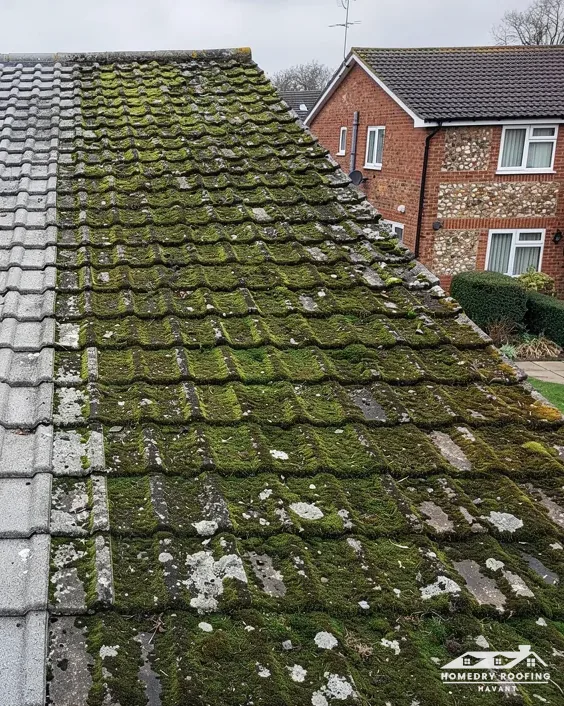
Roof Cleaning and Moss Removal in Havant
We lift moss from Havant roofs by hand, treat what needs treating, then check the tiles and clear the gutters below.
10-year workmanship guarantee, in writing
Moss and cleaning explained
All guides- How moss is removed from a roof, step by stepGuide
- Should you pressure wash roof tiles?Guide
- What a roofer checks once the moss has goneGuide
- Is roof cleaning worth it? A roofer's honest viewPost
- The best time of year to remove moss from a roofPost
- Moss or algae: what is on your roof, and does it matter?Post
- How much should you pay to have your roof cleaned?Answer
- How much should moss removal cost?Answer
- What is the fastest way to remove moss from a roof?Answer
- What will permanently kill moss on a roof?Answer
- Do you need a biocide after moss removal?Answer
- Can you remove moss from your roof yourself?Answer
- How can you tell moss from lichen on a roof?Answer
- What are the black streaks on my roof tiles?Answer
- Does moss actually damage roof tiles?Answer
- What happens to the moss after it is taken off the roof?Answer
Moss on a roof, followed from ridge to gutter
Six places where growth sits on the rain's way down, what a roofer does about each one, and what gets checked once the roof is clear.
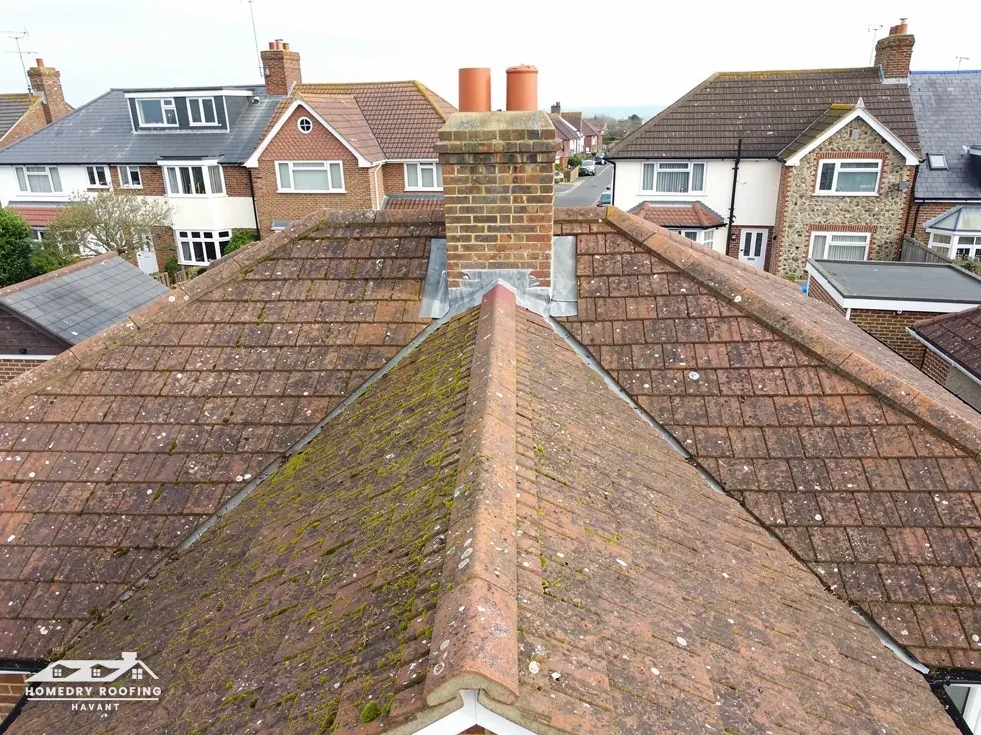
Moss can sit on an open joint and hide it until the day it lifts.
RidgesThe top line, read before anyone cleans a tile
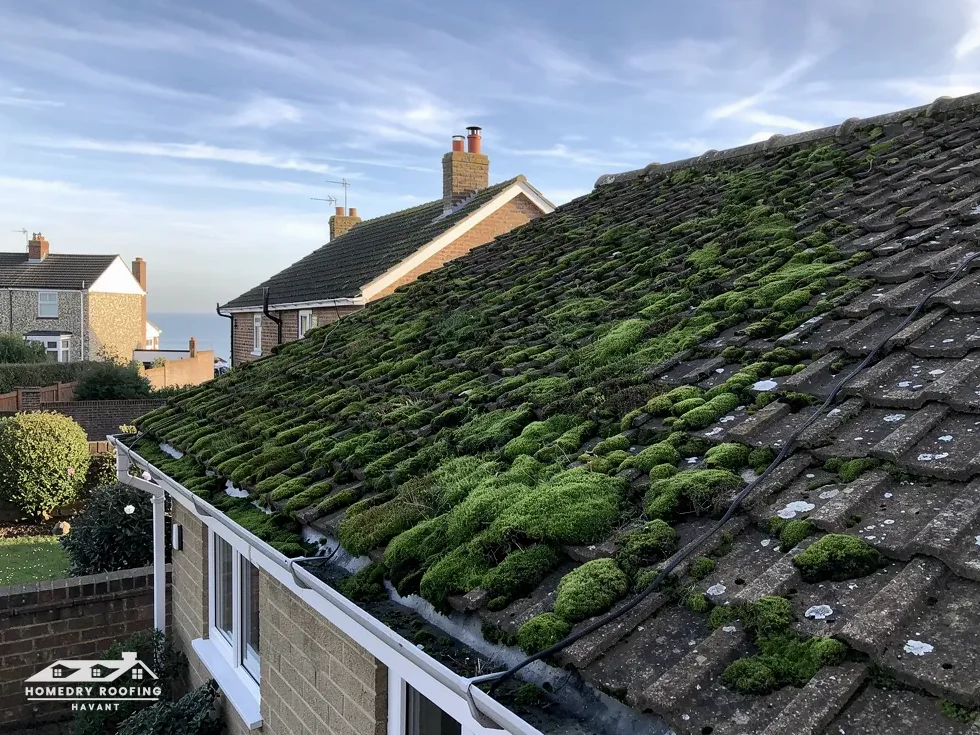
Roof cleaning in Havant starts with looking, because rain has a path down your roof and the moss is sitting along it. Water lands first on the ridge, the capping along the top where two slopes meet, then runs over every tile below it on the way to the gutter. Before we quote, we survey the roof from the ridge down and note what is growing, where it grows and what it might be covering.
The ridge comes first for a practical reason. Mortar joints between ridge tiles can crack, and a cushion of moss over a joint hides the crack until the moss comes away. Lifting it may leave an opening that was covered the day before. A slipped tile can stay hidden the same way, and we would sooner know about either one before the work starts, so the survey takes in these points:
- whether the ridge tiles are firm and their joints closed
- any slipped, cracked or missing tiles on the slopes
- how far the growth runs and what kind it is
- how we can reach the roof safely
Then we tell you what the roof needs. If a clean will do, you hear that plainly. If a tile or a joint wants attention first, we explain why, and that work goes ahead of the clean or alongside it. Our page on roof repairs sets out how a fault is traced. You then get one written total price for everything the roof needs.
What the survey records
- Growth
- Moss, lichen or algae
- Ridge
- Tiles firm, joints closed
- Slopes
- Slipped, cracked or missing tiles
- Access
- Ladder, tower or scaffold
Seen from the pavement
Some signs show from the ground. Look along the ridge for green cushions, then across each slope for thick growth, and check the path below for clumps that have dropped. A clump on the patio tells you something is growing above. It says nothing about the tile underneath, and that takes someone at roof level with safe access. Keep your own feet on the ground while you look, and use the zoom on your phone from across the road.
Where it shows
Green cushions along the ridge line, and clumps of moss dropping onto the path or patio below the eaves.
Where it gets in
A cracked mortar joint under the growth, covered up until the moss comes away from it during the clean.
Why start at the top of the slope?
Moss lifted higher up would otherwise land on tiles already cleared. Working downhill means each course gets done once, and the scraper moves with the lap, never up under the edge of a tile.
LapsHow we clear moss from the overlap by hand
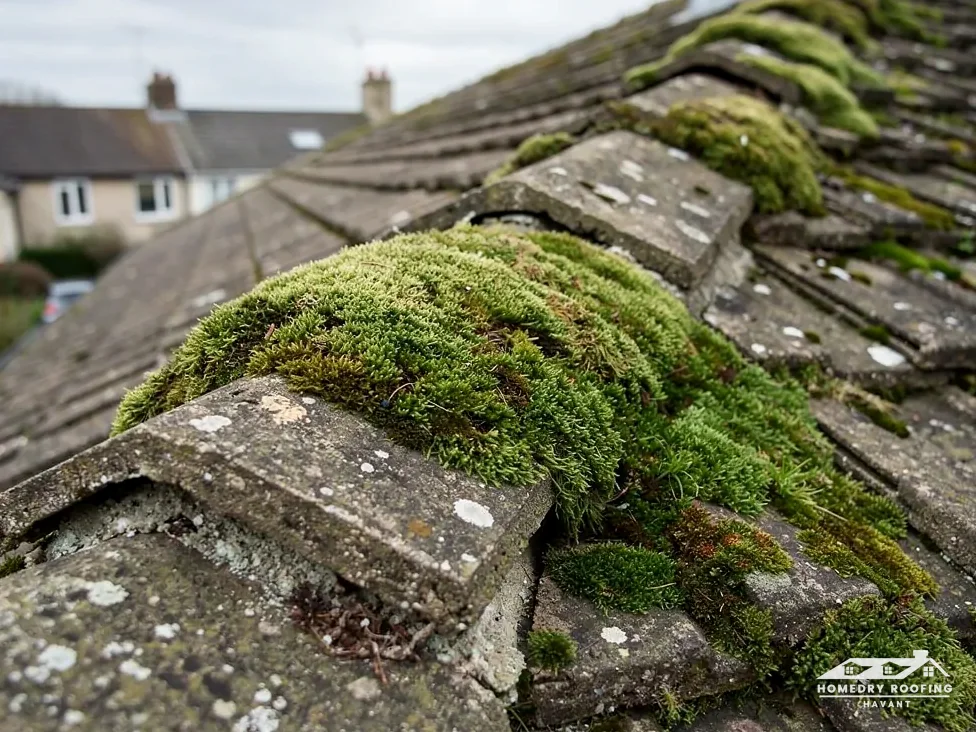
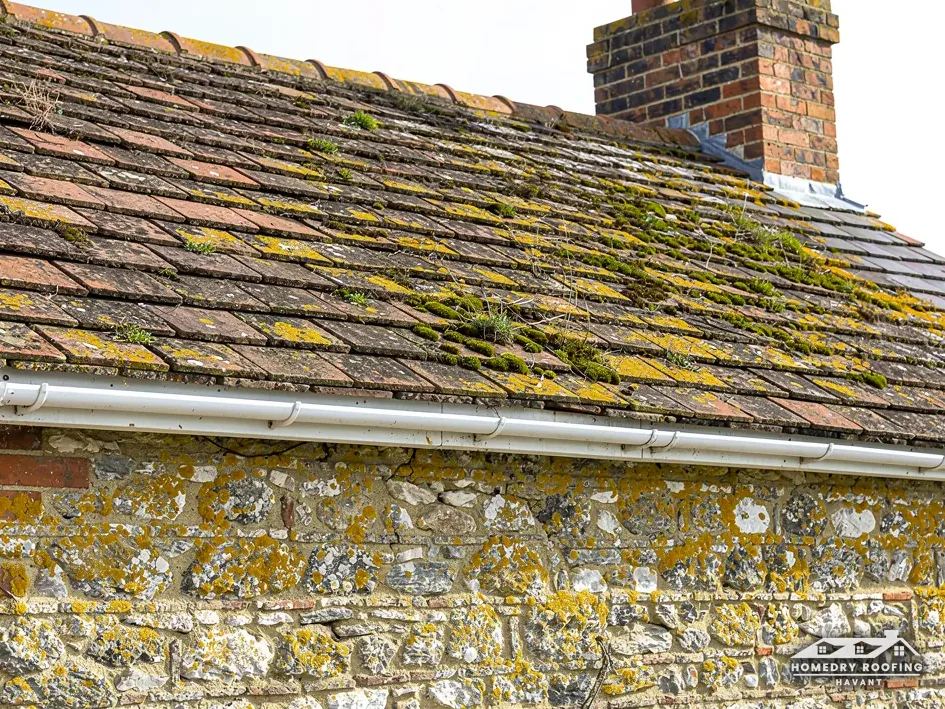
The lap is the part of a tile that sits over the tile below it. Rain is meant to run across that joint and carry on down the slope. A thick cushion rooted in the lap can hold wet against the tile and slow the run-off, and it can spread along a course until the joint disappears from view. That is the growth we are there to remove, and moss removal in Havant, as we carry it out, is hand work.
The process runs in the same order on every roof:
- We set up safe access and protect the ground below.
- Starting high on the slope, we lift the moss with scrapers and soft brushes, working down towards the eaves.
- The moss goes into bags and comes down to the ground, so it stays out of the gutter and off your paths.
- We look along each lap as it comes clear, and note any tile that has cracked or moved.
A tile that has been on a roof for decades can be brittle, and handling it is part of the job. If one breaks, or has already broken under the moss, we tell you and it gets replaced. Our guide to how moss comes off a roof, step by step goes through each stage in more detail. The same hand work carries on around a roof window or a chimney, where a scraper has to stop short of the flashing, the weatherproof strip at the join, and a soft brush takes over.
A cushion in the lap holds wet exactly where the tile is meant to shed it.
Why the bags matter
Moss swept off the eaves has to land somewhere, and the gutter is directly underneath. Bagging it takes longer than letting it drop, and it keeps the clumps out of the outlets, off the conservatory glass and away from the flower beds. When we leave, the bags leave with us, and the paths and patio get swept as part of clearing the site. Nothing is left in a corner of your garden.
How we work a slope
- Tools
- Scrapers and soft brushes
- Direction
- Ridge down to eaves
- Waste
- Bagged and lowered down
- Laps
- Checked as they clear
Is soft washing no more than gentler jet washing?
No. Force does the cleaning in a jet wash, and that force is what can damage a tile. A soft wash relies on the solution, applied at low pressure, which suits a film of algae far better than thick moss.
SurfacesWhy a jet wash never touches the tile
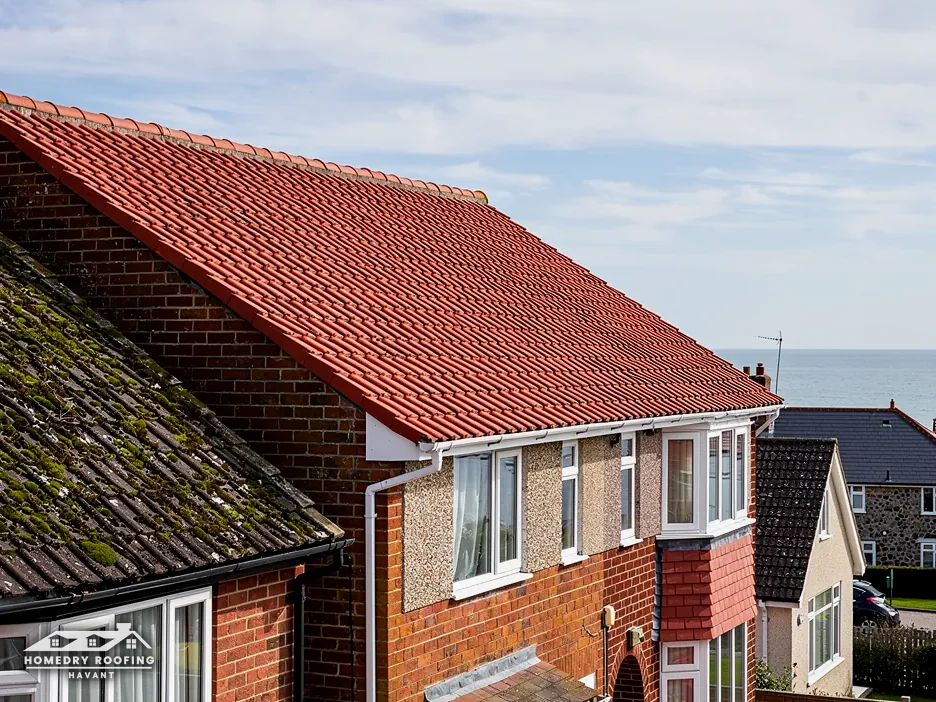
A tile sheds rain from its face, and that face is what a high-pressure lance strikes. Marley, the tile maker, is direct about it: "The use of high powered jet washes is not recommended as it can damage the surface of the slate or tile, thus reducing its expected life considerably". A roof can look far better the same evening and still have lost some of the surface that was keeping it in service. So no pressure wash goes on the roof: we clean with hand tools and a soft wash, a cleaning solution applied at low pressure and rinsed gently. Our guide to why pressure washing can harm roof tiles sets out the reasoning.
What goes on the surface depends on what is growing there, and a green patch seen from the garden can be any of the three kinds below, so we name it first. Our note on telling moss from lichen shows the differences.
| Growth | How it looks | Our approach |
|---|---|---|
| Moss | Soft green cushions | Lifted by hand |
| Lichen | Flat, crusty patches | Treated or left, never scraped hard |
| Algae | Green or black film and streaks | Soft wash, if you want it gone |
Lichen and algae raise a question of looks more than of water, and we will tell you if that is where your roof stands. You can then decide whether the cleaning is worth doing at all, or whether the money belongs on another job.
A roof can look better by evening and still have lost some of its surface.
Slate as well as tile
The maker's warning names both materials, so a slate roof gets the same care. Slate brings its own concerns: each one hangs on its fixings, and a slate that has lost its grip can come away under a brush. We check the fixings as we go. Where slipped slates turn up, the repair goes into the plan, and the cleaning waits until the slope is sound again, so nothing gets done twice.
What you see
A jet-washed roof looking bright and even, with no moss left on it after a single visit.
What the tile loses
Some of the tile's face, which Marley says can reduce its expected life considerably.
Whatever goes on the slope comes back through the valley and down the pipe.
ValleysBiocide, and where its run-off ends up
A biocide is a chemical treatment that controls living growth, and on a roof it is a possible second step once the moss has gone. It stays a choice, and nothing about it is automatic. We lift the moss first, then talk through whether treatment suits your roof, and we can leave it out altogether. Our answer on biocide after moss removal takes that question further.
The rules that bear on it are general ones. HSE says "A biocidal product must be authorised before it can be made available on the market." It also says "If you use biocides in your workplace or home you're responsible for using them correctly so they do not cause harm to people, pets, the environment or wildlife." We follow the directions for the product and think hard about where it travels, because a roof drains to just a few points.
That is where the valley comes in. A valley is the channel where two roof slopes meet, and it carries the run-off from both. Anything applied higher up comes through it on the way to the gutter, then down the pipe. So before any treatment we ask you about what sits below the roof:
- which drain or soakaway each downpipe feeds
- any water butt or pond connected to the roof
- planting and pets close to the outlets
Some roofs are better off without treatment once those answers are in, and we will tell you if yours is one, with the reason.
Asked before any treatment
- Product
- Authorised for the market
- Downpipes
- Where each one drains
- Below
- Planting, ponds and pets
- Choice
- Yours, after the survey
A product from the shed
HSE's wording covers use at home as well as at work, so a bottle of moss killer on your own roof makes you the one responsible for using it correctly. Read the directions before opening it, and think about the downpipe as well as the slope. If you would prefer someone else to take that on, ask us at the survey and we can talk it through with you, including whether the roof needs it at all.
Where it shows
Treated run-off reaching a border, a pond or a water butt below the downpipe after a shower.
Where it gets in
A valley or gutter carrying water from two treated slopes towards the same single outlet at the bottom of the run.
What if birds are nesting in my eaves?
We leave that stretch of the roof alone while the nest is in use or being built, and agree with you when to come back for it. The rest of the roof may still go ahead.
EavesThe bottom course, and whatever lives behind it
Down at the eaves the roof runs out: the bottom row of tiles overhangs the gutter here. Everything that came down the slope passes this point, so growth and debris can collect here. It is also where birds and bats can be living, and that changes how a clean goes ahead.
The law on wild birds works on what the nest is doing and has no calendar in its wording. Under section 1 of the Wildlife and Countryside Act 1981 it is an offence to intentionally take, damage or destroy the nest of any wild bird "while that nest is in use or being built". Bats have stronger protection still. GOV.UK says "All bat species, their breeding sites and resting places are fully protected by law", and damaging or destroying a roost is an offence whatever the intent.
That is why we look before anyone starts along the eaves, and again as the work reaches them. Where a nest is in use or being built, that part of the roof waits. Where there are signs of bats, we stop work there and talk to you about what comes next. Slopes the nest or roost does not touch can carry on, and we will explain how the timing affects your job.
The bottom courses also get their own check for loose or slipped tiles once they are clear. If one needs refixing, the method follows the fixing specification worked out for that house, so the last row ends up as firm as the rest.
The test for a nest is what it is doing today, whatever the month says.
On coastal addresses
Homes near the coast are graded for higher exposure, so the fixing specification is calculated for the site under BS 5534, which is a code of practice rather than law. That matters here because a clean can turn up tiles that have worked loose. If we refix any along the eaves or verge on a coastal house in Hampshire or West Sussex, they go back to that calculated specification. That is about the fixings and nothing to do with moss.
Checked along the eaves
- Nests
- In use or being built
- Bats
- Any signs of a roost
- Tiles
- Loose or slipped courses
- Debris
- Moss packed at the edge

How long before the moss comes back?
We would not put a number of years on it. Shade, damp and overhanging trees set the pace, and at the survey we can point out which slopes are likely to green over again first.
GuttersClearing what came down, then checking the roof
However carefully the moss is bagged, some of it ends up in the gutter. Gutters take every drop from the slopes above, and a clump sitting over the outlet stops the water where the downpipe begins. So cleaning the gutter is the closing step of every roof clean we carry out. We clear the runs and the outlets by hand, then confirm that the downpipes take water. A gutter above a conservatory gets a second look too. Anything beyond clearing, such as a sagging length, a split joint or tired fascias, belongs with our work on gutters, soffits and fascias, and we will tell you if we see it.
Then comes the part a cleaner may not be set up to offer, because a clean roof is the easiest roof to read. With the growth gone we walk through a roofer's check, which our guide on what gets checked once the moss has gone covers in full:
- tiles cracked, slipped or missing
- ridge and hip joints that were under the growth
- flashings, the weatherproof strips at chimneys and walls
- valleys free of debris
You hear what we saw, and if something needs a repair, we explain why. Moss tends to return where shade and damp stay, so we point out the slopes to watch as part of your maintenance from then on. A look from the ground each autumn, once the leaves are down, is enough to catch thick growth early, and clearing the gutters before winter helps too.
A clean roof is the easiest roof to read, so that is when we read it.
Maintenance from the ground
Keeping a roof clear does not call for going up there. Cutting back branches that shade a slope helps it dry after rain, and clearing leaves from the gutters keeps the outlets open. After a storm, look along the slopes for anything out of line. If moss starts to thicken again on the same slope, or a gutter overflows in a shower, send us a photo on WhatsApp and we can talk it through.
Where it shows
Water spilling over the gutter in a heavy shower, or a damp line on the wall below the eaves.
Where it gets in
Moss sitting over the outlet, where it stops the water at the point the downpipe begins its drop.
Moss and roof cleaning answered
Cost, timing, biocide and doing it yourself, with published figures named by source.
What should roof cleaning cost on a house in Havant?
MyJobQuote's roof cleaning guide, updated September 2026, lists moss removal and biocide at £8 to £15 per m², with an average of £400 to £600 for a semi-detached house. That is a typical UK figure from a cost guide, not our price, and it gives no VAT basis. The price on your own roof depends on its size and height, how thick the growth is, the access, whether you want treatment and whether anything needs repairing. We give you one written total price after a survey. If you are comparing quotes from other roof cleaners, check whether VAT and access are included in each. Treat the guide as a yardstick, because no cost guide has seen your roof.
Is paying to have a roof cleaned worth it?
It depends on what is growing and where. Thick moss in the laps, moss dropping into gutters and growth covering joints we cannot otherwise inspect are good reasons, because clearing them lets the rain run as it should and lets us see the tiles beneath. A thin film of algae or a few patches of lichen are more about how the roof looks, so that part comes down to your own preference. If the moss is light and the gutters run freely, leaving it for now can be a fair call. We tell you at the survey which one applies to your roof. If the tiles under the growth are near the end of their life, we will say that too, because cleaning a roof that needs replacing is money badly spent.
What time of year suits moss removal best?
We pick the time around the roof and the weather, since no single month is right for every house. Dry, settled days make a roof safer to work on and let moss come away more cleanly than a wet slope does. Any treatment also needs dry weather, so that it stays where it was applied. Wildlife can move the date too: the test for a nest is whether it is in use or being built, and we check for that at the survey and again on the day. Bats get the same care. If birds have been flying in and out under your eaves, mention it when you call, and we can plan the work around them with you. A clean booked for a dry spell can move by a few days without any trouble.
What is the quickest way to get moss off a roof?
A high powered jet wash would be the quickest, and it is the one to avoid: Marley does not recommend it because it can damage the surface of the slate or tile and reduce its expected life considerably. Lifting moss by hand takes longer and leaves the face of the tile alone. It also gives us time to look at each lap as it clears, which is where a cracked or slipped tile shows up. How long your roof takes depends on its size, its height and how thick the growth has become. Speed also tempts people towards hard scraping, which can crack an older tile, so we keep a steady pace. We can give you a clear idea of the time at the survey.
Will anything kill roof moss for good?
We would not promise that from any product. Moss returns where the conditions suit it, so the shade from a nearby tree or a slope that stays damp will keep inviting it back, whatever has been applied. A biocide can be part of the answer on some roofs, and HSE says a biocidal product must be authorised before it can be made available on the market, though that wording makes no promise about moss. What lasts is a routine: clearing thick growth before it packs the laps, keeping gutters open and trimming back what shades the slope. We can show you which slopes need that attention. If a label or a seller promises permanent results, ask what happens when the shade and damp stay as they were.
Is it safe to clear the moss from my own roof?
It is one of the riskier jobs a homeowner can take on, so we would keep it off your list. HSE says "all roofs should be treated as fragile until a competent person has confirmed they are not", and that "almost one in five deaths in construction work involve roof work. Some are specialist roofers, but many are just repairing and cleaning roofs." A wet, mossy slope gives very little grip, and reaching over from a ladder is no safer. From the ground you can still look for signs of thick growth, clear what you can safely reach and photograph the roof from the garden. Picking up a clump that has fallen on the path is fine. Then leave the slope itself to someone with the right access equipment.
Does every moss removal job need a biocide afterwards?
No. Removal and treatment are two separate decisions, and we price them around what you choose. Lifting the moss by hand deals with the growth that is there today. A biocide is an extra step that some owners want and some roofs suit, and it brings the responsibility HSE describes: using the product correctly so that it does not harm people, pets, the environment or wildlife. If a downpipe feeds a pond or a water butt, or the planting below matters to you, those are good reasons to leave it out. We would explain how each option looks on your own roof, and you decide after the survey. Leaving treatment out never stops us lifting the moss, clearing the gutters or checking the tiles.
Can moss on the tiles cause a leak inside the house?
It can play a part, though we would look for the cause before blaming the moss. A thick cushion can hold water in a lap, and clumps can block a valley or a gutter outlet so that rain spills where it should not. Moss can also hide damage that is the real fault, such as a cracked tile, an open ridge joint or a worn flashing. If you have a stain on a ceiling or damp in the loft, clearing moss may not solve it on its own. Tell us about the leak when you book the survey, because we would trace the water first and add repair work to the same visit where that makes sense. Clearing the growth also gives us a clear view of the laps, which helps with that tracing.
Are slate roofs cleaned differently from tiled ones?
The same warning against jet washing applies, since Marley says it can damage the surface of the slate as well as the tile. What changes is the handling. Slate is thinner, and it relies on its fixings, so the brush work is lighter and each slate gets a look as it clears. A slate that has lost its nail may slip when the moss holding it in place comes away, and that repair goes into the plan before the clean carries on. A tile with a deeper profile gives moss troughs as well as laps to pack into, and that takes more patient hand work. On a mixed roof we deal with each slope on its own terms, and the survey sets out how.
Which towns around Havant do your roof cleaners cover?
We take on roof moss removal across Havant and up to 30 road miles out, on both sides of the line between Hampshire and West Sussex. Emsworth, Hayling Island and Waterlooville are close by, Portsmouth and Fareham lie to the west, Petersfield to the north and Chichester to the east. Our areas page lists every town we reach. The method is the same wherever the house is: survey first, hand removal, treatment only if you want it, gutters cleared and the roof checked at the end. On coastal addresses, any tile we refix follows a specification calculated for the site. Call 023 9396 0313 or send a photo on WhatsApp to 07880 284133, and we can arrange a time to look at the roof.
Where's the water showing?
You'll get one written total price.