
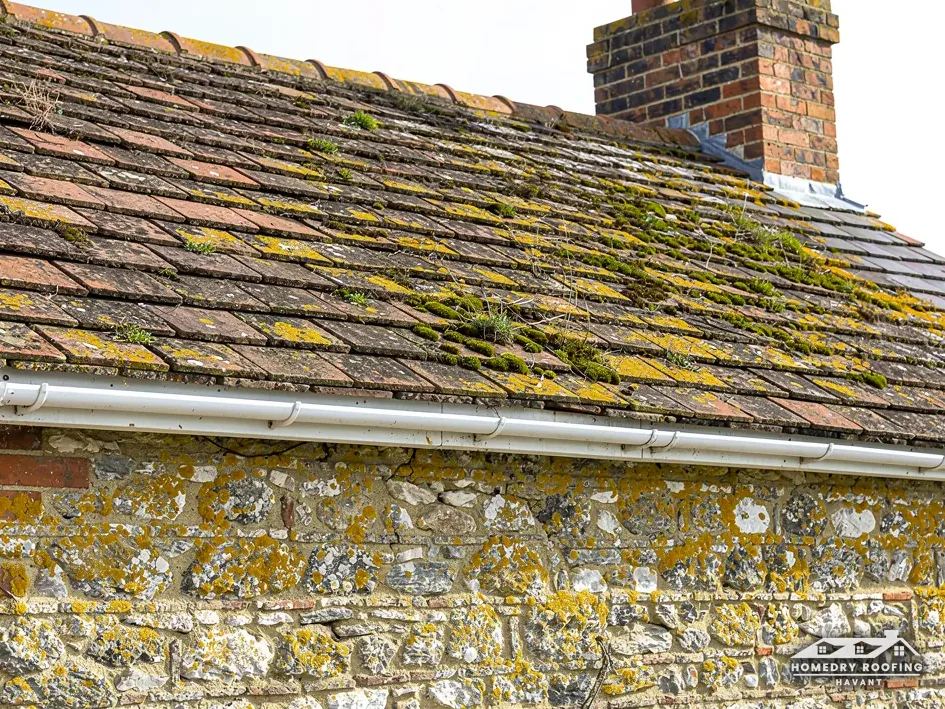
Bagged on the roof and lowered down
Moss comes off a roof in pieces, and each piece has to be handled. A roofer working down a slope puts the moss straight into bags as it comes away, instead of sweeping it off the edge. The bags are then passed down to the ground, not thrown.
The order of work keeps the ground tidy:
- Sheets or a trough go down below the eaves to catch anything that drops.
- Growth is lifted from the high end of the slope and goes into a bag at once.
- Full bags are lowered by rope or passed hand to hand.
- The bags go onto the vehicle and leave with the roofer when the job ends.
Handling moss this way takes more time than letting it fall, and the reward is a clear gutter, clean glass on a conservatory and unmarked beds. Our guide to how moss is removed from a roof describes the full order of work from the first look to the last sweep. The bags are the visible end of a job that was planned around keeping the garden as it was found.
Why it is not left to drop over the edge
Below the eaves sit the gutters, the downpipes and the drains they feed. Moss that falls into a gutter does not stay in one clump. It spreads along the run, packs round the outlet and can hold water in the gutter long after the roof above has been cleared.
A gutter is laid to fall towards its outlet, and Brett Martin advises a fall of 1 mm for every 600 mm. Moss packed into a run stops water travelling that way, and a run that then stands full may be sagging on its brackets, which is a repair and not a cleaning job.
Beyond the gutter, there is the ground below. A heap of moss on a path makes it slippery and makes more work, and on glass or a lean-to roof it stains and blocks. Bagging as the work goes prevents each of these problems, and it spares the downpipe a plug that would only show in the next heavy rain.
Our post on moss in your gutters follows the growth into the gutter itself and what to do about it once it is there.
Treated roofs and what comes off them
Where a biocide is used, the question of what comes off the roof has a second part. HSE's wording puts the duty on the person applying a biocide, who is "responsible for using them correctly so they do not cause harm to people, pets, the environment or wildlife". That reaches as far as where a product ends up once it has been applied.
For an owner, this comes down to three plain questions to raise with a roofer before any treatment is applied:
- Which product is it, and what does its label say about run-off?
- What lies below the roof that it could reach, such as plants, a pond or a path?
- Is the work done in settled weather, so that it stays on the tiles?
HSE names no moss killer, so the answers come from the label and from the roofer. A treatment you do not need is a cost and a risk with nothing gained, and a roof can be left untreated on the roofer's advice, and our answer on whether you need a biocide after moss removal covers that decision.
What to expect when the job ends
Disposal is part of a quote, so it should be part of a conversation. You are entitled to a plain answer on each of these points:
- Who bags the moss, and is taking it away part of the price?
- Are the gutters and the downpipe tops cleared as part of the job?
- Will the paths, patio and beds be swept when the work is done?
- Will you be told if the moss was hiding a damaged tile?
When the work is finished, the roof is clean, the gutters run and the garden is as it was. The bags and the sheets leave with us, and nothing remains in a far corner of the plot for you to deal with.
Moss disposal is a small part of the work, but it shows how the whole job is run. A single written figure follows the survey and states what is included. Our roof cleaning page sets out the rest of the job, from the opening survey to the final sweep of the path. Photographs of the finished roof and gutters are a fair thing to ask for.