
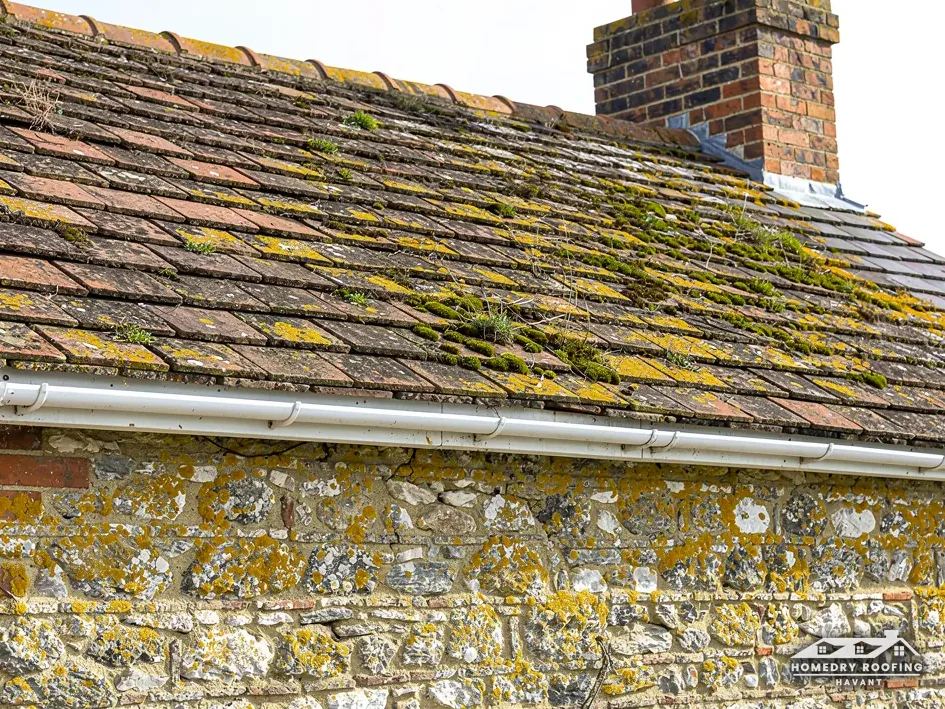
Moss on a tiled roof looks like a surface job, and the surface is the smaller part of it. The work is done on a sloping, fragile roof, above gutters that will take whatever falls, and sometimes above a nest. How the moss comes off decides what is left behind it, and what you can see of the roof afterwards. Each step is plain to follow.
This guide takes the job in the order it is done. It covers the checks made before anyone steps onto the slope, the hand removal itself, clearing what falls, the point at which a biocide comes in and what HSE says about its use, the look over the roof once it is bare, and the cost figures third parties publish.
It sits under our roof cleaning and moss removal pages. The rules cited are those for England, and the written price follows a survey of your own roof.
Checks made before the slope is touched
The first visit is made from the ground, and from the loft where it helps. It settles how the roof can be reached and what lies beneath the work, before any moss is moved.
- Access: whether a roof ladder reaches the slope safely, or whether a scaffold or a tower is the safer way up.
- The ground below: paths, glass, a conservatory roof, parked cars and planting that need covering or moving.
- The gutters and downpipes, since they will take the moss that falls.
- Loose, cracked or slipped tiles, noted before they are walked past.
- Any sign of a nest in the eaves, the ridge or the verge.
In HSE's guidance no roof is to be trusted to take a person's weight until someone competent has confirmed it. HSE also reports that almost one in five deaths in construction work involve roof work, and that many of those involved are just repairing and cleaning roofs. That is why the access is settled first, and why we do not ask you to climb up for a look.
Birds need the same care. Wild birds' nests are protected while a nest is in use or being built, and intentionally taking, damaging or destroying one is an offence. If one is found in that state, the work around it waits.
Any scaffold is part of the written quote, and where it stands on the highway we arrange it with our scaffolder.
Lifting the moss by hand
Hand removal is slow and close to the tile, which is the point. The moss is taken off the roof one patch at a time, with the roofer's eyes on the tile beneath.
- Loose and slipped tiles are made safe, so that nothing moves underfoot.
- Working from the top of the slope down, the moss is loosened from the tile with a scraper and a stiff brush, used with care for the surface. The brush stays soft enough not to scour the tile, and the surface is read as the moss comes away.
- Each patch is lifted away rather than dragged, so that it does not smear across a clean tile below.
- The valleys, the tiles beside the chimney and the laps between courses are done by hand, where moss packs in tightest.
- The slope is brushed down once more and the debris moved toward the gutter line.
Marley does not recommend high powered jet washes because they can damage the surface of the slate or tile and reduce its expected life considerably. A jet is not part of this method, and our guide to whether you should pressure wash roof tiles sets out the reasons in full.
The pace is set by the tile. A roof with loose moss on a sound covering goes steadily, and a roof where the moss has packed into the laps takes longer, because each lap is cleared with the hand and not with force.
Where a tile is already cracked, the scraper stays away from the crack and the tile is noted for the repair list, so that cleaning does not turn a hairline into a break.
Working down the slope sends the moss toward the gutter, so the gutter is part of the job.
Clearing what comes off
Moss that has been lifted still has to go somewhere, and on a roof the somewhere is the gutter. A clean slope above a blocked gutter has only moved the problem.
- Sheets or a trough go down on the ground and the lower roofs to catch the larger pieces.
- The gutters are cleared by hand as the work comes down, so that the debris does not wash into the downpipe.
- The downpipe's top and its first run are checked for a plug.
- Gutter joints, brackets and outlets are looked at while the gutter is open, since a gutter full of moss has been carrying extra weight.
- Paths, patios and flower beds are cleared and swept before we leave.
The roof is left clean, and so is the site. The moss goes into bags and leaves with us.
A gutter that has taken a slope's worth of moss gets a close look. Gutters are laid to fall towards the outlet, and Brett Martin advises a fall of 1 mm for every 600 mm. If moss has filled a run, the water has nowhere to go, and a gutter that holds water in one spot may be sagging on its brackets, which is a repair of its own and not a cleaning job.
The same attention applies to a flat porch roof or a garage roof that sits below the slope. Moss lands on them too, and it is cleared from them as well. The whole load is bagged and taken away, so nothing is left on the roof, in the gutter or on the ground.
Biocide, and what HSE asks of whoever applies it
Lifting the moss removes the growth. A biocide is a chemical treatment applied to the cleaned tiles, and it is a separate decision from the removal. It suits some roofs and not others, and we say which when we survey.
The law treats biocides as controlled products. HSE says a biocidal product must be authorised before it can be made available on the market, and that people who use biocides at work or at home carry the responsibility for using them correctly, so they do not cause harm to people, pets, the environment or wildlife.
Weather is part of the plan. A spray can drift on a windy day, so the visit moves if the conditions are wrong, and the neighbours' gardens are thought about as well as your own.
That sets the terms for the work:
- A product is chosen from those on the market and used as its label directs.
- People, pets and plants below the slope are protected while it is applied.
- Runoff is thought about before the work, with the downpipe and any drain in mind.
- The label is kept, so the product and its use are on record.
No product is named on this page, and none is described as approved by HSE. Whether a particular treatment suits your roof depends on the tile, the shade the slope sits in and what grows there, which only a survey can tell. Our answer on whether you need a biocide after moss removal goes into that decision, and the roof is treated only where the survey says it is worth it.
Looking over the roof once it is bare
A mossy roof is a covered roof. Once the growth is gone, every tile can be seen for the first time, and the condition of the covering is plain to read.
- Cracked or chipped tiles, and tiles that have slipped out of line.
- Ridge and hip tiles, and whether the pointing or the fixings are sound.
- Flashings at the chimney, the walls and the valleys.
- The state of the tile surface where the moss sat.
- The eaves, gutters, fascias and soffits beneath.
Photographs are taken before and after, from the same places where we can, so the change is plain to see. The written note lists each finding against the part of the roof it belongs to: the slope, the ridge, a flashing or a gutter.
Moss removal is cleaning, not repair. If it uncovers a fault, the fault is still there, and it is written up with a photograph so that you can see it for yourself. These checks overlap with a survey, and our guide to what a roofer checks once the moss has gone covers them in detail.
If something is found, a sound repair is preferred to a replacement, and the survey says which this is. A cracked tile is replaced, a slipped one is refixed, and a worn run of pointing is dealt with. Whatever is found goes into one total price after the survey, and you decide whether to go ahead. A roof that comes up clean and sound needs nothing more than the clean, and we put that in writing.
Cost figures from third parties
A cleaning price depends on the method, roof size, access and what the survey finds. Third-party figures set the scale. They describe other people's jobs and are not a quote for yours.
| Item | As published |
|---|---|
| Cleaning a roof, all methods | "typically range from £8 to £25 per m², depending on the method used" |
| Moss removal and biocide | £8 to £15 per m² |
| Moss removal and biocide, semi-detached | £400 to £600, listed as the average cost |
MyJobQuote's page was last updated on 07/09/26, and it gives no VAT basis, so ask any roofer whether VAT is in the figure. The per-m² figure is not multiplied up here, because the area of a roof is only known after a survey, and two roofs of one size can need different amounts of work.
Our price is one written total, given after we have looked at the roof. Access and scaffold sit inside it, and so do the gutters. A flat section, a conservatory or a long run of gutter below the slope adds work, and the survey counts it before the price is written. The row to compare with a quote is moss removal with biocide, a hand method, and not the figure for any other way of cleaning. Whoever quotes, ask for the method to be named in writing, so that two quotes describe the same job.