
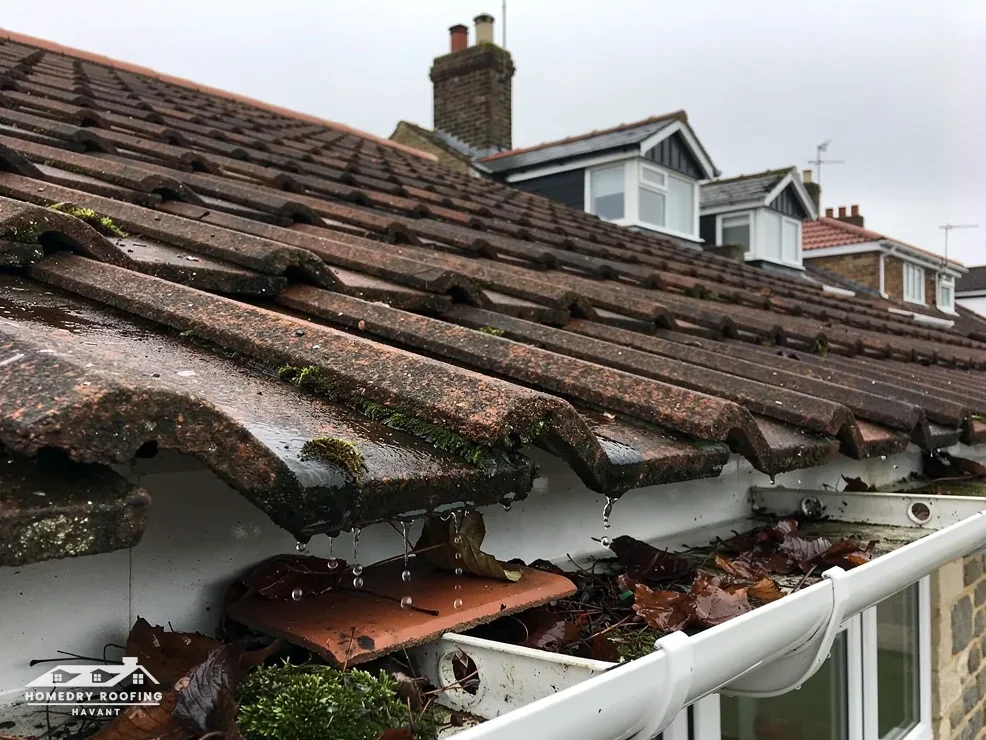
Where moss does its work on a tiled roof
A tile is meant to shed rain. Moss interferes with that where it gathers, and it gathers in particular places:
- The laps, where one tile overlaps the next and a cushion can root.
- The valleys, where two slopes meet and carry a heavy share of the run-off.
- The foot of a slope, above the gutter, where drips and damp linger.
- Around a chimney or roof window, where a scraper cannot reach easily.
In each place the reasoning is the same. A thick mat holds wet against the tile and slows the water on its way to the gutter. That is a roofer's reading of how a roof sheds water and not a measured rate, which is why a dense patch in a valley gets more attention than a thin film on an open slope.
Moss also drops into gutters as pieces come away, and a gutter full of moss is a second problem below the first one, with its own repair if the run has been left to hold water. Our post on moss in your gutters follows it down from the roof edge.
What a mat of moss hides
The more serious trouble with a thick mat is what you cannot see. Growth covers the face of a tile, and a covering of green can sit over a crack, a chip or a slipped tile without any sign from the ground. It can also hide a mortar joint at the ridge that has begun to fail, or the edge of a flashing where lead meets the tile.
That has a consequence for the work. When the moss is lifted, a gap that was covered the day before may be open, and a tile that looked sound may break. A roofer who has looked first is not caught out by either, and tells you what was found. If a tile breaks, or has already broken beneath the growth, it is replaced.
It also explains why a roofer looks over the tiles once the roof is bare, and why that look is worth asking about when you compare quotes. Our guide to what a roofer checks after moss removal sets out that look, course by course, and why a clean roof is not the same as a checked one. A thick mat is a reason to survey, whatever else it does.
Is it worth removing moss?
The answer depends on the roof. These tests help you weigh it:
- What is the thickness of the growth, and does it sit in the laps and valleys or only as a film?
- Is moss dropping into the gutters, or are they running clear?
- Is the covering underneath sound, or showing cracks and slipped tiles?
- Does the look of the roof matter to you, as well as how it works?
Thick growth in the laps with moss in the gutters is a good reason to clear the roof. Light moss on a sound covering with gutters that run freely may be left for now, and nobody should press you either way. If the tiles are close to the end of their working life, a clean spends your money in the wrong place, and the roofer should tell you so before you commit. Your own view counts too: if the look of the roof bothers you, that is a fair reason on its own. A roofer's part is to say plainly which of these tests your roof meets, and to leave the decision with you.
Our post asking whether roof cleaning is worth it goes through the question in more depth, including what a clean cannot do for a tired roof.
How the method decides what is left
The method of cleaning can harm a tile in its own right. Marley's page on cleaning says "The use of high powered jet washes is not recommended", and gives its reason: "thus reducing its expected life considerably". A tile with its face stripped has lost something the moss never touched, and no amount of tidy colour makes that good again. Ask a roofer to name the method before the work, in writing, so the choice is yours.
Hand removal works the other way. The roofer lifts the growth with scrapers and a soft brush, one patch at a time, and reads the tile beneath. It takes longer than a jet, and the tile keeps its face, which is the point of doing it that way. The extra time buys a tile that is still whole afterwards.
Our roof cleaning page describes the whole job. Start with a survey. The written figure that follows settles the method and the cost before anyone steps onto the slope, and you can compare both with another roofer's.