
What can still be checked from outside
Foam sprayed to the underside of a roof changes nothing about the weather side, so the outer roof is inspected as it would be on any house. The covering, the ridge and hips, the valleys, the flashings and the gutters are all in view from a ladder, from the ground or by camera.
- Tiles or slates that are cracked, displaced or absent.
- Ridge and hip pieces, and the joints under them.
- Flashings around the chimney, roof windows and walls.
- Valleys, the channels where two slopes join.
- Gutters, downpipes and the fascia boards behind them.
This matters since a fault in the covering stays a route for rain, foam or no foam. A displaced tile or a peeled-back flashing lets rain in to the layer beneath, whatever is fixed under the rafters. An outside check is therefore as worthwhile on a foamed roof as on any other, and its findings go into the written report with photographs.
Those photographs matter more on a foamed roof. If the underside cannot be examined, a dated picture of each outside finding gives the owner, and anyone who reads the report later, the clearest record of how the roof stood on the day.
What the foam hides
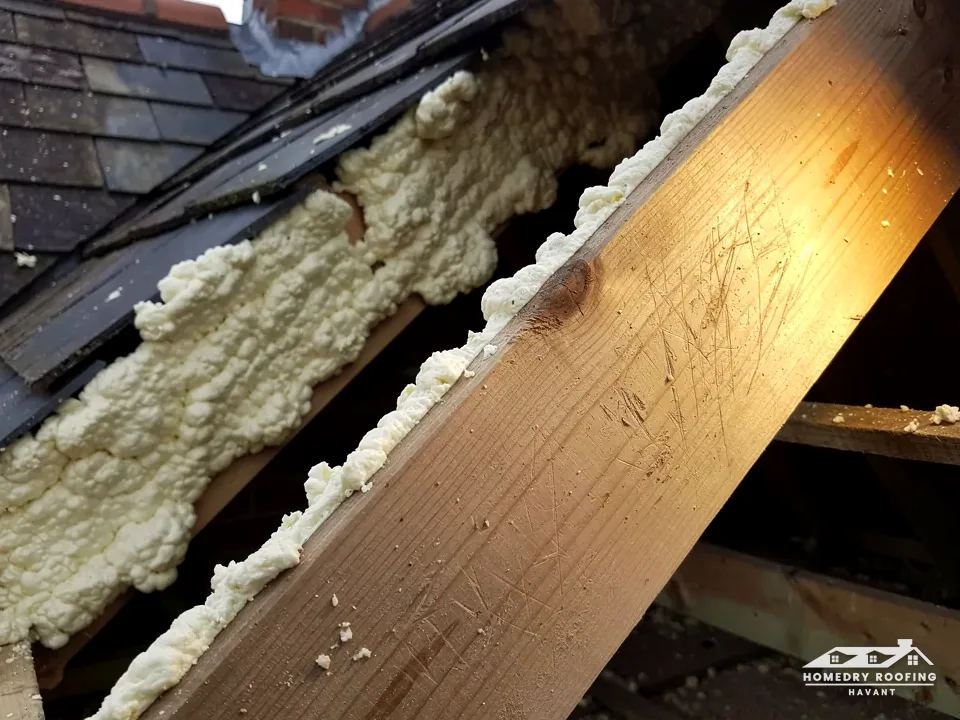
In the loft, an inspector sees the surface of the foam and not the roof structure behind it. RICS's guide to spray foam insulation puts it plainly: "If the timber roof structure is covered with spray foam it cannot be fully seen or inspected." A roofer would normally look at the rafters, the battens and the felt's underside for damp, rot and old leaks, and with foam over them nobody can.
The Energy Saving Trust explains why that is a concern. It names closed-cell and open-cell foam as the main two, and says "spraying foam directly to the underside of the roof will partially seal the timber." On the rot risk it says "this risk should be much lower with an open-cell foam." Much lower is not the same as none, and the type of foam matters to the answer.
A report can describe only what the foam surface shows. A reader should take the words "not visible" at face value, as a limit of the inspection and not as a reassurance about the timber.
So an inspection report on a foamed roof states what was seen, and states just as clearly which parts could not be seen.
Why a lender or buyer may ask
A roof that cannot be fully inspected is a question for anyone relying on it. Whoever relies on the roof, whether buyer, surveyor or lender, may want evidence that the timber is sound, and a report that says "not visible" does not supply it.
RICS reported in March 2023 that there has been concern within specific sectors of the lending market, such as equity release mortgages. Its guide advises owners to "check with your mortgage provider whether their lender policy allows the installation of such products." The Energy Saving Trust says that "there should be less of an issue with getting a mortgage for homes that have had spray foam insulation installed correctly."
Both lines point the same way: ask your lender before any spray foam work, and keep the paperwork if you already have it. A dated inspection report of the outside of the roof and the visible loft gives a buyer or lender something to read, but it cannot stand in for the hidden timber. Our guide to what a roof condition report covers shows how the unseen parts are recorded.
Options when the timber has to be seen
If a sale, a mortgage or a damp problem makes the hidden timber matter, the foam has to come off at least in part so the structure can be looked at. The Energy Saving Trust is blunt about the consequence: spray foam "is considered a permanent installation. If you decide to remove it at a later stage then you might also need to replace the structure it was applied to."
That is a decision for a surveyor and the owner, made with the facts about the particular roof. Before taking it, set out what is known:
- Get the outside of the roof inspected, so faults in the covering are found and recorded.
- Ask the report to describe the foam that is visible, and which parts of the structure stay covered.
- Check with your mortgage provider before any further work is done.
- Only then ask for a view on removal.
Removal is a job in its own right, with its own cost and waste, and our spray foam pages deal with it. Whichever route is chosen, an outside inspection stays useful, because the covering is where the rain arrives first.
Our spray foam insulation removal pages cover that route. For the inspection itself, see our roof inspections page.