
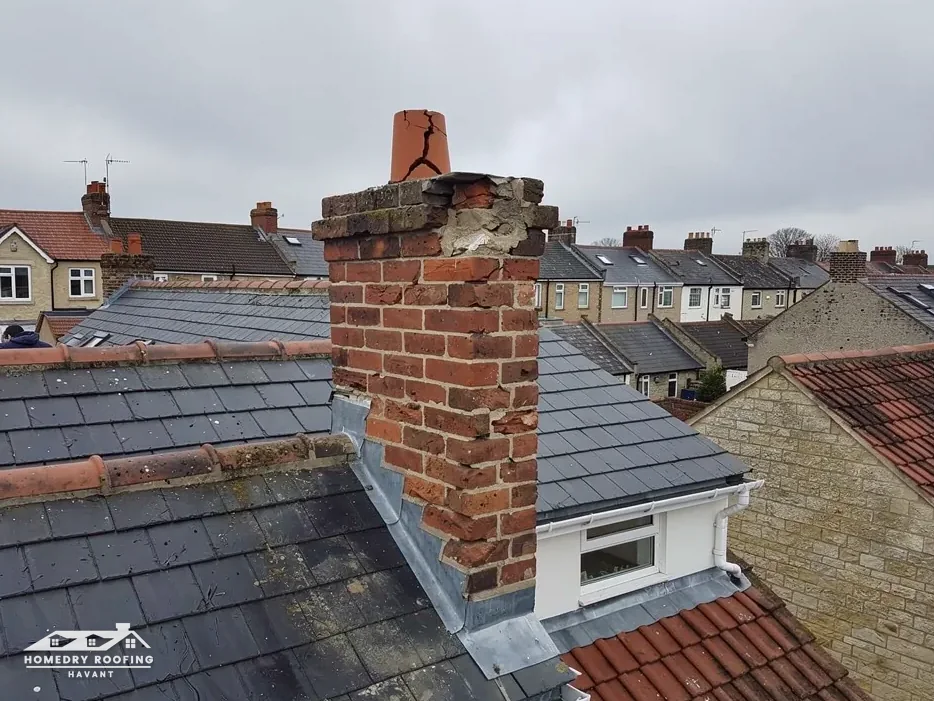
Where a chimney's brickwork rises through the slope, the join between the two is a place where rain gets a chance to slip past the covering. Lead flashing is the set of metal pieces dressed over that join. When it fails, the damp often appears some distance from the chimney, on a ceiling or on the chimney breast inside the house.
This guide follows the lead from the outside in. It names each part of the flashing, shows how a leak is traced back to the metal, lists the ways the lead lets rain past, and sets out when a repair is enough and when the lead is renewed. It then covers lead sheet codes, how long lead can last, what third-party guides report for cost, and the rules that can apply around a stack.
The brickwork and the mortar cap above the flashing are covered on our chimney repairs page. Here the subject is the lead.
How the lead is laid around a stack
A flashing is not one piece of lead. It is a set of separate pieces, each shaped for one side of the stack and each doing its own job, and they lap over one another so that rain is always passed down and outward.
| Part | Where it sits | What it does |
|---|---|---|
| Apron | Across the face pointing down the slope | Carries rain from the brickwork onto the covering |
| Step flashings | Up each side, tucked into the joints | Follow the slope up the brickwork |
| Soakers | Under the tiles or slates beside the stack | Pass rain from the side flashing onto the covering |
| Back gutter | Behind the stack, on the high side | Collects rain and sends it around the stack |
The lead is held in two places. At the brickwork it is tucked into a raked-out joint and held there by mortar. At the roof covering it laps over the tiles or slates by enough to shed rain. If either end loosens, water can run behind the metal instead of over it.
Lead suits this job because it can be dressed by hand to the shape of the brick and the tile. That is also why the work takes a trained hand: each piece is cut and bent on the roof to the stack in front of the roofer, not made in advance to a pattern.
When we survey a stack, each of those four parts is checked on its own, because a sound apron does not make up for a back gutter that has failed.
Tracing a stain back to the lead
Damp inside the house marks where the water arrived, and the way in can be some distance from it. Rain that passes the lead can run along a rafter, across the back of a ceiling or down inside the breast before it shows, so the first job is to follow it back up.
- Note the room, the wall and the position of the stain, and whether the damp is on the breast itself or on a ceiling beside it.
- From the loft, follow the wet timber or the stained underlay up towards the stack.
- On the outside, look at each part of the flashing in turn: the apron, both sides, the back gutter and the covering next to them.
- Rule out the other routes into a stack, such as a cracked mortar cap, a worn joint or a slipped tile, before blaming the lead.
It also helps to note when the damp appears. A stain that shows only after heavy rain, or only with the wind in one direction, points us towards one face of the stack. A dated photograph of the stain, and one of the stack taken from a window or from across the road, is useful before the visit.
Please stay off the roof to look. The slope beside a stack gives little room to stand, and the fault is easier to read from a safe place. Photographs can reach us by WhatsApp or with the quote form, and we plan the survey around them.
The stain on the ceiling is where the rain arrived. The fault is higher up, at the stack.
How the lead fails and what the repair is
The lead can let rain past in several ways, and one stack often has more than one fault at the same time.
How the lead fails
- Mortar has dropped out of a joint, so a step flashing has pulled away from the brickwork.
- Lead has split along a fold or a bend where it has moved.
- An apron or a step no longer laps far enough down the slope to throw rain clear.
- The back gutter has filled with leaves and moss and spills over its edge.
- A tile or slate beside the stack has slipped, and rain runs in under the soaker.
- An old patch in mastic or tape covers the real fault.
What the repair is
Where a repair will hold, we recommend it and give you the reasons. A loose joint holding sound lead gets its mortar raked out and renewed. Lifted lead that has kept its thickness can be dressed back into place. A split step or a worn back gutter can be replaced in sections. Lead that is split, thin or patched all the way round is renewed as a whole flashing, because a new section lapped to old metal leaves the old weakness in the roof.
If the brickwork joints and the mortar cap need work as well, it makes sense to do the lead in the same visit. Our guide to chimney repointing and flaunching explains those two jobs.
Lead codes and how long lead can last
Lead sheet is made in numbered codes, and each code is a thickness. Royston Lead's cast lead brochure lists codes 3 to 8, with colours, thicknesses and the details each one suits. The four that matter for a stack are in this table.
| Code and colour | Thickness | Weight | Listed for |
|---|---|---|---|
| Code 3, green | 1.32 mm | 14.97 kg/m² | Soakers only |
| Code 4, blue | 1.80 mm | 20.41 kg/m² | Soakers, flashings, pitched valley gutters, dormers |
| Code 5, red | 2.24 mm | 25.40 kg/m² | Flashings, valley gutters, parapet and box gutters, dormers |
| Code 6, black | 2.65 mm | 30.05 kg/m² | Flashings, valley gutters, parapet and box gutters, dormers |
The brochure marks code 3 "Recommended for lead soakers only", so we do not cut a flashing from it. Codes 4, 5 and 6 are listed for flashings. No single code serves a whole stack. Each detail is specified in its own right and given the thickness it needs, and the weight rises with each code, from 14.97 kg/m² for code 3 to 30.05 kg/m² for code 6.
On lifespan, MyJobQuote says "Lead flashing that is correctly installed can last for over 80 years". The hedge and the word correctly both matter. The figure describes a flashing that is fixed well, and a good flashing can still be let down by mortar or a covering around it that has not held.
Access, and what third-party guides report for cost
How we reach the lead depends on the stack. A low one may be reached from a roof ladder, while a tall one on a steep slope needs scaffold around it. The scaffold is built into the written quote, and if it must stand on the highway we arrange the licence with our scaffolder.
Third-party guides give a sense of scale. They are not our prices: the written quote that follows a survey gives one total for your own stack.
| Guide | Job | As published |
|---|---|---|
| MyJobQuote | Chimney lead flashing patch repair | "typically costs around £200" |
| MyJobQuote | Full replacement | "averages around £570" |
MyJobQuote's lead guide, updated in September 2026, also gives a wider range for a full leadwork replacement, "between £350 and £920, depending largely on whether scaffolding is required". Checkatrade's repair table, updated June 2026, lists lead flashing repairs at £50 to £70 per metre, excluding VAT and access equipment. A per-metre repair rate is not a price for a stack, because the length of lead involved is only known once the stack has been surveyed.
Which job yours is cannot be told from the ground. A patch repair suits lead that is sound apart from one fault, and a full replacement is the job when the metal has split, thinned or been patched all round. Whoever quotes, check that the written price says whether scaffold and VAT are included, so two quotes can be compared like for like.
Permissions, nests and bats around a stack
Repairing lead is not rebuilding a stack, but a few rules still sit around chimney work.
- Listed houses and conservation areas: we check with the council before work starts. Under the permitted development rules for roofs, altering or replacing a chimney is outside the right that covers a re-roof, and our planning guide for roof work shows where the lines fall.
- Portsmouth: Article 4 directions in Old Portsmouth, the Castle Road conservation area, Campbell Road and other areas list chimney stacks among the items needing permission to remove or alter, at the numbered addresses they name only.
- Langstone, in Havant: the council's leaflet lists chimney, flue and waste pipe work among the alterations its direction covers, on elevations that face the public. At Homewell, Havant Borough Council is the body to ask. Our answer on chimneys in conservation areas goes further.
- Nests and roosts: knowingly taking, damaging or destroying a wild bird's nest while it is in use or being built is an offence, and damaging or destroying a bat roost is an offence whatever the intent.
- Removal: the Planning Portal says "Building regulations approval will always apply when removing chimney breasts as they are part of the building's structure." A breast on a party wall brings in the Party Wall etc. Act 1996 as well, which our answer on a party wall and a chimney breast explains.
None of these rules stops lead being repaired. They shape how the job is done on certain houses, and we check each one at the survey so that the written price reflects it.