
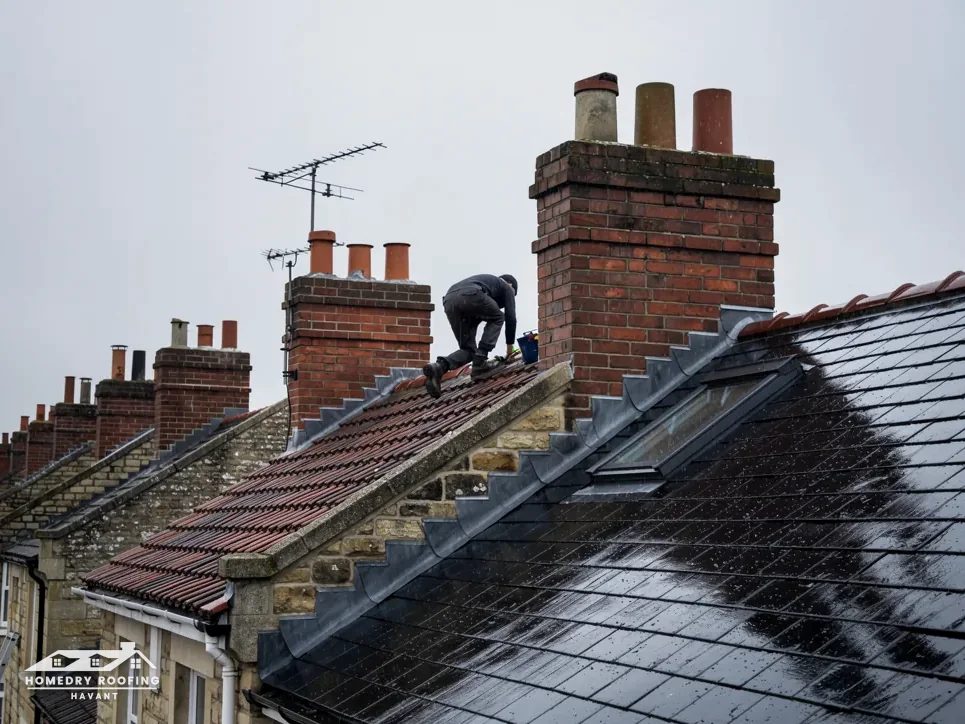
Two maintenance jobs on a chimney get mixed up because both use mortar and both are done from the top of the stack. They do different things. Flaunching is the mortar cap at the very top, packed around the base of the pots. Pointing is the mortar between the bricks, all the way down the stack.
A stack is exposed to the weather on every side, so each face has joints that can wear and the cap has to cope with whatever falls on it. Mortar that has cracked, shrunk back or crumbled gives rain a way into the brickwork and the flue, and from there into the house. Maintenance means putting that mortar right while the bricks beneath it are still sound, which asks far less of the stack than a rebuild.
The sections below say what each job involves, how the work is done, how to spot trouble from the ground, and where maintenance stops being the right answer. The lead around the base of the stack is a third part of the same route and has a guide of its own.
What flaunching does and what pointing does
Both jobs keep rain out, but they work on different parts of the stack and fail in different ways.
| Job | Where it is | What it does | Sign of trouble |
|---|---|---|---|
| Flaunching | Cap at the top, around each pot | Holds the pots and gives rain a slope to leave by | Cracks, hollow patches, gaps at a pot's base |
| Pointing | Joints between bricks, on every face | Closes the gaps between bricks to the weather | Mortar worn back, loose or missing |
The two are done together often enough that people treat them as one job, and sometimes that is sensible, because the access is already in place. They are still separate repairs with separate causes. A cap can be sound while the joints below it have worn back, and sound joints can sit under a cap that has split.
Neither job is a rebuild. Each keeps the stack you have, with its bricks, its height and its pots, and renews only the mortar that has done its work. Where that is enough, it is the job we recommend.
Which job comes first depends on the evidence. Loose pots and mortar fragments at the base point to the cap. Rain staining that follows the joints down a face points to the pointing. A stack in poor order can need both, and the order of the two is settled at the survey, once the cap and each face have been seen up close.
Cap and joints are separate repairs, and the survey decides which of them this stack needs.
Reading the stack from the ground and the loft
A good deal can be seen without going near the roof. Stand back from the house, or look from an upstairs window, and compare the stack with your memory of how it looked.
- Lumps of mortar lying on the tiles, caught in the gutter or fallen into the fireplace.
- A pot that leans, or that looks as though it sits loose in its cap.
- Joints that have gone dark and deep, so that each brick seems to stand in a shadow.
- Brick faces that are flaking or have lost their surface.
- Stains on a bedroom or living room wall that holds the breast, or up on the ceiling next to it.
Damp indoors does not tell you which part of the stack is at fault. It can come from the cap, from the joints or from the metal flashing at the point where the stack joins the slope, and our guide to chimney flashing leaks shows how that last route is traced. Sound mortar above and below an open joint is not a reason to leave the joint alone, because rain only needs one gap.
Please leave the mortar-testing to us. A dated photo taken from the street or an upstairs room is enough to plan the visit; send it with the quote form or on WhatsApp. The check that counts is the survey, when the whole cap and each face are looked at close up.
Birds can also drop twigs and debris down a flue, so a heap of sticks in the fireplace is worth mentioning. Make a note of which room the damp is in and which way that wall faces. It helps us decide which face of the stack to look at first.
How repointing is done
Repointing is done joint by joint. The order of the work matters, because new mortar only holds if it goes into a clean, sound joint.
- Access is set up around the stack, by ladder or by scaffold.
- The worn mortar is raked out of each joint to a depth where it is firm.
- Dust and loose fragments are brushed out so the new mortar can bond.
- New mortar is packed in, filling each joint fully.
- The finish is shaped to sit with the brickwork around it, and debris is cleared away.
The mortar is chosen to suit the brick it sits beside, and the survey notes any earlier patches in a different mortar and the state of the brick faces around them.
We check every face of the stack, because the face you can see from the garden tells you little about the face turned to the road. If one face has worn more than the rest, that face can be repointed alone while the access is up and the others are sound. Repointing preserves bricks that are still good, and it cannot bring back ones that have gone, which is where the later question of a rebuild begins.
Where an earlier repair used a different mortar, we point it out and show how the surrounding joints look, so the reason for any extra raking out is clear.
Time spent on preparation decides how long the work holds, because mortar packed into a dusty or crumbling joint soon loosens again.
How flaunching is renewed
Flaunching sits at the top of the stack, where nothing shelters it and where the pots depend on it for their hold. Renewing it means looking at the pots as well as the mortar.
The pots are tested first, to see how firmly each one is bedded. Where the cap is cracked and hollow, or where a pot is loose, the old mortar is cleared. The pots are lifted off, and their seating is cleaned. They are then reset on a new bed of mortar, and the new cap is formed around each one.
The shape of the new cap does a lot to keep the stack dry:
- It slopes away from every pot towards the edge, so rain runs off instead of lying.
- It is laid up to the pot and finished tight against it, with no gap at the base.
- It covers the top of the stack, which protects the top layer from the weather.
A thin skim over cracked mortar is not renewal. The crack stays under it and works through. A cracked pot is a separate matter and is replaced as a pot. If any flue is left open under the cap, the pot needs a cowl or a cap of its own, which we talk through at the survey.
Each pot is checked for cracks as it comes off, since a pot that looks fine from below can be damaged at its base.
When maintenance is not enough
Maintenance fits a stack whose bricks are in good order. It no longer fits in a few clear cases:
- Brick faces have flaked away, so there is nothing firm to repoint into.
- Cracks run through several courses of brick, not along a single joint.
- The stack leans or has shifted from its original line. Our answer on a leaning chimney stack explains what to do.
In those cases the stack is taken down to sound brickwork and built back up, keeping whatever bricks are still good. A rebuild brings new flaunching and new lead where the stack meets the roof, and it keeps the height and detailing of the original unless you ask for something different and the rules allow it.
Taking a stack down, or removing the chimney breast inside, is different again. The Planning Portal says "Building regulations approval will always apply when removing chimney breasts as they are part of the building's structure." Birds and bats are covered by the law as well. Intentionally destroying a nest that is in use or being built is an offence, and so is damaging or destroying a bat roost, whatever the intent. Our answer on birds nesting in a chimney covers what to do if you hear them.
A rebuild is priced after the survey like any other chimney job. The survey records which bricks can stay, and that record is what separates a repair from a rebuild.
Access, rules and the written price
Reaching the cap and the upper courses means a roof ladder or scaffold, depending on how tall the stack is and where it sits in the slope. We include scaffold in the written quote, and a scaffold on the pavement or road needs a licence, so we arrange the licence with our scaffolder.
Chimney repointing is priced after a survey, because the cost depends on how much of the stack needs work and how it is reached. The quote is one written total price, and work starts only once you have agreed it. Ask any roofer whether the price quoted includes the scaffold and the VAT.
Several rules touch chimney work:
- Listed houses and conservation areas call for a word with the council first. Our planning guide for roof work and permission sets out the position, and an Article 4 direction can remove further permitted development rights.
- The permitted development right that covers re-roofing does not extend to altering or replacing a chimney, so a rebuild that changes the stack is a planning question.
- If you sign at home after our survey, you have 14 days to cancel, and work starts sooner only if you ask in writing.
When the survey is done we say whether the stack needs repointing, new flaunching, both or a rebuild, and why, and in what order the work would run. The full list of chimney work is on our chimney repairs page.