
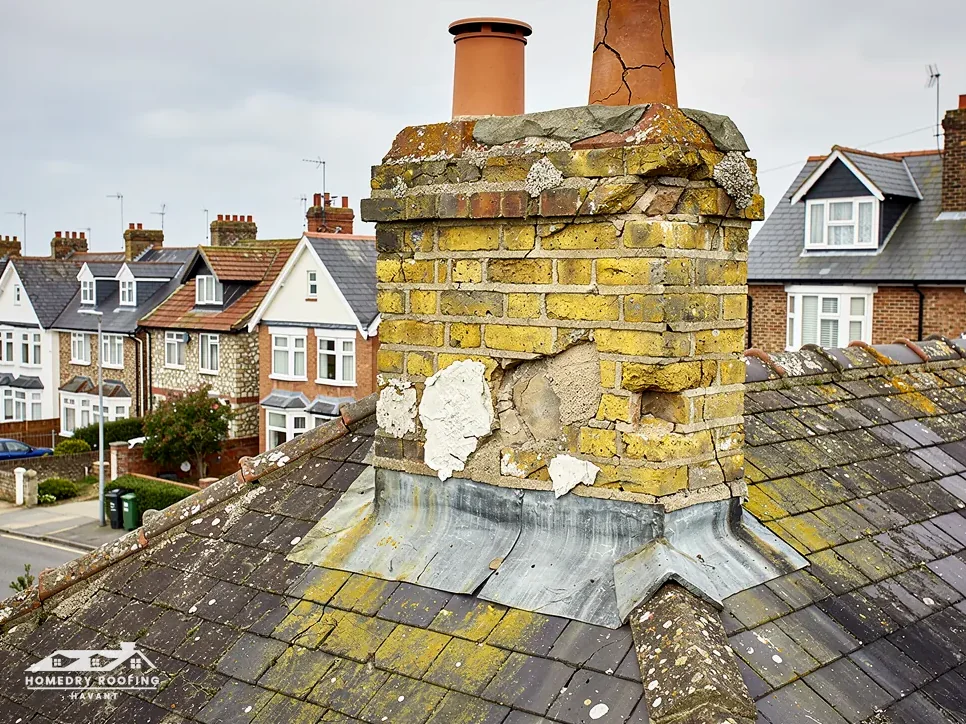
Why a lean matters
A stack is a column of brick and mortar rising through the roof, and it is built to stand straight. A lean means that something has moved: the joints, the bedding at the base, or what lies beneath it. From the ground, nobody can tell whether that movement is old and settled or new and still going.
That is the reason for caution. A stack that looks only slightly out of line can still be shedding brick or mortar, and what falls does so from the highest point of the house, onto a path, a garden or a parked car. The danger is to whoever is standing underneath, and it is not tied to how bad the lean looks.
There is also a second concern, which is the weather. Gaps that open as a stack moves can let rain into the brickwork and the flue, so a lean and a damp patch on the breast inside can turn out to share a cause. Our answer on damp on a chimney breast follows that trail.
Either way, the first step is the same: work out what is safe, then get a survey. A stack that has leaned for years may be perfectly settled, but only someone on the roof can say so.
What to do straight away
Each of these is safe to do on the ground or indoors:
- Move people, pets and any parked car out of the pavement, path or garden beneath the stack.
- Do not go onto the roof, and do not try to push, prop or pull at the stack.
- Take photographs from the ground, from two or three angles, with the stack against the sky.
- Tell your household and any neighbours who share the space beneath it.
- Note any fresh debris on the ground, and where it landed.
- Keep the room beside the chimney breast clear if the ceiling or wall there is cracked or bulging.
None of these steps is a repair, and none replaces a survey. They keep people safe while the survey is arranged.
If bricks are falling, or the stack looks about to come down, treat it as an emergency and keep everyone well back. Our hub for emergency roof repairs covers what counts as one, and our guide to loose tiles or a chimney after a storm goes through the same ground rules after bad weather.
If the lean follows a storm, the insurer should hear first, as the next section explains.
What a survey looks for
A roofer working from a safe position on the roof goes through the stack from the top down, because the cause of a lean is in the structure and not just the look of it:
- The joints between bricks: is the mortar open, crumbling or missing?
- The flaunching and the pot at the top, which can be loose or split.
- The lead round the base of the stack, and whether rain has been getting in beside it.
- The bedding where the stack meets the roof, and the timbers around it.
- Whether the lean is in the stack itself or comes from below it.
The survey leads to a choice between three routes: repair where the brickwork is sound, a rebuild of part or all of the stack, or taking it down below the roof and closing the slope. We lay out which route fits and why before you decide anything.
Once the survey is done, you receive a single written total. Our guide to chimney repointing and flaunching covers repairs to a stack that can stay.
Who to tell, and what else to check
If the damage follows a storm, tell your insurer first. The Financial Ombudsman Service says that to judge a claim, "we'll usually look at expert reports and photos", so take pictures of the stack and the debris before anything is cleared away. A temporary make-safe is sensible, and the receipt for it is worth keeping.
If the breast below the stack is on a wall you share, talk to your neighbour early. Cutting away part of a chimney breast on a party wall brings in the Party Wall etc. Act 1996, and the building owner must serve a notice at least two months ahead of that kind of work. Our answer on a party wall and a chimney breast gives the detail.
A listed building, or a house inside a conservation area, may need consent before a stack is altered or taken down, and the council is the body to confirm which. We put that question to the council ourselves, and report what it says.
All our chimney answers start from the chimney repairs page.