
Why approval always applies to a breast
The Planning Portal's guidance on removing chimney breasts is blunt. The sentence is quoted in full at the top of the page, and the word that matters in it is "always". There is no size of breast, and no way of doing the work, that takes it outside the Building Regulations.
The reason given is the one that makes it a building matter and not a decorating one. A chimney breast is part of the structure, so taking it out changes how the house carries its loads. A tidy finish and a clean opening are what you see afterwards. What building control checks is what the house is left standing on afterwards, and what carries the weight above the gap.
The Portal sets the rule out on its page about permission to remove chimney breasts. The same page also points to a party wall notice when the breast is on a party wall, which has its own answer further down.
This page is about the approval itself, since the cost is a separate subject with its own published averages. For those, see our answer on the cost to remove a chimney stack.
Why the stack above is part of the question
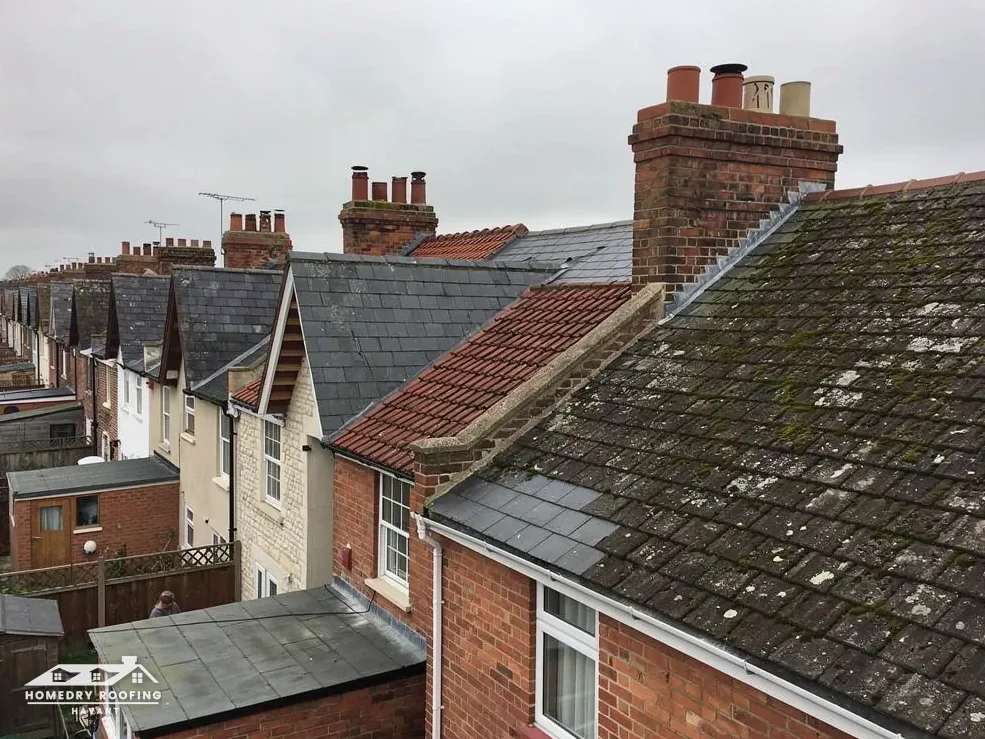
A breast and the stack above it are one structure seen from two sides: the inside part in the rooms, the outside part above the roof. If you are planning the work for a loft conversion or a new layout, the same two questions come first. Taking out the lower part leaves the upper part with a decision to make. Either the stack comes down as well, or something new has to carry it.
That is why we ask two things when a removal is mentioned:
- Is the stack above the roof coming down too?
- If it stays, what is going to hold it up?
If the stack comes down, the roof has to be closed across the gap with covering that matches the slope around it. If it stays, building control will want to know how it is supported. Either way, we talk the options through with you when we survey, ahead of any price, and the answer decides who does what.
It also decides how long the job takes to organise. Approval and notices are settled first, then scaffold goes up, and only then does the first brick come out.
Who gives the approval
Building control is carried out by the council's building control team or by a registered building control approver. Private approvers must be registered with the Building Safety Regulator, whose registration regulations came into force on 6 April 2024, so you can choose either route.
The first step is the same for both: tell your building control body what you plan, before work starts. In Havant, we confirm the building regulations route with your building control body before work starts. For an address elsewhere, we put the same question to whichever team covers it.
Planning is a separate matter. A stack taken down above the roof changes the roofline, so ask the council whether planning permission is needed as well, because approval under the Building Regulations does not answer that question.
A listed house needs listed building consent where the work reaches the home's special character, and a conservation area can bring an Article 4 direction. Those checks sit in the next section, and our answer on chimneys in conservation areas goes further.
The order of the steps
Put in order, a removal runs like this:
- Survey of the breast, the stack and the roof around it.
- Confirm the building regulations route with your building control body.
- Check for listed status, and for a conservation area with an Article 4 direction.
- A breast on a shared wall brings in a party wall notice, which the building owner serves at least two months ahead of the start. Our answer on a party wall and a chimney breast gives the detail.
- Scaffold, with the licence arranged by us through our scaffolder if it stands on the highway.
- The removal, then the roof closed across any gap.
None of this is something to hurry. The weeks taken by the notice and the approval are why a start date is only fixed when the survey has been completed.
All of our chimney answers start from the chimney repairs page, and your written price is one total, given when the survey has been done. Ask us if you want the order explained for your house.