
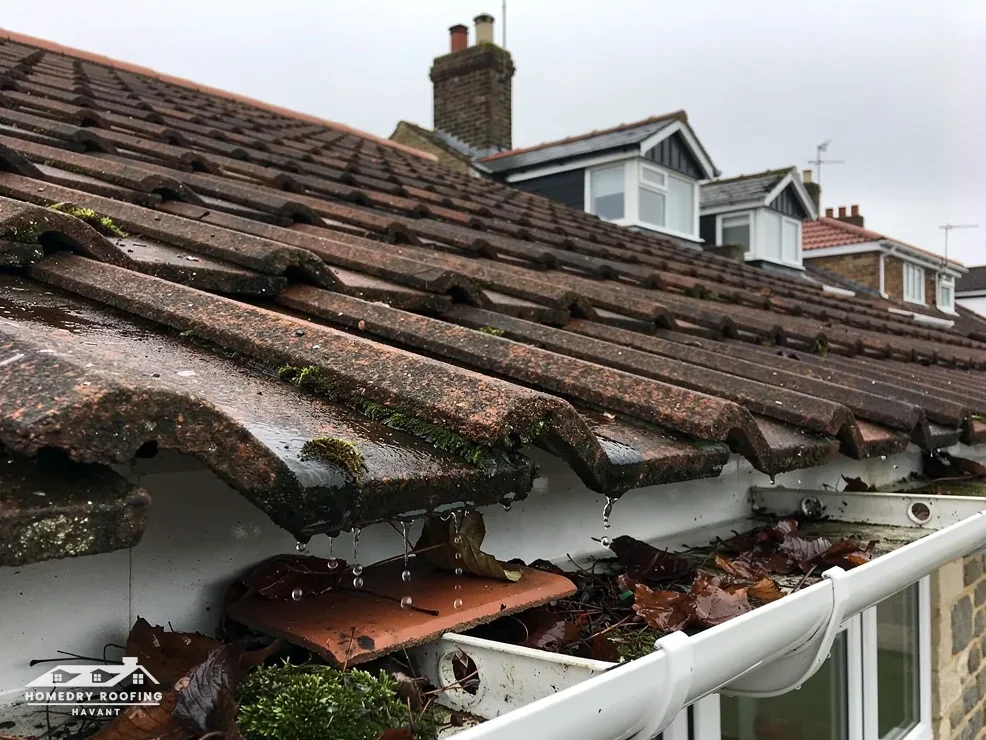
Clues in the timing and the place
Start with a notebook rather than a ladder. Each time damp appears, write down the date, what the sky had done in the previous day and where on the ceiling or wall the mark sits. Three or four entries start to show a pattern. The table sets the clues side by side, and no single row is proof.
| What you notice | Points towards |
|---|---|
| Wet only after rain or wind-driven rain | A leak in the covering or a flashing |
| Wet on dry, cold mornings | Condensation |
| One damp patch that grows after a storm | A leak near that spot, or uphill of it |
| Black spotting in corners and behind furniture | Condensation and poor air movement |
| Beads or drips on the underside of the felt | Condensation in the loft |
Treat the table as a list of questions to ask. A house can have both problems together, and a leak that has soaked the insulation can leave the loft damp for days after the rain has stopped, which muddles the diary. Mention both in your notes if you suspect it.
What makes moisture settle in a loft
Cooking, washing and breathing put moisture into warm air. When that air drifts up into a loft and meets a cold surface, the moisture turns back to liquid. A cold roof keeps its insulation along the ceiling, so the loft above stays close to the outdoor temperature, and the underside of the roof covering is exactly that cold surface.
A roof is therefore built to let air through. Marley, the tile maker, gives eaves ventilation for roofs laid with high-resistance (HR) underlay, a felt that does not pass vapour: "25mm along the length of the eaves for pitches of 15° or less; 10mm along the length of the eaves for pitches of more than 15°." For an underlay that lets air through, sitting over a tightly sealed ceiling, it says "fortuitous ventilation at the eaves via normal eaves construction (3mm) is all that is required, provided the requirements of UKAS Third Party certification are fully met."
Those figures follow BS 5250, which BSI lists as a code of practice on managing moisture in buildings, and they describe how a roof is built, not how yours is. Insulation pushed hard into the eaves, a blocked vent or a bathroom fan that vents into the loft each change the picture, so a survey checks the ventilation as well as the covering.
Looking from the hatch, and staying safe
You can learn a good deal without leaving the loft hatch. Use a torch and check four things:
- whether the underside of the felt or boarding looks dark, beaded or dripping;
- whether the insulation is wet, flattened or stained in one patch;
- whether the eaves vents can be seen, are open and are clear of insulation;
- whether a pipe, fan duct or chimney passes through with a gap round it.
Stand on the hatch ladder and lean in. Ceiling boards between the joists will not carry you, and a misplaced foot can go through into the room below. Keep off the roof outside too. HSE's advice is that "all roofs should be treated as fragile until a competent person has confirmed they are not." Binoculars from the garden show a good deal without a ladder.
Photographs help a survey. A clear picture of the damp patch, the matching place in the loft and the eaves is worth more than a long description, and you can send them on WhatsApp or through the quote form before a visit is booked.
When it needs a roofer, and what it may cost
Call a roofer if the damp returns after rain, if a patch grows or if a stain sits under a chimney, a valley or a wall junction, because covering and flashings meet at those places. If the clues point to condensation, the cure is about air: clearing the eaves vents, taking extractor fans outside and keeping moisture down in the house. That may not be roofing work at all, and the survey will say so.
We trace where the water runs and say whether the job is a small repair or something larger. You receive a single written price after the survey, never before it.
For scale, here are published figures, none of them ours. MyJobQuote gives around £650 as the average roof repair cost in 2026, with no VAT basis stated. Which? gives £75 to £400 for one to six broken or missing standard tiles, with VAT left out, in a November 2025 survey of its Trusted Traders. See also our answers on finding a roof leak and on leaks that appear only in heavy rain, or the roof repairs page.