
Why only some storms get through
On a calm day, rain runs down the slope and off the roof by the route the roof was designed for. Wind changes that in two ways. It drives rain at an angle, so water reaches places a vertical shower never touches, and it can push water upslope beneath the edge of a tile or past a flashing. A gap that stays dry in ordinary rain can pass water when the rain arrives hard from one side.
Volume matters too. In a downpour a great deal of water arrives at once and the roof's channels, meaning valleys, gutters and downpipes, must carry it away. A blocked or undersized outlet backs up, and water spills over an edge it was meant to leave behind.
Cupa, the slate maker, says "Most significant is the environment, with the two main factors being exposure to wind and rain." It adds that "Buildings positioned on slopes, hills or coastal areas as well as tall buildings will be graded with higher exposure." That is why fixings and details on exposed roofs are chosen for the site, and why a one-sided leak deserves attention.
None of this means the roof is failing everywhere. It means the weak point has a trigger.
Reading the pattern
Because the leak needs a trigger, your notes on the trigger are a tool. The table links what you might notice to what it can point to.
| What you notice | What it can point to |
|---|---|
| Wet only when wind blows from one direction | A gap on the slope, gable or chimney facing that way |
| Wet only in a downpour, whatever the wind | A valley, gutter or outlet that is overloaded |
| Wet after hours of steady rain | Rain working slowly through a worn covering or an old flashing |
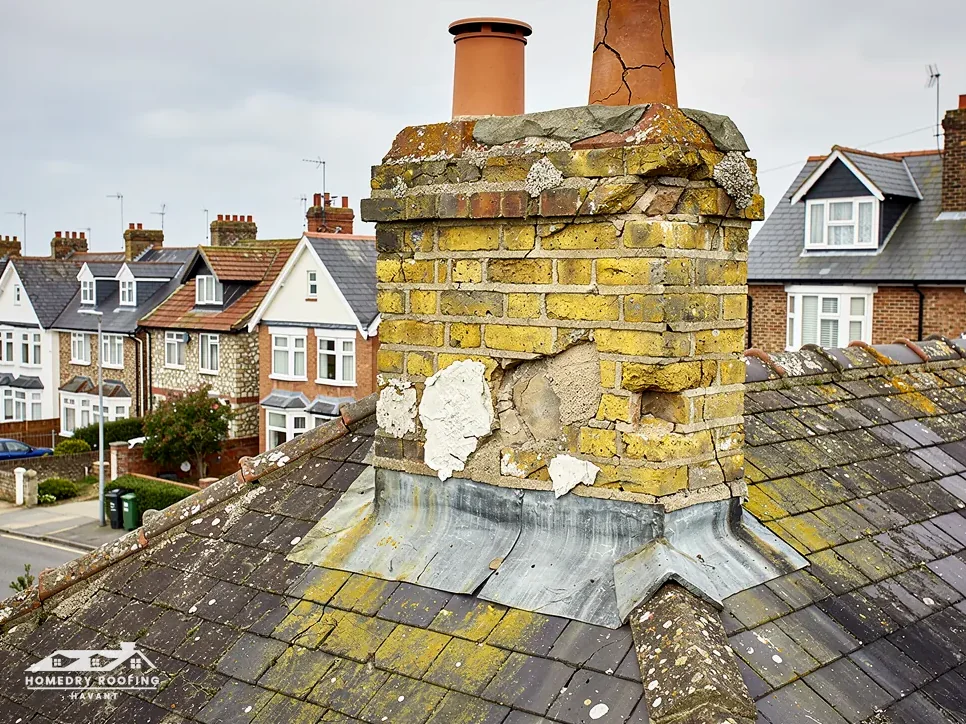
| Wet only near a wall or chimney | A flashing, or the junction between roof and wall |
These are possibilities to check and not findings. A leak can have two triggers, and a stain can lie some way from the entry point, so a roofer reads your notes against what the roof itself shows.
If the same damp appears whatever the weather, condensation may be involved, and our answer on condensation or a roof leak explains how the two differ.
Gutters, valleys and outlets under load
When a leak appears only in a downpour, look at where the water leaves the roof before looking at the covering. A valley is the trough where two slopes meet, and it carries the rain of both. Leaves, moss or debris in it can slow the flow until the water rises over the covering beside it.
A gutter that is full, sagging or leaking at a joint can send water down the wall or back beneath the first row of tiles. A flat roof with a blocked outlet can pond, and standing water exposes any weakness in the membrane. Some of these causes can be spotted from the ground with binoculars, and the rest belong to a roofer on the roof itself. Note which gutter or downpipe is overflowing and whether it happens in every downpour, because a blockage shows the same way each time while a gap in the covering depends on the wind as well.
HSE says "all roofs should be treated as fragile until a competent person has confirmed they are not." Clearing a valley is therefore no job for a homeowner's ladder. Our answer on why gutters overflow covers the gutter side in more detail.
What to record and what happens next
Keep a short log: the date, the hour the drip began, how hard it rained and which way the wind blew. Photograph the stain when it is wet and again when it is dry. If you have a loft hatch, look at the timbers above the stain during or just after the rain, by torch from the hatch, and do not step off it. Our answer on how to find a roof leak sets out the safe method.
A survey then examines the face of the roof the wind came from, the flashings, the valleys and the outlets. We trace the route, name the job and put one written total in your hands after the visit.
If a storm did the damage and you plan to claim, the Financial Ombudsman Service says "Rain, hail or snowfall by itself can constitute a storm." It also says "we'll usually look at expert reports and photos". Tell your insurer first, take photos and hold on to the receipt for any temporary repair. The roof repairs page describes the work we carry out.