
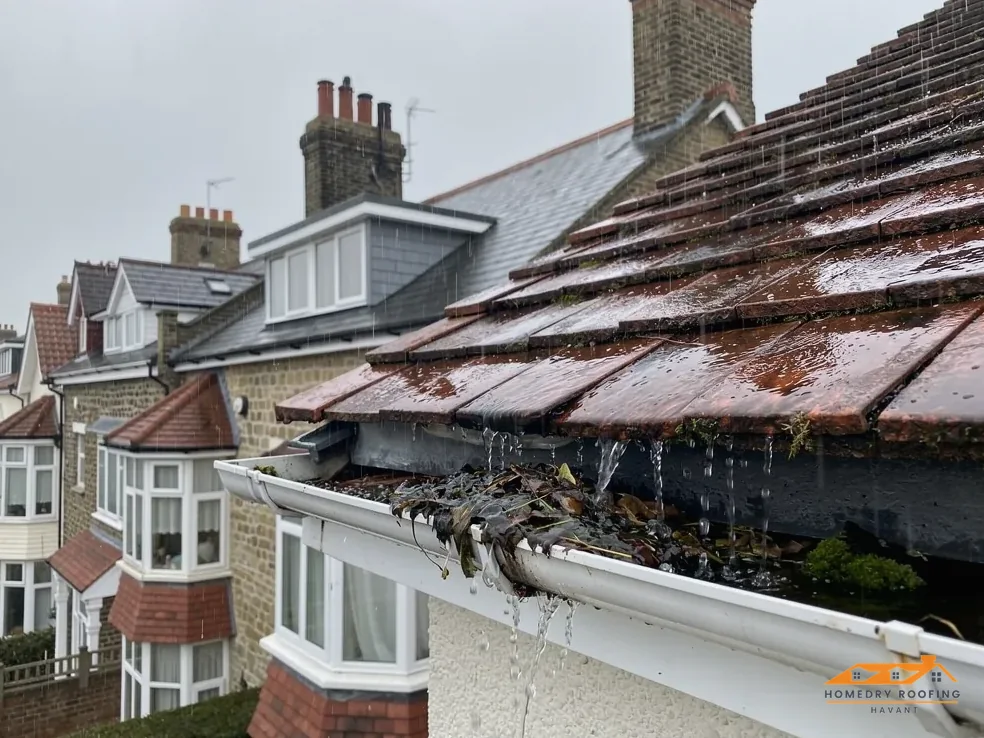
The fall has slipped
The first check is the lean of the run. Brett Martin advises a fall of 1 mm for every 600 mm towards the outlet, so the slope is slight, and it takes little to lose it. A bracket that has pulled loose, a fascia board that has softened or a sagging stretch between supports can all leave a hollow where water collects.
That hollow fills in rain and spills over the front, even though the rest of the run is dry and spotless. Standing water in the gutter a day after rain is the giveaway, and so is a line of green growth that stops abruptly at one point.
Clearing does not restore the lean. The fix is new fixings set to a fresh line, and our answer onwhat fall a gutter needs shows how that is set and checked.
A gutter does not have to be full of leaves to hold a pool. Take a photograph of the spot after rain, then another a day later. If the same hollow is still wet, the run has lost its fall there, and the repair is new fixings, not another clear.
The blockage is further down
A gutter can be spotless while the problem sits below it. Debris travels with the water, and it can lodge where the flow narrows: at the outlet, in the elbow below it, in the downpipe or at the shoe where the pipe meets the drain. Once that is blocked the whole run backs up behind it, and the first sign is water spilling at the point furthest from the blockage.
Two quick checks help:
- Listen during rain for a downpipe that gurgles or runs silent.
- Look at the base of the pipe for a drain that is full or a pipe that is dry while the gutter above is spilling.
A water test shows which of these is happening, and our answer onthe little known trick for cleaning gutters sets out how to run one safely. A downpipe blocked underground needs the drain cleared, which is a separate job from the gutter.
If the downpipe is the culprit, it can sometimes be cleared from the top with a hose or rods, but a blockage in the drain below needs the drain cleared and not the gutter. Say which you think it is when you call.
Joints, brackets and the edge of the roof
Two causes look like overflow but start elsewhere. The first is a failed joint. Where two lengths meet at a union, or at a stop end, a seal that has perished lets water drip out, and in a heavy downpour the drip becomes a stream down the wall. The second is the roof edge. If the last row of tiles overhangs too far or not far enough, rain can shoot past the front of the gutter or curl back behind it, however clear the gutter is.
Here is how to tell them apart:
- Water falling in a curtain past the front suggests the tiles and the gutter are out of step.
- A drip at one point suggests a joint.
- Dark staining down the wall below suggests water running behind the run.
Take a short video of the roof edge in steady rain, from somewhere safe. It tells a roofer more than a dry-day look can.
Neither of these is cured by a clear. A new seal or a repositioned run is the fix, and the roof edge itself is checked at the same visit so the cause is dealt with and not just the symptom.
Finding the cause and fixing it
Work through the causes in order. The simplest checks come first, and each one rules something in or out:
- Watch the run in rain from the ground and note where it spills.
- Look for standing water the day after rain.
- Feed a hose in at the far end and check the flow reaches the outlet.
- Check the downpipe and the drain at the foot of it.
- Look at the joints and brackets nearest the spill.
If the cause is the fall or the fixings, the board behind the run may need attention, and the survey shows when it does. If it is a simple blockage, our answer on how often gutters should be cleaned helps you judge the timing.
Where the cause is not obvious, a survey of the roof edge comes first, and the repair that follows is priced as a single written total. The wider work is under gutters, soffits and fascias.
Keep the video, the photographs and your notes together, since they let a roofer see what you saw without waiting for the next storm. A repair priced from good evidence is one total, written down.