
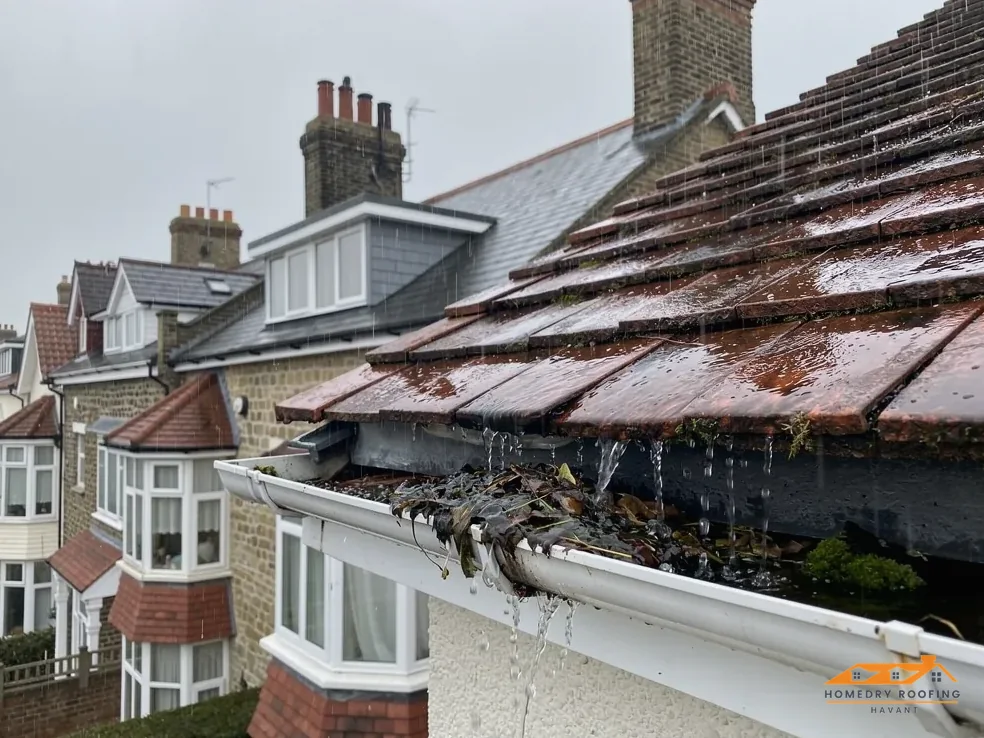
The roofline is the strip of boards and gutters where the roof meets the wall. The fascia is the board facing out under the roof edge, which carries the guttering, while the soffit is the board seen from below, filling the space between that fascia and the wall. They are replaced as one job, because the work to reach one exposes the other and the gutters have to come off either way.
It is a job with more steps than its size suggests. The boards hide the ends of the rafters and the top of the wall, so what is behind them is only seen once they come off. Some of the decisions belong before anything is cut: whether the soffit might contain asbestos, whether the roof depends on it for air, and whether anything is nesting in the eaves.
This guide follows the order of the job and sits under our gutters, soffits and fascias page. Each section covers one decision, and the facts and figures come from named third parties, never from us.
The order of work from survey to clean-up
A replacement runs in a set sequence, and a quote that follows it is easier to compare with another. The visit to the house comes first, where the roofline is looked at from the ground and from scaffold or a ladder where that is safe. That survey is where the asbestos question, the ventilation question and the wildlife question are put.
The work itself then goes in this order:
- Scaffold goes up where the height or the position calls for it, and we arrange the licence with our scaffolder where the scaffold has to stand on the pavement or road.
- The gutters and downpipes come off and are set aside.
- The old fascia and soffit boards are removed, and the ends of the rafters and the top of the wall are looked at.
- New boards are fixed, with any ventilation detail the roof needs.
- The gutters are refitted to a fall, and the joints and outlets are checked.
- The site is cleared and the old boards and fittings are taken away.
If the boards are sound and it is only the paint that has failed, say so at the survey, because a repaint or a repair is a smaller job than replacement. Replacement is for boards that are rotten, split or sagging, and the survey says which case you have.
The point of seeing the rafter ends is that a rotten board can mean a rotten timber behind it. If the timber behind is damaged, the survey changes from a roofline job into a repair to the roof structure, and the written quote is for the whole job once that is known.
Scaffold is included in the written quote.
Check the soffit for asbestos before cutting
Houses built or refurbished before 2000 are the ones to think about first. The Health and Safety Executive (HSE) says: "If the building was built or refurbished before 2000, assume that there is asbestos in it." HSE's list of asbestos locations includes white soffit panels under the eaves made of asbestos insulating board, shortened to AIB.
The classification matters for the plan. HSE sets out that work on AIB is licensed where the risk assessment shows it will not be of short duration, while short-duration AIB removal in a refurbishment is notifiable non-licensed work. Asbestos cement rainwater goods carefully removed without breaking up are non-licensed.
- A survey comes before a quote that depends on the answer.
- If asbestos is confirmed, the quote states how the work is classed and who will carry it out.
- If a board is damaged, it is left alone and photographed from the ground.
MyJobQuote's average for an asbestos survey is around £325 in 2026, a general UK figure that does not fit every house. Our guide to asbestos in soffits covers HSE's rules, the waste route and what to ask for in more detail, and it is worth reading before a date is booked.
A roofer who offers to start without a check on a house of this age is skipping the step that protects everyone on site. The order matters: check, classify, then cut.
The boards at the eaves hide the rafter ends, so the first visit asks what is behind them as well as what they are.
Soffits, eaves ventilation and the roof space
A soffit board is not always solid. It can also be the intake for air, and what the new boards must do depends on how the roof is built. Marley, a tile maker, gives the figures for a cold roof, one where the insulation sits at ceiling level and the loft above is ventilated, with a high-resistance underlay.
| Pitch | Ventilation along the eaves |
|---|---|
| 15 degrees or less | 25mm |
| More than 15 degrees | 10mm |
Marley notes that high-resistance underlay does not let vapour through, which is why it depends on the eaves ventilation in the table. For an air-permeable underlay with a well-sealed ceiling, Marley says "fortuitous ventilation at the eaves via normal eaves construction (3mm) is all that is required, provided the requirements of UKAS Third Party certification are fully met."
What this means when boards are replaced: the new soffit must not seal off an eaves gap the roof relies on, and where the old boards had vents, the new ones need to give the same airflow. The standard behind these figures is BS 5250 on managing moisture in buildings, which BSI lists as current and under review.
A loft that has been boarded out or insulated right to the eaves can change what the ventilation has to do, so tell whoever surveys if insulation has been added.
The loft and underlay type differ from one house to the next, so the survey records which case applies. Our answer on whether soffits need vents goes through it.
Gutter fall, fixings and what sits behind the fascia
Because the gutters come off for the boards to be replaced, the refit is the moment to set the fall properly. Brett Martin, a guttering manufacturer, advises a downward fall towards the outlet of 1mm for every 600mm of guttering.
The arithmetic is simple. A run of six metres falls by 10mm from the high end to the outlet, so the difference is slight to the eye, which is why it is set with a line and not by looking. A fall that is too flat leaves water standing, and the outlet is where that water is meant to leave.
Behind the new fascia, three things are checked:
- The ends of the rafters and the timber they sit on, for rot or damage that the old boards were covering.
- The fixings that will carry the gutter, which need sound timber and not a strip of old board.
- The position of each outlet, so the downpipe lines up with where the water must go.
Old gutters on asbestos cement are a separate case from plastic or aluminium ones, because HSE places carefully handled asbestos cement rainwater goods in the non-licensed group, and breaking them up changes that. If the gutters are old and grey, the same survey that checks the soffit checks them.
Cleaning is a different job. Which? gave a range of £75 to £350, excluding VAT, in November 2025, for clearing out all the gutters at the front and back of a property, which is a clearing price and not a replacement price.
Materials, lifespans and the cost of capping
uPVC is one replacement material. A retailer, Plastic Centre, says that when installed correctly, uPVC fascia boards "can typically maintain reliable performance for between 20 and 40 years". A retailer has an interest in selling the boards, so treat that as a seller's estimate and not as an independent test, and read it as a range for boards fitted correctly, not as a promise about yours.
There are two routes with different results. Replacement removes the old boards and puts in new ones, which exposes the timber behind. Capping fits new covering over the existing boards, which leaves the old board in place and hidden. MyJobQuote gives an average cost of capping fascias and soffits of around £800, and an average gutter replacement cost of around £1,000 to £1,600 in the UK. These are separate third-party averages and are not added together here.
| Item | Figure | Source |
|---|---|---|
| Capping fascias and soffits | Average around £800 | MyJobQuote |
| Gutter replacement | Average £1,000 to £1,600 | MyJobQuote |
| uPVC boards | 20 to 40 years, typically | A retailer |
Capping leaves a question: if the board under the cap is unsound, nobody sees it. That counts with an older house, where the asbestos question also applies, and our blog post on capping over fascias is for readers weighing it up. Ask which route a quote is for, since the two are different jobs with different results, and what happens to the board under the cap if capping is chosen.
Birds, bats and what a written quote should say
Work on the eaves can disturb wildlife, and the law is specific. Under section 1 of the Wildlife and Countryside Act 1981, a person who intentionally damages a nest of a wild bird commits an offence if the nest is in use or being built. Bat roosts are protected more tightly, because damaging or destroying one is an offence whatever the intent. Our answer on birds nesting in the eaves covers the nest side.
That is why the survey looks in the eaves before a quote is fixed. If a nest in use or a roost turns up, work on that section stops, the plan changes and you are told before anything goes ahead.
The quote that follows the survey is one written total. It names the boards, the gutters, the access, the waste and the clean-up, so that you can see what it covers. Check that it states these points:
- The boards and gutters it covers, with VAT and scaffold stated one way or the other.
- How the soffit is checked for asbestos, and what happens if the answer is yes.
- The ventilation detail where the roof needs one.
- What happens if rot is found behind the fascia.
A short note on what is behind the boards, once seen, is worth asking for as well, since it records what was found for the next time work is done on the eaves. Photographs taken while the boards are off do the same job, and they are the evidence if rot or damage is found that nobody could see from the ground.