
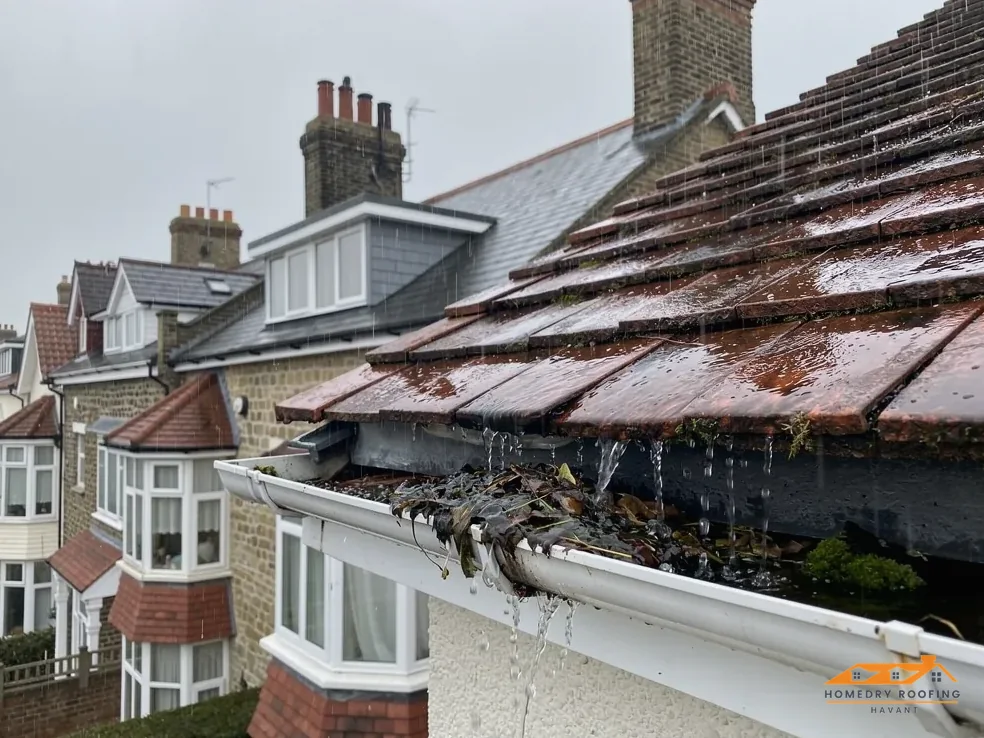
Checking from the ground
The least costly and safest check needs no equipment at all. Pick a day when rain is steady, put on a coat and walk round the outside of the house, looking up at the roof edge. Do it again once the leaves are down from any trees nearby. That is enough to see whether the gutters are carrying water or spilling it.
You can judge most of what matters without a ladder. Walk round the house during or just after rain and compare what you see with the table.
| Sign | What it points to | Next step |
|---|---|---|
| Water spilling over the front | Blocked run or outlet | Clear, then retest |
| Green or weeds along the top | Debris and damp sitting in the run | Clear and look at the roof above |
| A dripping joint | Failed seal or lost alignment | Repair the joint |
| Dark streaks on the wall | Overflow or a leak behind the run | Survey the roof edge |
Standing water in a gutter long after the rain has stopped points to a lost fall, which clearing alone will not cure.
A note on your phone of what you saw and when gives you your own interval over a year or two.
What changes the timing
The right gap between clears depends on the house, not on a calendar. These things pull it in either direction:
- Trees that overhang the roof, which drop leaves, seeds and twigs into the run.
- Shade and damp, which let moss and weeds take hold on the roof and wash into the gutter.
- The condition of the roof covering, because worn tiles shed grit and fragments into the run.
- The fall of the gutter itself. A run that drains cleanly passes debris along, and one that holds water collects it.
Moss in the run is worth a look upwards as well as along, because it can start on the roof above.
A written record helps. Dated photographs of the run before and after a clear show how fast it fills at your house, which is the only figure that matters.
A gutter beside a tree and one on an open elevation fill at different rates, and only your own checks show which yours is. That is what replaces a fixed date.
Who should do the clearing
Clearing a gutter is a job done at height, and the risk is in the access, not in the debris. If the eaves are above a single storey, or the ground is sloping, soft or crowded with garden features, a roofer with proper access equipment is the sensible choice. HSE says all roofs should be treated as fragile until a competent person has confirmed they are not, which matters if the only way to the gutter is across a porch or garage roof.
Before anyone starts, check for nests. Wildlife law covers a wild bird's nest while it is in use or being built, and our answer on birds nesting in the eaves covers what to do if you find one.
Which? Trusted Traders price clearing every gutter on a property, front and back, at £75 to £350 excluding VAT (November 2025). Our answer on the normal cost of gutter cleaning sets out the basis for that range.
Whoever does it, ask for photographs of the run at the start and the end of the visit, showing what was cleared and what was left behind. A photograph of the downpipe outlet at the base is worth having too.
After the clear: does it drain?
Clearing is a means to an end, and the end is a gutter that carries water to the drain.
A clean run is only half the job. Once the debris is out, start a hose at the end furthest from the outlet and follow the water along. Look for four things:
- Water leaving at the outlet rather than pooling along the run.
- No drips at the joints, stop ends or the corners.
- The downpipe taking the flow without backing up.
- Dry brickwork below the run.
If water still stands or spills, the cause is not leaves. Our answer on why gutters overflow covers the other causes.
Where the problem is bigger than a clear, the roof edge gets a survey and the fix a single written total. The wider service sits under gutters, soffits and fascias.
A record helps here as well. Dated notes of when the water ran clear and when it did not turn a vague worry into a pattern, and they give a roofer something to work from when you call.
If a problem returns soon after a clear, mention it at the survey, because that points away from debris and towards the fall or the joints.