
What 1 mm in 600 mm looks like
Brett Martin's installation guidance sets the fall at 1 mm for every 600 mm, sloping down towards the outlet. The figure is small on purpose. The gutter is not a drainpipe laid on a slope, only a channel with a lean that keeps water moving.
The table works the arithmetic along some typical lengths of run. It is worked from that one ratio, so treat it as an illustration and not as a separate published figure.
| Length of run | Drop towards the outlet |
|---|---|
| 3 m | 5 mm |
| 6 m | 10 mm |
| 9 m | 15 mm |
| 12 m | 20 mm |
Those are small differences over a long distance, which is why a gutter that looks level to the eye can be right or wrong.
A worked example makes the point. A 6 m run at that rate drops 10 mm from end to end, spread across the whole length. Each extra metre adds under 2 mm, so a small error in setting the high end is a large share of the whole fall.
How the fall is set and checked
A fall is built in when the gutter goes up, and it is easy to lose afterwards. Setting it is a matter of marking the fascia so that the high end sits above the outlet by the right amount, then stretching a line between the two points and hanging the brackets along it.
The checks, in the order they are made:
- Mark the position of the outlet, which is the low point of the run.
- Mark the high end on the fascia, working back by the fall the run's length needs.
- Stretch a line between the two marks and fix the brackets to it.
- Hang the gutter and use a level to confirm the lean.
- Run water through it and look for standing water or drips.
The water test is the final judge, because it shows what the gutter does rather than what the line says. Water started at the far end from the outlet, as in our answer onthe little known trick for cleaning gutters, does the same job on a gutter that is already up.
A short run needs the same care as a long one, since the lean has to be set at both ends.
Signs that a fall has been lost
Even a perfect fall on the day of fitting can drift.
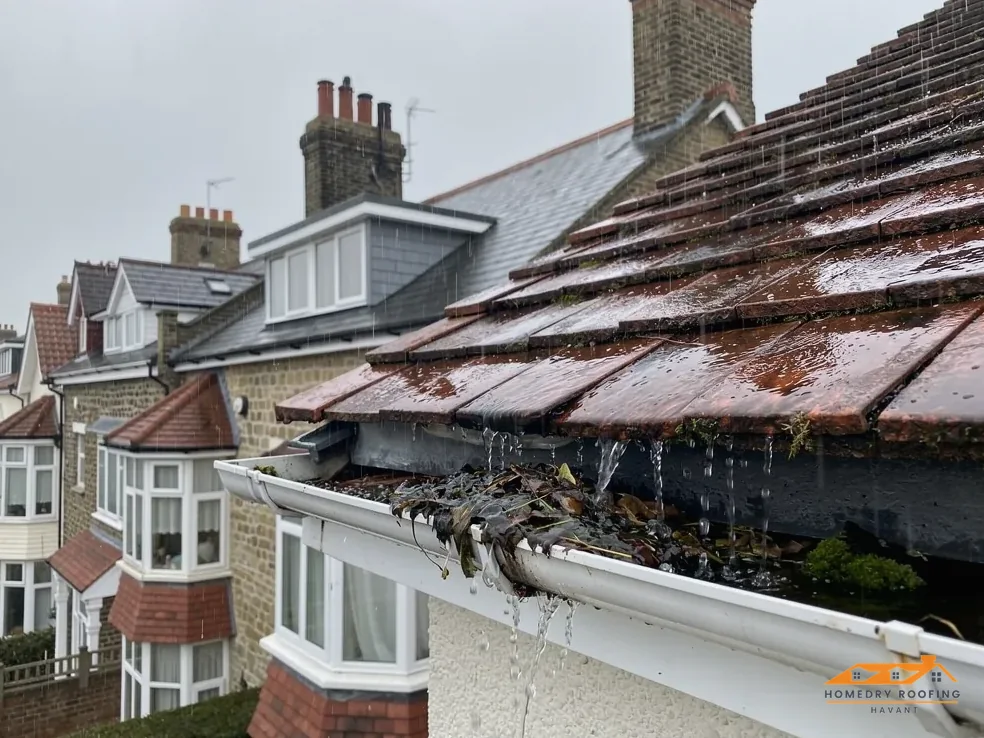
A fall can disappear without anyone touching the gutter. Brackets work loose, boards soften and the weight of wet debris pulls a run downward in the middle. The signs are easy to read from the ground:
- Water lying in the gutter a day or more after rain.
- Green growth along one stretch of the run and not the rest.
- A visible sag between two brackets.
- Overflow at a point that is not the outlet.
- Staining on the wall below a particular section.
Clearing the debris does not restore a lost fall. The brackets need re-fixing along a fresh line, or the fascia board behind them needs attention. Our answer on why gutters overflow sets out the other causes.
Where the board behind has softened, replacing the gutter on the same board would only repeat the problem.
Water that stands in a run carries silt and weight that work on the brackets, so a small loss of fall can grow into a larger one if it is left. A fresh line and fresh fixings put it right, and the survey says which brackets or boards are at fault.
Flat roof gutters are a different standard
The 1 mm in 600 mm advice is for gutters hung on the outside of a pitched roof's eaves. A flat roof is a different case, and so is the gutter that sits inside it, often called an internal gutter or a box gutter. NFRC reports that BS 6229:2025 sets a minimum finished fall of 1:80 for general roof areas and internal gutters, which is a far steeper slope than the 1 in 600 of an external run.
The two figures belong to different parts of the roof and should never be swapped. A flat roof's designer allows for tolerances, so a membrane roof is drawn up with a steeper design fall than its finished minimum.
If the water is pooling on a flat roof rather than in a run along the eaves, ask for a survey of the flat roof itself. The wider roofline work is under gutters, soffits and fascias.
If a flat roof still shows water standing a day after rain, the cause may be the roof's own fall, and that needs a survey by someone who can measure it with a level and a straight edge. Nothing in the gutter fixes that.