
You have a roof problem and a house to sell. Maybe a tile has gone, a ceiling has a stain or an old flat roof is showing its age, and you are weighing whether to fix it before the first viewing, to leave it and let the price reflect it, or to carry on and see what a buyer's survey says.
There is no single right answer, because the right one depends on what is wrong, how large the job is and how much time you have. A single slipped tile is a different matter from a covering that has run out its useful life. What helps in every case is knowing exactly what the fault is before anyone else tells you, and having a written price in your hand.
This guide sets out the three routes, what a buyer's survey can see of a roof from a roofer's point of view, how to find out what is really wrong, what a repair before listing involves, how to price the problem in and what to give your solicitor. What the sale paperwork must say about the roof is a question for your solicitor, and we leave it with them.
Three routes for a house with a roof fault
Sellers in this position have three broad choices, and they can be combined. Here they are in a table, each with the question a roofer can answer.
| Route | What it means | Roofing question |
|---|---|---|
| Repair first | The fault is dealt with before viewings begin | Is a repair sound, and what is the total? |
| Price it in | The roof is left, and the asking price allows for it | What would the work cost, in writing? |
| Describe it plainly | The buyer is told what is known about the roof | What can be shown in photographs? |
The third is not an alternative to the other two. Whichever you choose, ask your solicitor how the roof should be described on the sale paperwork. The conveyancing forms are a matter for them, and what they ask and how to answer is not something we can set out here.
Time matters too. A repair needs a survey, a written price and any approvals first, so a seller who wants the work finished before the listing photographs are taken should start with the roofer's visit and not leave it until an offer is in.
The decision turns on three facts: what the fault is, how big the job is and how long you have. A roofer can settle the first two. The third is yours, together with your agent and your solicitor, and it is worth knowing the first two before you decide on the third.
What a buyer's survey can see of your roof
A buyer's surveyor writes about what they can see, and a roof is hard to see. Knowing which parts show and which do not tells you what a survey might raise.
These can show from the ground, a window or the loft hatch.
- Tiles or slates that are cracked, out of line or absent.
- A ridge line that dips or a ridge tile with the mortar gone.
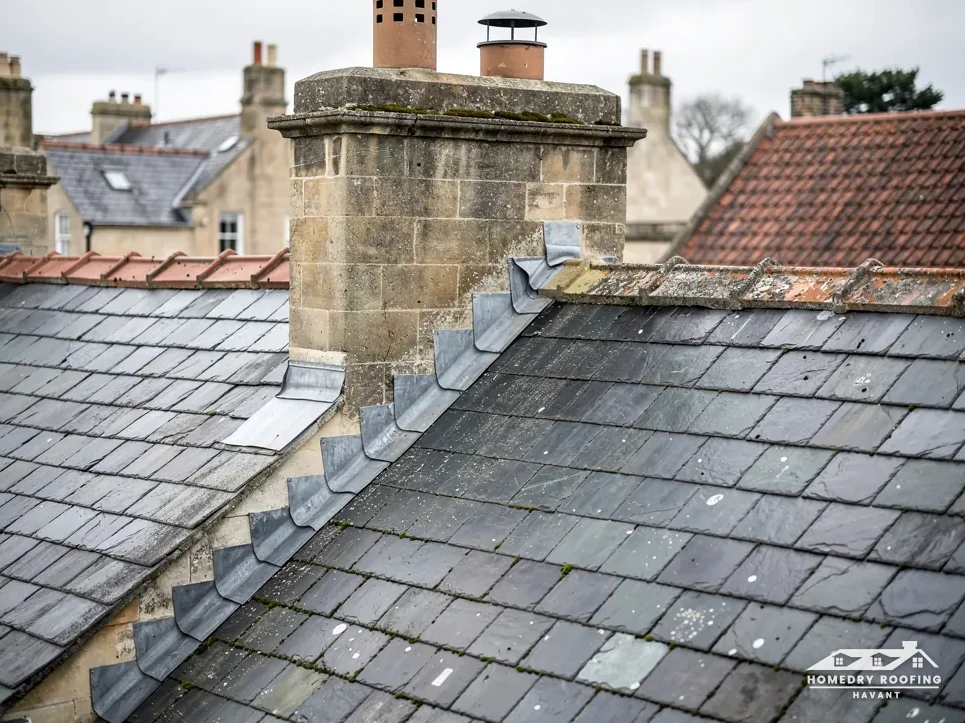
- A chimney stack that leans, has loose mortar or has lead standing away from it.
- Gutters that overflow, sag or are streaked with green.
- Stained ceilings, wet timber, marked underlay and daylight in the loft.
These are harder to see, and a report may say so.
- The far side of the roof, or a slope hidden behind another building.
- The surface of a flat roof viewed from a window.
- Lead behind a chimney stack or tucked along a wall.
- A roof structure covered in spray foam, which RICS says cannot be fully seen or inspected.
Where something is not seen, a report might recommend a closer look, and that is where a roofer's findings come in. Our guide for the other side of the deal, when the survey says the roof needs work, shows what a buyer might do with those words. None of this means a roof will be marked down. It means the survey is a conversation starter, and a seller who has already had the roof looked at can answer it with facts.
Finding out what is really wrong first
Before you decide on any route, get a roofer to look at the roof and tell you in writing what the fault is. A ceiling stain shows only where the water ended up; the cause could be a flashing, a tile, a gutter or something else. A decision made on the stain alone can send money to the wrong place.
A useful visit gives you these things.
- Photographs of each fault, dated and labelled with their position on the roof.
- A statement of where the water gets in and where it shows.
- A verdict on the fault: repair, renewal of one part or full replacement, and why.
- A single written total for the work, which makes the figure firm instead of a guess.
MyJobQuote's roof survey guide puts the average at around £300 (updated October 2026). Our guide to finding a roof leak explains how we trace the cause.
Ask the roofer to say what could not be reached as well as what was found, so that nothing in the findings reads as a statement about parts nobody saw.
Painting over a ceiling stain removes the evidence and leaves the cause. A buyer's surveyor can still look in the loft, where wet timber or a marked underlay can show, so a cover-up may hide nothing from them. Tell your solicitor about the stain and what has been done about it.
Repairing before you list
Repairing first suits a small, well-defined fault: a few tiles, a section of lead, a gutter joint. The house then reaches viewings with the problem dealt with and a record of how.
What to keep from the work is as useful as the work itself.
- The roofer's written findings from before and after.
- Dated photographs of the fault and of the finished repair.
- The invoice, which names the work and the date.
- Any note from the roofer about parts of the roof that were looked at and found sound.
Third-party guides show the scale. MyJobQuote's average for a roof repair is around £650 in 2026, while the Which? Trusted Traders survey of November 2025 lists £75 to £400, excluding VAT, for a small tile job of one to six tiles. Those are other firms' ranges and not our prices. Our quote is one written total that follows a survey, with scaffold inside it.
Check whether the work needs any approval. On the Planning Portal's test, re-roofing normally needs no building regulations application where less than 25 per cent of the building envelope and less than 50 per cent of the roof is affected. Approval is needed whenever the new covering is 15 per cent or more heavier. A listed house is a separate case: the council is asked first, because listed building consent applies to work that alters its character. Our answer on small repairs says what a minor job involves.
Pricing it in, and giving the buyer a figure
If a repair before sale does not suit, perhaps because the whole covering is at fault or because you want to leave the choice of work to the buyer, the other route is to leave the roof as it is and let the asking price allow for it. This works best with a number behind it.
A figure from a cost guide is a range, not a quote. A written total from a roofer who has looked at your roof, for the work that your roof actually needs, is the number a buyer can weigh. It also stops the conversation drifting towards the worst case, because the worst case has been priced.
Your agent will have a view on how to present the roof to viewers. The roofer's part is to make sure the document is accurate and dated, and to say how long the written total can be relied on, so that nobody is working from a stale figure. If a buyer's own roofer later visits, they can compare their findings against yours.
Hand over the paperwork with the offer to talk.
- The roofer's findings, with photographs.
- The written total for the work.
- A note of what the roofer saw that was in good order, because that is part of the picture too.
- The date of the visit, since a roof changes with weather.
If the written total covers a whole new covering, tell your solicitor and your agent so that the asking price and the description of the roof go together. Our verdict is repair or replace, with the reasons, and we start from the repair wherever one will hold. Our answer on how long a roof repair lasts is useful if a buyer asks.
Describing the roof, and who to ask
What the sale paperwork asks about a roof, and how to answer it, is a legal matter. Ask your solicitor, and take them the facts. A roofer can supply the facts, but the form, the wording and the duty that goes with them are for the conveyancer.
These are worth gathering first.
- Dated photographs showing the roof today.
- Any roofer's written findings and the date of the visit.
- Invoices and notes for earlier work, including who did it and when.
- A note of any leak, when it appeared and what was done.
- The details of any insurance claim for roof damage, and the photographs sent with it.
If the roof is shared with a neighbour, as on a terrace or in a block, say so to your solicitor, because who is responsible for a repair can affect what a buyer is told.
Be accurate about what you know and what you do not. If you do not know the age of the covering, say so, and do not guess. A roofer's report can state what was seen and what was not, which is more useful to a solicitor than a general impression. Leave your own views on the roof's future life out of any answer unless a roofer has put them in writing, because lifespans in guides are typical ranges and never promises.
If a storm caused damage and you are claiming, the Financial Ombudsman Service says it will usually look at expert reports and photos of a property's condition, so keep dated photographs. Our roof repairs page explains how a survey leads to one written price.