
Why the stain is not the hole
Water does not drip straight down from a hole. It runs along whatever it lands on, such as the underside of the felt, a rafter, a purlin or the top of the insulation, until gravity pulls it free. The place it finally drops from can be a metre or more away from where it came in.
That is the idea behind following the route of the rain: look for where it entered, then for the path it took, and only then at where it showed. Work done only at the stain closes nothing, and the drip comes back on the next wet day.
Your own pattern of observations is the first tool, and a notebook is all it takes. Record the date, the weather in the hours before the stain appeared and, if you know it, the wind direction. If a mark grows only when wind drives rain at one side of the house, the entry point probably faces that side. Our answer on leaks that show only in heavy rain goes further into this idea.
A safe method from the loft hatch
Work in daylight where you can, carry a torch and have someone else in the house. These steps stay at the hatch.
- Shine the torch on the underside of the roof directly over the stain, then uphill from it.
- Check the timbers for dark, wet or stained patches, and the felt for drips or beads of water.
- Look at the loft insulation below the suspect spot to see whether it is damp, flattened or discoloured.
- Examine anything that passes through the roof, such as a chimney, a soil pipe vent or a roof window, for tide marks.
- Photograph each finding, with a coin or tape measure beside it for scale.
Do not walk across the loft unless it is boarded, because a ceiling cannot take a person's weight and a misplaced step can end up in the room below. A dark spot is a clue and falls short of a diagnosis. Daylight showing through the roof from inside is worth recording too, because it marks a gap or a missing tile, and a thin line of light under the ridge or beside a wall is easy to overlook in a bright loft. Mark the position on a photograph, or against a rafter with chalk, so that the spot can be found again by someone who has never been up there.
Looking from the ground instead
Once you have a suspect spot, the urge is to climb up with a ladder, and that is the step to avoid. HSE advises that "all roofs should be treated as fragile until a competent person has confirmed they are not." A wet or mossy slope is slippery in any footwear, and the edge of a roof offers little to hold.
The garden gives a useful view. With binoculars, look for:
- a slipped, cracked or missing tile or slate;
- a lifted or open line of flashing against a wall or chimney;
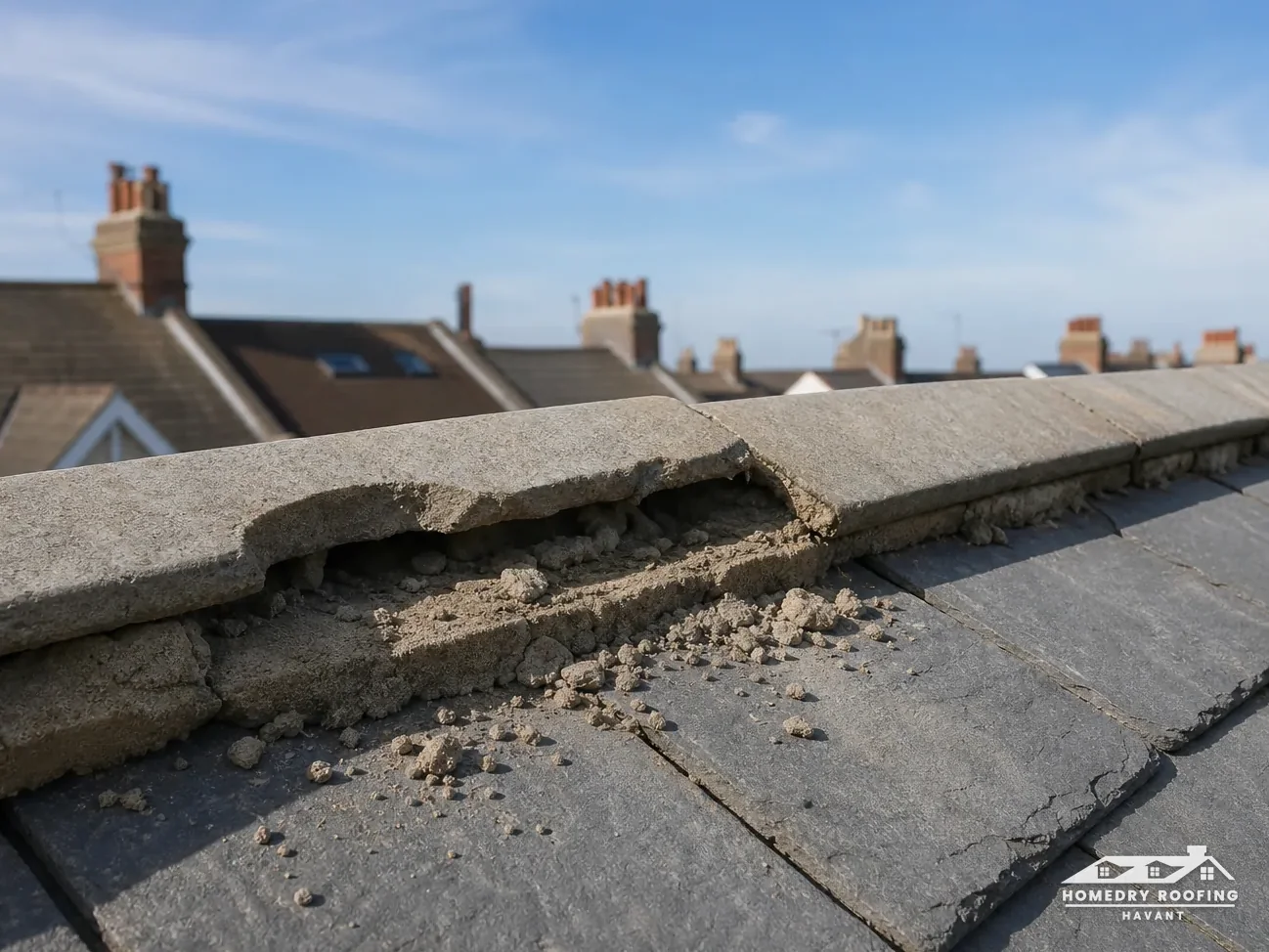
- a gap or tilted tile along the ridge;
- a gutter that has dropped, overflowed or filled with debris, wetting the roof edge.
Each is a possibility to report and not a finding to fix. Take photographs in good light and note where each sits against a fixed point such as the chimney or a window. Those pictures save time at the survey, because the roofer starts with a list of places to look first. They also give you a dated record of how the roof looked before any work was done, which is useful whatever the survey finds.
When to hand it to a roofer
Hand the search over when the stain keeps growing, when more than one room is affected, when water runs through a light fitting or when your own search has found nothing. A survey checks the covering, the flashings, the valleys and every junction where one roof slope, wall or extension meets the next, and the loft side is read against the outside. That cross-check is what turns a suspicion into a finding. If a ceiling is wet around a light fitting, read our answer on a roof leak near lights before you touch a switch.
We trace the route first and name the job afterwards, and one written total follows the visit, so you know the cost of the job before anything is booked.
For scale, MyJobQuote reckons the average roof repair at around £650 in 2026, with no VAT basis stated, and Which? lists £75 to £400 for one to six broken or missing standard tiles, VAT excluded, in November 2025. Our answer on why a roof is leaking lists places a leak can start, and the roof repairs page describes the work.