
What decides how long a repair lasts
Four things matter. A repair deals with a single place, so its life is limited by what happens everywhere else on the roof.
- What failed: a tile broken by impact is a one-off, while a flashing that lifted because the wall moved may lift again.
- Whether the cause was found: closing a gap without asking why it opened can leave the same weakness in place.
- The state of the surroundings: new tiles beside tired ones, on soft battens, are only as secure as the timber beneath them.
- The materials and workmanship used for the repair itself.
That is why we follow the route the water took, from where it showed to where it entered, before naming the job. A patch put on at the stain, when the entry point lies two metres uphill, can look finished and drip again at the next downpour.
A repair is not a warranty, either. The written price describes the work done, and the roof carries on ageing around it, so ask what the survey saw elsewhere and when a second look would be worthwhile.
Published lifespans for the roof around the repair
Published lifespans describe whole coverings, not repairs, but they hint at how much life the roof around a repair may have left. They are typical ranges and never promises, and each source's wording matters.
| Covering | As published | Source |
|---|---|---|
| Welsh slate | 100+ years, approximate | HomeBuilding |
| Clay tiles | 60-80 years, approximate | HomeBuilding |
| Plain concrete tiles | 40-50 years, approximate | HomeBuilding |
| Torch-on felt | 10-15 years, approximate | HomeBuilding |
Marley, the tile maker, writes that "Typically, roof tiles are expected to last for around 60 years" and adds "This is not a guarantee or warranty of its longevity." For lead, MyJobQuote says correctly installed lead flashing can last for over 80 years.
A repair near the end of one of these ranges is a different proposition from the same repair in a roof's middle years, because the work around it is nearer to needing attention in its own right. A survey can place your covering within its range, using what the roofer sees from the ladder and from the hatch, and that placing is the useful part of the exercise. Our answer on how long a flat roof lasts sets out the flat-roof figures, where sources disagree.
Different repairs, different outlooks
Each type of repair has its own weak point, and knowing it helps you judge what you are offered.
Replacement tiles on sound battens are as secure as the tiling around them. The risk lies with the neighbours: if tiles nearby are cracked or slipping, a new one will not stop them.
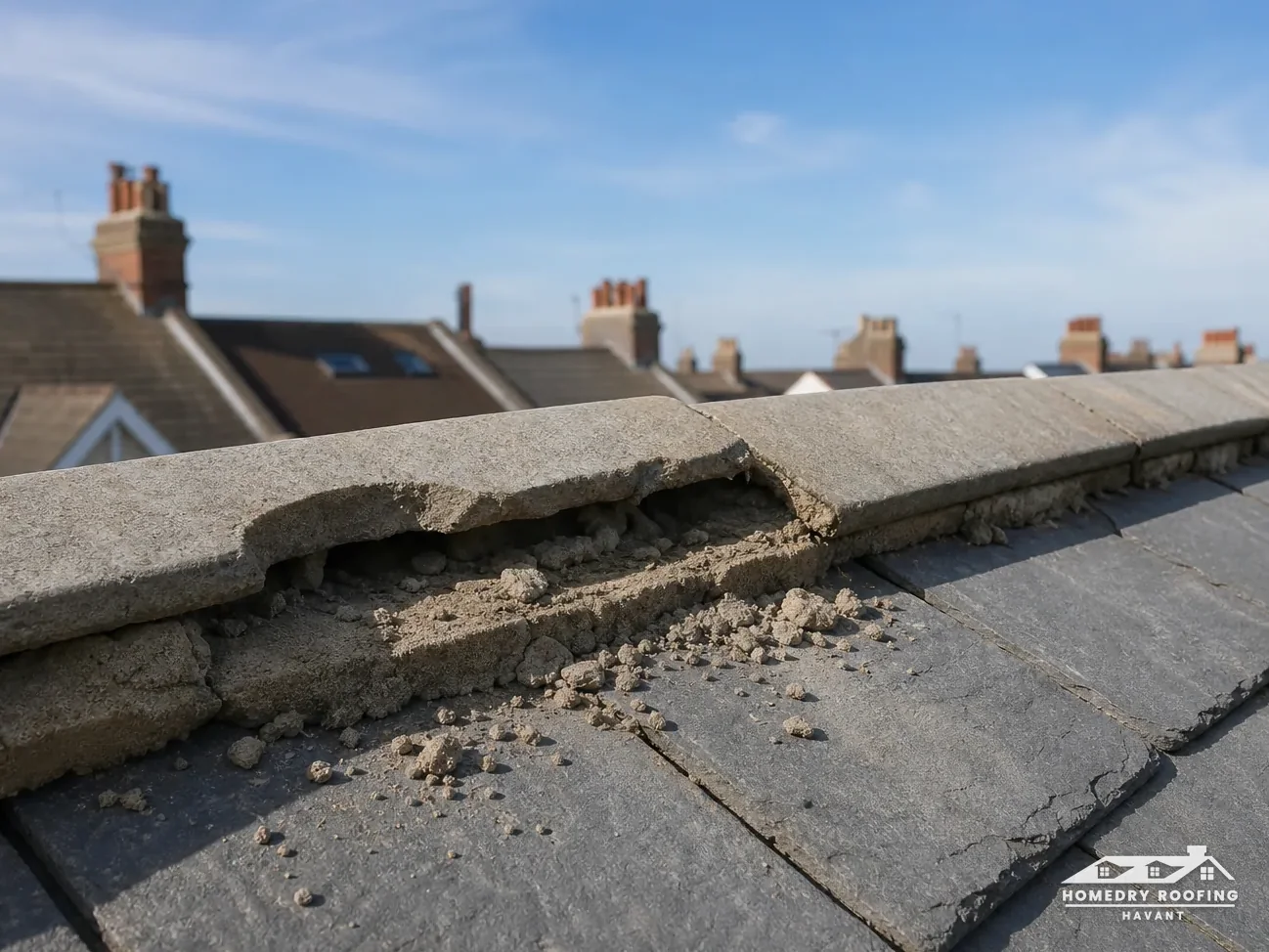
Ridge repairs depend on how the tiles are fixed. Marley says that "the tensile strength of mortar alone could no longer be relied upon", and Marley also notes that installing to BS 5534 "isn't required by law". A sound bed may justify a mortar repair, while a dry-fixed ridge adds mechanical fixings, so ask the roofer what will hold the tiles down once the job is finished.
Flashings and flat roofs
Flashings and lead depend on the wall they meet. Lead cut, dressed and fixed to suit its position can serve for a long time, but a wall that moves can open a joint again.
A patch on a flat roof depends on the membrane around it. On felt or membrane near the end of its life, a patch is a way of gaining time, and a survey will say how much. Our answer on small roof repairs shows how such a job is arranged.
Getting the most from a repair
A few habits lengthen the useful life of a repair, and none of them needs a ladder.
Keep the written quote and any photographs from the survey, because they record what was done and what else was seen, which makes the next decision easier. After the first big storms that follow the work, look at the roof from the ground, with binoculars if you own a pair. You are looking for slipped tiles, a sagging gutter or a new stain on a ceiling inside. HSE says "all roofs should be treated as fragile until a competent person has confirmed they are not." Leave the climbing to the roofer.
Keep gutters clear, since an overflowing one can soak the wall and the roof edge. If new damp follows a repair, tell us soon: a second look close to the work is simpler than a puzzle months later, and a note on the date helps us match it against what was done.
For how the job itself runs, see how long a roof repair takes, or the roof repairs page for the full list of work.