
What the survey has to prove first
An overlay is a decision about the layers under the new covering, so those layers are checked before anything is priced. The survey looks for these points, some of them visible only from underneath, so it includes the ceiling and any loft or void below the roof:
- The deck is firm underfoot from a safe position and shows no soft or stained boards from below.
- Any insulation in the build-up is dry, because new waterproofing laid over wet material traps it.
- The old felt is bonded down, with no open laps, splits or long hollow blisters.
- The edges, upstands and outlets can take a second layer without being rebuilt.
A flat roof is a route for rain, and every layer under the covering is part of that route. Where the old felt has let water into the boards, a new top layer leaves the wet exactly where it was. That is the situation in which an overlay turns into a replacement that has only been put off.
Our guide to blisters on felt explains what the bubbles on a surface can and cannot tell you.
Falls, edges and heights an overlay inherits
BS 6229:2025 is the standard for flat roofs covered by membranes, and NFRC says it sets a minimum 1:80 finished fall for general roof areas and internal gutters. An overlay follows the fall that is already there. If the old roof holds a puddle, the new one holds the same puddle, and only new falls remove it. The same goes for an outlet that sits too high: a second layer makes it a little higher still.
| Detail | Overlaid | Stripped to the deck |
|---|---|---|
| Falls | Stay as they are | Can be re-set |
| Boards below | Not seen | Inspected and replaced |
| Upstand height | Reduced by a layer | Set fresh |
| Roof level | Rises | Stays the same |
A roof that meets a door sill or a wall flashing has little height to give, and that can decide the question on its own, whatever the felt looks like.
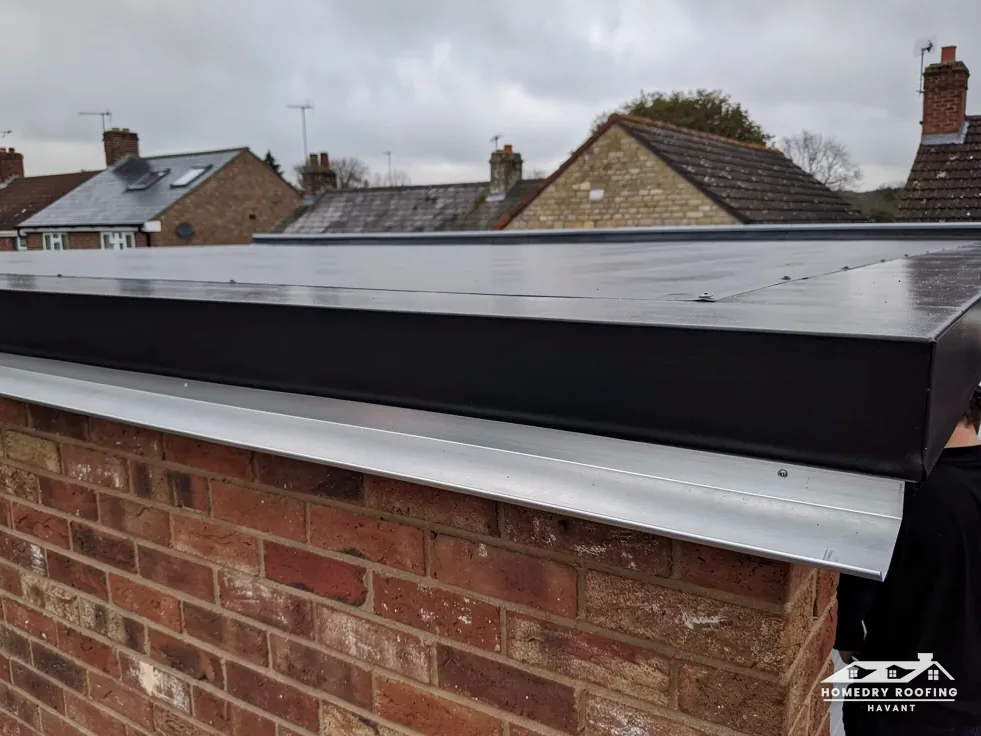
Edges matter as much as the middle. A drip trim at the roof edge carries water over into the gutter, and a second layer can leave the felt sitting too shallow against it, so water runs back behind the trim instead of dropping clear. The survey checks every edge, and every wall junction, before it says that an overlay can work on a given roof.
Weight, insulation and the Building Regulations
The Planning Portal's guide says approval is needed where the new roof covering adds 15 per cent or more weight, or where its fire performance would be significantly different. Read the 15 per cent as a test of added weight. A second layer adds weight on top of the first, so ask building control whether the added layer counts for your roof. At a Havant address we put the building regulations route to your building control body before work begins, and the answer is recorded in the quote.
AD L 2021 names the replacement of a flat roof's waterproof membrane as renovation (para 11.2(d)). Whether an overlay falls inside that wording is a question for building control, not a point to assume either way. The route is the one set out in our answer on flat roof building regulations, and the answer can differ between a patch, an overlay and a strip.
Planning permission is a separate question. Class C of the General Permitted Development Order covers further changes to a house roof, and the planning guide explains the exceptions for listed homes and flats.
When stripping is the sound choice
Stripping to the deck is the sound choice wherever the survey finds wet boards, wet insulation, open laps across a wide area, or falls that need setting right. It is also the only way to see the boards, which an overlay never does, and the only way to re-set a fall, to renew a trim or to replace a damaged outlet collar.
Price is one reason to weigh an overlay. Published guides show the scale of the job: Which? Trusted Traders give £1,400 to £3,500 for a felt roof on a typical single garage (6m x 3m), excluding VAT, in November 2025, with the upper end of that scale more likely in the South East. That is another party's range, not ours, and it is silent on whether the old roof was stripped. The quote you receive is one written total, issued after the survey.
Ask the quote to say, in plain words, whether the old covering is stripped or overlaid, what condition the deck is in, and whether VAT and scaffold are included. Our flat roofing page covers the wider choice between repair, overlay and replacement.