
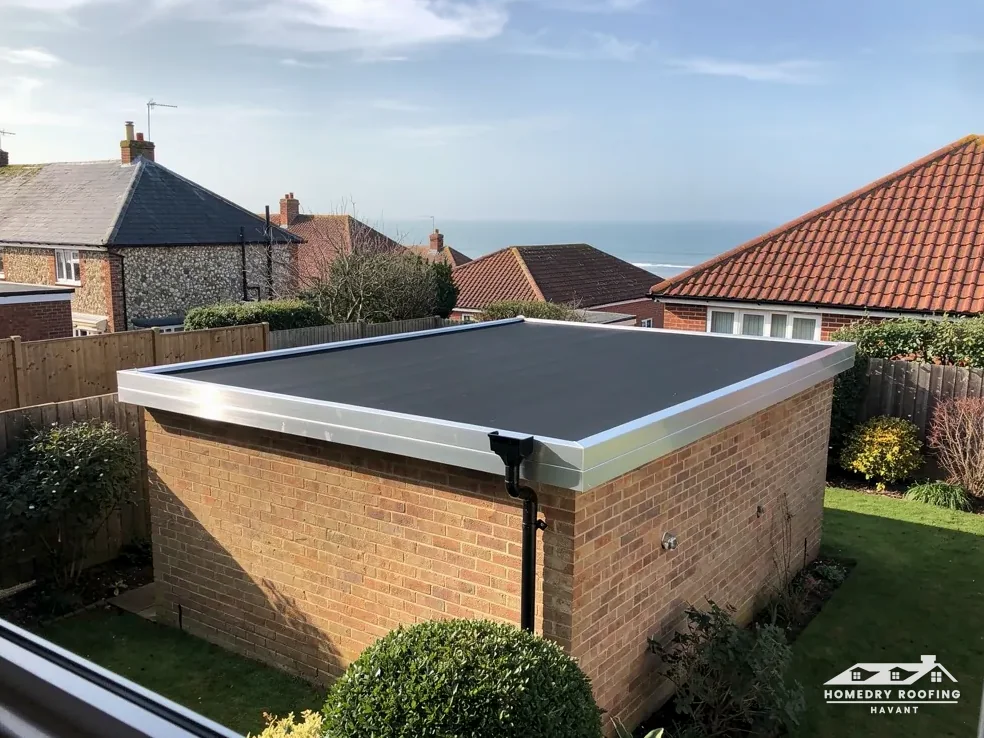
You spot a raised patch in the felt on your flat roof, perhaps from an upstairs window or from the garden. It has a soft look, a bit like a blister on skin, and it was not there last year. The natural question is whether it is the start of a leak.
The bubble alone cannot tell you. A blister is a pocket where the layers of a felt roof have lifted apart, and what is trapped in the pocket, and what is happening around it, decides whether it matters. Some blisters sit quietly for as long as the roof does. Others sit on top of a deck that has taken in water, and from outside the two can look identical.
This post explains what a blister is, what the signs are, how to look at a roof without putting yourself at risk, and how a surveyor separates a repair from a roof that has come to the end of its life. It gives published lifespans and costs from outside sources, with their dates, and never as a price for yours.
What a blister is, and what it is not
A felt flat roof is built from layers. The surface you see, the cap sheet, is bonded to the layers below, and those are bonded to the deck. A blister is a patch where that bond has let go and the layers have lifted. The pocket underneath holds air, moisture or both.
Moisture or air trapped under or between layers can push the felt up as the roof warms. The cause behind that can be damp in the layers or the deck when they were laid, a bond that did not take properly, or water that has since got in. Each of those is a different problem, and the bubble looks the same in every case.
It helps to be clear about what a blister is not.
- It is not proof of a leak. A blister can be dry, and water may reach the ceiling from somewhere else entirely.
- It is not the same as ponding, which is water standing on the roof because the fall is wrong.
- It is not always growing. One that has stayed the same size and shape for a long time tells you something different from one that has spread since you last looked.
Photographing it from the same spot every few weeks costs nothing and gives a surveyor a record to read. A size and a date written on the back of each photo is enough. If the blister has changed between photographs, say so when you call.
What you can read from inside and from below
The ceiling beneath the roof is one of the most useful pieces of evidence. Water that has travelled through a felt roof can show as a stain, a patch of flaking paint or a damp smell, and the position of the mark helps a surveyor work back towards the entry point. The mark and the blister are not necessarily in line, because water can run along a deck or a joist before it drops.
From inside and from the ground, without going near the roof, these are worth noting:
- Whether there are stains or damp patches on the ceiling or the wall below, and whether they have changed after rain.
- The number of blisters, their rough size and whether any have split open at the top.
- Any water standing on the roof a day or more after rain, which points to a fall problem and not to a blister.
- Felt that has pulled away at an upstand, an edge or around a pipe or rooflight.
- Moss, debris or a blocked outlet, which keep water on the roof for longer.
Write down what you see and when. A dated list is more use to a roofer than a general description, and it keeps your own memory honest if the signs change.
Our guide to finding a flat roof leak goes further on tracing the source, including why the stain may be far from the entry point.
Why the roof itself stays out of bounds
It is tempting to climb out and press the bubble, or to cut it open to see what is inside. Resist both. HSE's advice is to assume that a roof will not carry a person until someone competent says it will, and it warns that no sheeted roof of any material should be trusted to bear weight.
A flat roof built over a garage, a bay or an extension looks like a floor, and that is what makes it risky. HSE's figures link roof work to nearly one in five of the deaths in construction, and those who died include specialist roofers as well as people doing a repair or a clean. A fall from even a low flat roof can do serious harm, and a pocket of damp felt is a poor thing to stand on in any weather.
There is a second reason to stay off. Walking on a blistered roof can split the felt open, and a split that was not there before turns a small problem into a leak. A surveyor who is used to the work knows how to move across a roof and where to put weight, and uses the right access to do it.
If the roof is reached from a window, a ladder or a flat roof outside a bedroom, treat it as a place to look from and not to stand on. Looking is enough to record what you can see, and a roofer can take it from there with the right equipment and a plan for getting on and off safely. Where a roof can only be reached by stepping out of a window, that is a good sign the survey needs proper access and not a quick look.
When a blister is a repair
Some blisters are repair jobs. A repair is the sensible call when the trouble is confined to one spot while the rest of the covering is in good condition. The signs that point that way include:
- A small number of blisters, each intact, with no split and no open edge.
- No stain, damp or flaking on the ceiling below, and none after heavy rain.
- A roof that is well inside its published life, with the felt otherwise flat, bonded and free of cracks.
- Falls that drain properly, with no water left standing a day after rain.
- An edge and upstand detail that is still attached and covered.
- A blister that has not changed in the photographs you have been taking.
No single sign settles it. It is the combination that counts, and a roof that ticks every box on this list is one where a repair has a real chance of being the end of the matter.
A repair on a blister means opening it, finding out what is underneath and making good what that shows. The method follows the findings, and a surveyor can tell you which it is only after seeing the layers. If the layers beneath are wet, the repair cannot stop at the surface, and the wet material has to be dealt with before anything goes back. A repair laid over damp felt can hide the problem for a while and then fail, which is why the written quote should state what the roofer plans if the blister turns out to hold water.
Once the survey is done we name the job and give the reason, and repair comes first wherever it is sound. Our flat roofing work starts with a survey of the whole roof. The page on whether to repair or replace a flat roof goes through the decision in more depth.
When blisters point to replacing the roof
Other blisters are a symptom of a roof that is finished. The signs include blisters that are numerous, large or spreading, felt that is splitting or cracking, a deck that feels soft or looks stained from below, and standing water that never clears.
Age also counts. Published lifespans for felt are not promises, and the two sources that give them disagree. HomeBuilding gives approximately 10 to 15 years for torch-on felt. Less says torch-on felt lasts 10 to 20 years depending on quality and installation. A roof that has reached the end of either range and shows several of the signs above is a candidate for replacement, not another patch.
Cost guides set the stakes. MyJobQuote puts the average flat roof replacement at between £1,500 and £6,000 in 2026, and its average roof repair at around £650. Those are third-party averages for different jobs, not figures for yours, and Which? gave £1,400 to £3,500 in November 2025, excluding VAT, for a felt roof on a single garage of 6m x 3m, which it describes as typical. Your own price is the single total you receive in writing after a survey.
If replacement is the answer, some roofers will suggest laying a new layer over the old felt. Whether that suits a roof is a separate question, covered in can you overlay an old felt roof, and a new membrane also brings the energy rules into play under Approved Document L paragraph 11.2(d).
What a survey and a written quote should cover
A good survey of a blistered flat roof is more than a glance at the bubbles. It looks at the whole roof and writes down what it finds, so the quote that follows describes the roof in front of you.
- The condition of the felt across the whole roof, not only at the blister.
- Whether the deck beneath is dry and sound, and how that was checked.
- The falls, where BS 6229:2025 sets a minimum finished fall of 1:80, with the design aiming steeper to allow for tolerances.
- The upstands, edges, outlets and every pipe or rooflight.
- Evidence of water inside, on the ceilings and walls.
The quote should then say what is being done and why, with one total price. It should also say whether VAT and any scaffold or access equipment are included. If it offers a repair, ask what the roofer expects to find under the blister and what happens if it finds something else. If it offers replacement, ask what the old roof showed that made repair the wrong call.
That reasoning, written down, is the thing to compare between quotes. Two roofers who have read the same roof differently should be able to say why, and the better answer is the one that rests on what the roof actually showed. Keep the survey notes and the photographs together, because they are the record of the roof as it stood on the day, and they make any later change easy to spot.
Filed under Flat roofing