
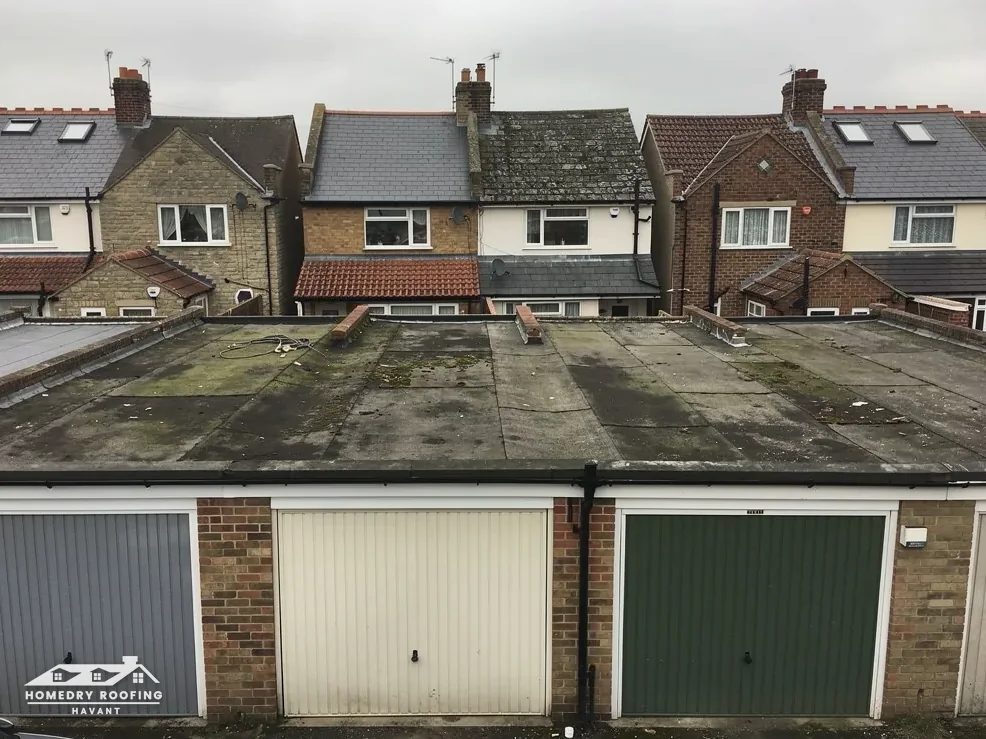
Re-covering a garage involves the same decisions as a large roof, only smaller: what covering goes on, what it sits on, which way the water runs and where it leaves. The covering gets the attention, and the three names that come up are felt, EPDM and GRP. Felt here means the torch-on kind, EPDM is a rubber membrane, and GRP is glass-reinforced plastic, usually called fibreglass.
Which? priced two of them for the same garage, which makes a useful starting point because the size is stated: a typical single garage, 6m x 3m. Their figures sit alongside MyJobQuote's wider garage range, and lifespan figures from HomeBuilding and Less, further down this guide.
Before any of that, one question has to be answered about the existing roof, because a garage of a certain age may not have a roof you can simply strip. Our garage roofs page covers the whole service, and this guide takes the choice of covering end to end.
Check what the old garage roof is made of
The covering choice only arises once you know what is coming off. The Health and Safety Executive (HSE) advises: "If the building was built or refurbished before 2000, assume that there is asbestos in it." A garage with grey corrugated sheets is the familiar case, and HSE sheet A14 states that "AC roofs are always fragile", where AC means asbestos cement.
The advice covers a garage built before 2000 and one refurbished before 2000, so the date of the last major work matters as well as the date of the build. A flat felt roof on timber is a different material, but a garage that has been re-covered more than once can have older sheets under the visible layer. The sensible order is to establish the roof build-up first and choose the new covering second.
What to gather before anyone prices the work:
- The age of the garage, and a note of the last time the roof was re-covered or altered.
- Photographs from the ground of the roof surface, the edges and the gutter or outlet.
- A note of anything you can see inside, such as daylight at the joints or stained boards.
For a survey, MyJobQuote's 2026 average is around £325, a general UK figure and no quote for your garage. Until a result is back, nobody should walk on the roof, drill it or cut it. Our guide to what to do with an asbestos garage roof goes through that stage in full.
What the Which? single garage figures show
Which? gathered its prices from a survey of 11 traders in November 2025. The figures include labour and materials and exclude VAT. Hampshire and West Sussex fall in the South East, and Which? expects a price in London or the South East to be likely to land at the upper end of its scale, so read the lower end of each range with that in mind. For a typical single garage (6m x 3m), the two rows read as follows.
| Covering | Which? range | What the row says |
|---|---|---|
| Felt | £1,400 to £3,500 | Felt flat roof, single garage |
| PVC / rubber EPDM | £1,950 to £4,000 | With new boards |
The two ranges overlap between £1,950 and £3,500, so the spread inside each row matters as much as the gap between them. This guide quotes no Which? figure for GRP, so nothing here prices a GRP garage roof.
MyJobQuote, a separate source, says that in 2026 the average garage roof replacement costs between £750 and £3,500. Its rubber roofing page says that typical rubber roofing prices of around £60 per square metre mean the average rubber roof costs £1,050 fully installed. Those are separate figures on separate pages, so they are not added together or averaged here. The quote you receive is one written figure, after a survey, so these ranges frame the conversation and never replace it. A range this wide also tells you that size, access and the state of the deck move the figure a long way.
The Which? ranges overlap, so what a quote covers tells you more than the name of the covering.
How long each covering is said to last
Lifespans are the other half of the comparison, and the two guides do not agree with each other. HomeBuilding gives approximate lifespans in its new roof cost guide, and Less gives its own in a flat roof cost guide last updated in October 2026. Both are third-party estimates for a correctly installed roof. Neither is a promise from us or from a manufacturer, and each reader should treat the range as a guide to what is plausible, not as a date to plan around.
| Covering | HomeBuilding | Less |
|---|---|---|
| Felt (torch-on) | 10-15 | 10 to 20, depending on quality and installation |
| EPDM | 25-30 | 30 to 50, typically |
| GRP | 25-30 | 25 to 40, with minimal maintenance |
Two readings are fair. Both sources place felt shortest, and both put EPDM and GRP well above it. Past that point the ranges overlap, with Less more generous than HomeBuilding for EPDM and for GRP, so these two guides cannot name one covering as the longest-lived.
The words in the Less wording matter: depending on quality and installation, typically, with minimal maintenance. A lifespan range describes a roof laid to a good standard and looked after, which is why two sources can sit on different numbers for the same membrane. Debris left in a gutter, a blocked outlet or a damaged edge can shorten any of them, so the figures belong beside a survey of the actual garage, not in place of one.
Falls, outlets and edges matter on any covering
Everything on a small flat roof depends on its falls, the gentle slopes that carry water to the outlet. NFRC, the National Federation of Roofing Contractors, reports that BS 6229:2025 sets "a minimum 1:80 finished fall for general roof areas and internal gutters". The standard covers flat roofs with continuously supported flexible waterproof coverings, which means membranes.
IKO reports that the recommended minimum fall for a flat roof is 1:80, and that the code of practice says the roof should be designed for 1:40 to achieve that. The design is steeper than the finished minimum to allow for tolerances. Across a 3m depth, a fall designed at 1:40 is about 75mm, which is why the deck has to be checked before the covering is chosen.
The deck underneath is part of this, since a covering is only as flat and sound as the boards it sits on. Where a garage sits against a house wall, the junction at that wall is a place water can reach as well, so it is checked at the same visit.
Things to settle with whoever quotes, whichever covering you pick:
- Whether the existing deck is sound, or needs replacing boards (the Which? EPDM row is for a roof with new boards).
- How the finished fall will be set, and where the water leaves: into a gutter, an outlet or over the edge.
- How the edges and the wall junctions are finished.
- Whether any ponding on the old roof points to a deck or fall problem that a new covering alone would not cure.
Our guide to repairing or replacing a felt garage roof covers the point where patching a sound deck is the better route.
Setting the three side by side for your garage
With the old roof identified and the falls understood, and with the Which? price rows and the lifespan estimates in front of you, the choice comes down to a few plain comparisons rather than a verdict on materials. The ones that can be checked against published figures are price range, lifespan range and what the quote includes.
- On price, Which? puts a felt single garage at £1,400 to £3,500 and PVC / rubber EPDM with new boards at £1,950 to £4,000, excluding VAT. This guide quotes no Which? figure for GRP.
- On lifespan, HomeBuilding gives felt 10 to 15 years, EPDM 25 to 30 and GRP 25 to 30, while Less gives 10 to 20, 30 to 50 and 25 to 40.
- On the quote itself, it should name the covering, the deck, the fall, the outlet and the edges.
A lower first cost for one covering and a longer life for another are both genuine advantages. Neither source reduces the choice to a rule, because what you plan to keep in the garage, and how long you plan to own it, differ between households.
What we do on a survey is climb up safely where the roof allows it, look at the deck, the falls, the edges and the way the water leaves the roof, and then say which covering suits that garage and why. Make sure any quote is clear about VAT and scaffold, because the Which? figures exclude VAT and were gathered for a different garage from yours.
If the old garage roof is asbestos cement
When the survey finds asbestos cement sheets, the covering choice waits for the removal. HSE separates the work by what happens to the material. It lists carefully removed cement products, "provided the material is carefully handled/removed without breaking up", as non-licensed work. Sheet A14 covers dismantling a small asbestos cement structure such as a garage as long as the cement stays intact. If it starts to break up and creates significant dust, the work becomes notifiable non-licensed work.
Waste has its own rules. On waste, HSE guidance is a lockable skip for asbestos, and sheeting laid over an ordinary skip falls short of it. A household is not covered by the consignment-note exemption for asbestos waste, because the exemption for domestic hazardous waste reads "other than asbestos waste".
If you take your own cement-bonded asbestos to a recycling centre, Hampshire County Council accepts it at only five household waste recycling centres: Andover, Basingstoke, Efford, Netley and Portsmouth. Booking is by phone beforehand, with a limit of 15 sheets, and no sheet larger than 1200mm by 600mm. Work by a tradesperson cannot count towards a household's DIY allowance. In West Sussex, householders' own cement bonded asbestos goes to one of four named sites, to a maximum of 200kg, and that route belongs to West Sussex addresses only.
Those centres suit householders' own small amounts, whereas asbestos removed by a roofer is trade waste, moved with a consignment note. MyJobQuote gives an average asbestos removal cost for a roof in the UK of around £2,750. That is a typical UK figure, and it sits on top of the new covering, not instead of it.