
What looking at the roof can and cannot tell you
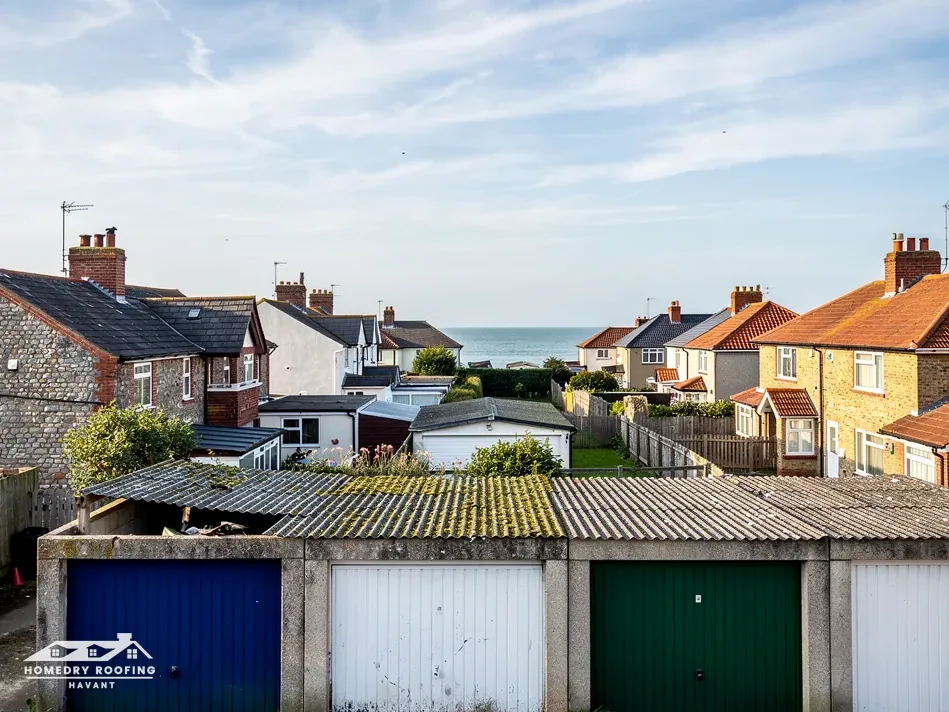
From the drive, a corrugated garage roof shows you a profile, a colour and a weathered surface, sometimes with moss and stains. Those describe how a sheet looks. They do not describe what it is made of, and HSE's advice does not ask anyone to guess.
West Sussex County Council does name garage roofing sheets as one of the places cement bonded asbestos may be found, along with down pipes. So an old sheet roof is a fair reason to ask the question. The same sentence also tells you why the question has no answer from the pavement: "may be found" is not "is".
What looking can do is record the roof's condition, which matters once the material is known:
- cracks, chips and broken corners
- patched areas and the fixings that hold each sheet
- rooflights set into the sheets
- the gutter and trims beside them
- the overlaps between sheets, where earlier repairs are easy to see
Take those pictures from the ground, from the garage interior or from a neighbour's side where you have permission. Nobody climbs up to take them. HSE's A14 sheet puts it plainly: "AC roofs are always fragile".
The date test HSE sets
HSE gives the nearest thing to a rule: "If the building was built or refurbished before 2000, assume that there is asbestos in it." The wording has two dates to check, the date the garage was built and the date it was refurbished.
For a garage you own, a few places can pin the date down:
- the paperwork from the purchase, including any survey report
- building control or planning papers for the garage, if it was added to the house
- a previous owner, or someone next door who saw it built
- the council's own records, for a garage that was built or altered with permission
If the date falls before 2000, or you cannot establish it, the safe course is to treat the sheets as asbestos until a result says they are not. If the garage was built later, HSE's wording does not reach it, though a result is still the only way to be sure of an individual roof that has been patched or re-sheeted.
None of this makes the sheets dangerous while they are intact and left alone. It governs how you treat them before any work.
What a survey adds
A survey is how the presumption becomes a result. A sample is taken from the sheets and analysed in a laboratory, and the report says what the material is and what condition it is in. MyJobQuote says "The average cost of an asbestos survey is around £325 in 2026."
That is an average across surveys of every kind, so a single garage may differ. What it buys is a plain answer that sits behind every later decision: whether the sheets can stay, and if they are to go, how the work is planned.
HSE's categories turn on whether the sheets stay in one piece. Whole sheets removed with care are non-licensed work, and cement "substantially damaged or broken up" becomes notifiable non-licensed work. So the survey also records the state of the sheets, because the plan for the job depends on it. A report that names the material but says nothing of condition is only half of what you need.
Our answer on whether you need an asbestos survey for a garage roof goes through when one is worth booking, and what to ask for in it.
What to do until the result is back
Until the material is identified, the roof is left exactly as it is.
- Do not walk on it, and do not rest a ladder on the sheets.
- Do not drill, cut, scrub, scrape or break a sheet, and do not lift a loose piece to see underneath.
- Do not leave a damaged corner or a cracked sheet to worsen: photograph it and say so at the survey.
- Keep children and pets clear of any place where a sheet has fallen or cracked.
- Tell the surveyor about any earlier repair, because a patched roof can carry sheets of more than one age.
Send photographs to us and we will tell you whether the roof needs surveying for asbestos first, and what to do while you wait. Our answer on walking on an asbestos cement garage roof explains why nobody steps onto the sheets.
The full route, from identifying the material to the waste, is in our garage roofs section. The price follows once the roof has been seen and the material is known, set down in writing as one sum, so nothing is guessed from a photograph.