
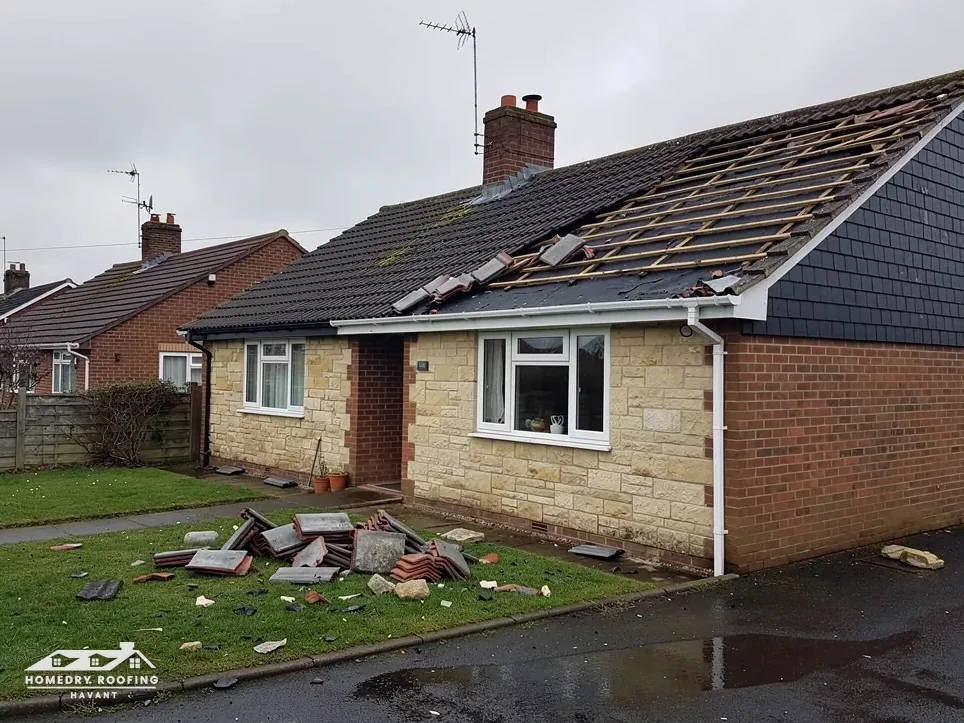
Ask three roofers what a job costs and you can get three different totals. Sometimes one of them has missed something. Or the three may be pricing three slightly different jobs, because each saw a different roof, or saw the same roof and decided on a different repair.
A good price is not a number pulled from the air, or an hourly rate multiplied by a guess. It comes from a survey: what is wrong, what has to come off, what goes back, how the crew gets to the roof and what has to be carried away afterwards. Once those answers are on paper, the price is one written total.
This post walks through what goes into that total, in the order the work happens, and where to look in a quote to see that nothing has been left out. It also gives published cost ranges from outside sources, each with its date and its house size, so you can judge whether a figure sits in a sensible place without treating any range as a price for your roof.
Why a roof is priced as one total
An hourly figure sounds simple, but it answers a question nobody is really asking. What you want to know is what the whole job costs, and that depends on the roof itself: its pitch, its covering, how far the damage runs and how the building can be reached. So what we put in writing is one total, reached after a survey, never a rate for you to multiply.
One total is not a way of hiding anything. It is the sum of several pieces of work that happen in sequence, and a clear quote tells you which of them it contains. If you can read a quote and say what has been included, you can set it beside the next one on equal terms. If you cannot, ask the roofer to explain it before you sign.
The pieces are much the same on almost every job, whatever its size:
- The survey, which decides between a repair and a replacement and gives the reason.
- Time on the roof for the strip, the repair or the new covering.
- Materials: the covering itself, plus the battens, underlay, flashings and fixings that go with it.
- Scaffold or other access, where the job calls for it.
- Taking away whatever comes off the roof.
- VAT, where the firm charges it.
The sections below take them in turn, in the order the work happens, so you can match each one to a line of words in your own quote.
Labour: time on the roof and who is needed
Labour is the time it takes skilled people to do the work properly, and that time is set by the roof, not by a rate card. A short run of slipped tiles on a straightforward slope is one afternoon. The same number of tiles around a chimney stack, with the lead dressed back and the mortar checked, is a different job even though the tile count has not changed.
Several things lengthen the time on a roof without making the roof look any bigger from the ground:
- A steep pitch, where everything is carried more slowly and fixed more carefully.
- Awkward details such as valleys, abutments, dormer cheeks and chimney flashings.
- A covering that has to be stripped to find out what lies under it.
- Weather that stops work, so materials are covered and the roof is made safe each evening.
Crew size matters too. A re-roof needs people who can strip, batten, lay and clear in a sensible order, while a single repair may need one or two. Neither number appears in the price as a sum of its own. It is folded into the total as the result of the survey.
HomeBuilding, the self-build magazine, notes that labour rates are higher in London and the South East, which is where Havant sits. The Which? Trusted Traders cost survey puts the South East at the top of its ranges. Treat any national figure as a rough guide to the shape of a price and nothing more.
Materials: the covering, the details and the waste
On a repair, the materials are often a small part of the job and the skill is in finding the cause. On a re-roof they matter far more, and the choice of covering moves the total more than almost any other decision. Concrete tile, clay tile, natural slate and man-made slate sit at different places, and so do the underlay, battens and fixings that go beneath them.
Two details are easy to overlook when you read a quote:
- The details around the covering. Flashings, valleys, ridge and verge fixings and abutments are places a leak can begin, so they should be named in the quote, not folded into a vague mention of materials.
- The fixing specification. Cupa, a slate maker, says hillside, coastal and tall buildings get a higher exposure grade. Marley, a tile maker, lists batten selection, the way the covering is secured and the calculation of the fixing specification among the contents of BS 5534. Ask whether the fixings were worked out for your roof's exposure.
Waste is the other half of the materials story. Old tiles, battens and felt do not vanish when the new roof goes on. Someone has to bag them, lower them and take them to a site that accepts them, and the price has to allow for that.
A garage or outbuilding roof of cement sheets brings its own rules. HSE advises assuming asbestos is present in any building built or refurbished before 2000, and asbestos waste goes in a lockable skip. So the covering should be identified before anyone puts a figure on clearing it.
Scaffold and the way onto the roof
How the crew reaches the roof can decide a good part of the total, and it is the piece homeowners see least. On a house with a clear drive, access can be simple. On a terrace with the front door on the pavement, the scaffold may have to stand on the public highway, and the highway authority has to grant a licence before it goes up.
For Havant addresses the highway authority is Hampshire County Council. Hampshire County Council charges £211.90 on application for the first 2 weeks of a licence and £72 for each additional 2-week period. Hampshire County Council also states that the scaffolding company makes the application on behalf of its customer. We arrange the licence with our scaffolder. The full picture is in our post on scaffold licences in Havant and Hampshire.
Scaffold is included in the written quote. Scaffold hire is a figure the survey settles, since the cost depends on how tall the building is, how long each elevation runs, how many weeks the frame stays up and whether a licence is needed.
Access and safety
Access also affects safety, and so it affects time. HSE says every roof should be treated as fragile until a competent person has ruled that out. That is why a quote for a flat garage roof or a conservatory may still allow for edge protection or a working platform, even when no tower goes up.
When you read a quote, look for the words scaffold or access, and for whether the licence fee is covered. If a quote says nothing about either, ask before you accept it.
What published ranges say, and what they do not
Outside sources publish typical costs. They are useful for orientation. They are not our prices, and none of them knows the pitch, covering or access of your roof. Each figure below is quoted with its source, its date where one is given and the unit it was published in. None of them is a promise about what a roof in Havant will cost, and none stands in for a survey of yours.
| Job | Figure | Source |
|---|---|---|
| Average roof repair | around £650 | MyJobQuote, 2026 |
| Average new roof | around £5,250 in the UK | MyJobQuote |
| One to six broken or missing standard roof tiles | £75 to £400 | Which? Trusted Traders cost survey, November 2025 |
| A whole new roof, average three-bedroom house | £7,000 to £21,000 | Which? Trusted Traders cost survey, November 2025 |
The Which? prices come from a survey of 11 Which? Trusted Traders in November 2025. Labour and materials are counted, VAT is not, and Which? says the South East sits towards the top of those ranges. HomeBuilding gives a worked example for a standard three-bedroom semi that includes scaffolding. MyJobQuote gives national averages with no VAT basis stated.
The figures disagree with one another, which is itself the lesson. A written total far above or far below the whole spread deserves a question, and the answer should be about your roof, not about the market.
Reading the written quote before you sign
A quote is a document you can check, so check it. A firm that has surveyed the roof properly can say in writing what it will do, with what, and for how much. These are the points worth finding on the page:
- One total price, with VAT shown as in or out.
- Scaffold, plus the highway licence if one applies: in the figure or not.
- The parts to be stripped or repaired, and the parts that will be put back, listed in everyday language.
- Where the waste goes, and the state the site is left in.
- The work in the order it happens, with a start period you can plan around.
- Extra work that appears when the roof is opened up: who agrees it, with the agreement in writing before the price moves.
The last point deserves care, because it is where a total price turns into a changing price. A roofer cannot always know what is under a covering until it comes off. A good quote says so, and explains how any extra would be agreed with you first.
Where a contract is signed at your home after a survey, it can be cancelled inside 14 days, and building starts inside that period only on your written request. Where you invited a roofer in for an urgent repair, that cancellation right does not apply. Our answer on what a roofing quote should include goes through the same points, and cancelling a roofing contract covers the 14 days. Back on the HomeDry Roofing Havant homepage you will find the survey and quote form.