
Signs from inside the garage
The inside of the garage tells you a good deal, and it costs nothing to look. Switch the light on, or use a torch, and check these points:
- drips, or drip marks on the floor, on the bench or on whatever is stored below
- boards or ceiling lining that are stained, dark or bowed
- a damp, musty smell that is stronger than it used to be
- daylight showing where sheets meet a wall or each other
- rust on tools or shelving that was clean last year
A stain shows where the water ended up, and that may be some distance from where it entered. On a flat roof the water can travel along the boards before it drops, so treat the mark as a hint about direction and not an address.
Photograph whatever you find, with the date, and note whether it appears after rain or at other times. That tells the surveyor more than a general description does.
An attached garage shares a wall with the house, so a stain on a ceiling or wall beside the garage can also begin on the garage roof.
Signs from outside, on the ground
From the drive or the garden you can read more of the roof than you might expect, and nobody needs to climb. Walk round the garage after rain and look up at the edges.
These outside signs are worth noting:
- water still lying on the roof long after the rain has stopped
- an edge or a middle that sags, as if the roof has settled
- a trim or fascia pulling away from its board, or a gap along the top of a wall
- streaks or damp patches running down the brickwork below the roof
- moss or growth along the laps, and a gutter that overflows, blocks or drags away from the edge
Moss alone is a place to check and not a verdict on the roof. A gutter that spills over a sound roof may only need clearing. It is the combination of signs that points towards a new covering.
Use binoculars if you have them, or a camera with a zoom, instead of a ladder. Our answer on whether an old felt garage roof is worth repairing explains what follows once you know what you are seeing.
Signs on a sheet roof, and why to stay down
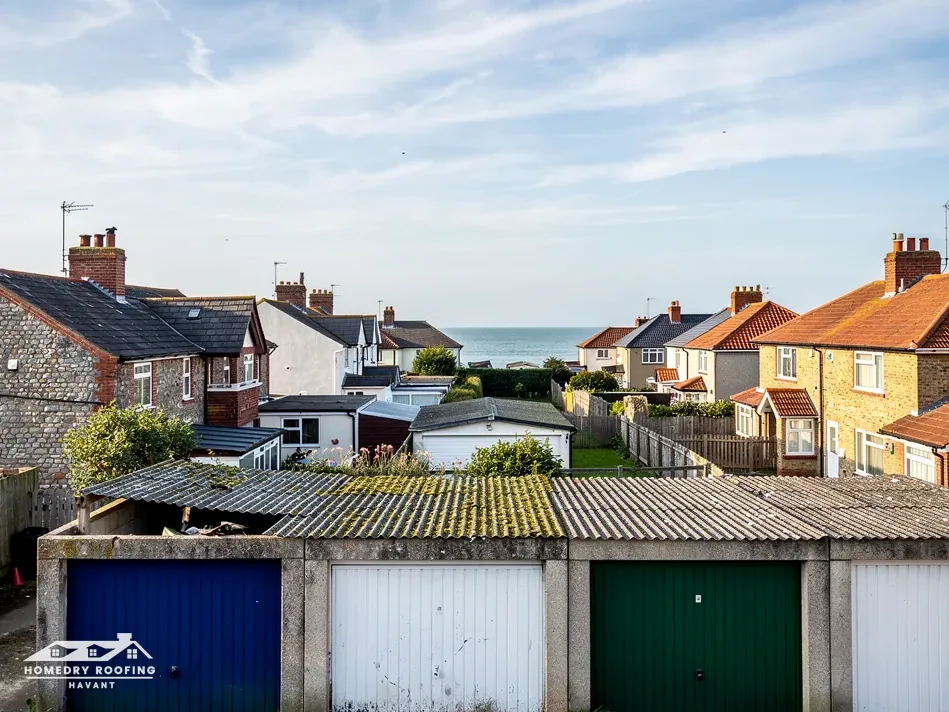
A garage with corrugated sheets needs a different kind of care. Cracks, chipped corners, lifted laps and fixings that have worked loose are the signs to watch for, and they show best from below and from the sides.
The sheets may be asbestos cement. HSE's advice is "If the building was built or refurbished before 2000, assume that there is asbestos in it", and its A14 sheet says "AC roofs are always fragile". So nobody steps on a sheet roof, and nobody drills, scrubs or breaks a sheet to test it. A cracked sheet is a reason to photograph the damage and get it surveyed, and not to patch it yourself.
Our page on how to tell if a garage roof is asbestos covers the identification step, and walking on an asbestos cement garage roof explains why the sheets are never a platform.
The same caution applies to a felt roof. HSE says "all roofs should be treated as fragile until a competent person has confirmed they are not." So a felt roof is looked at from the ground as well, unless safe access has been arranged for the job.
What to do when you spot one
One sign is a prompt to look again after the next rain. Several signs together, or any sign with soft boards beneath, are a prompt to ask for a survey.
Before you ring, gather what is easy to collect:
- dated photographs from inside and from the ground
- a note of when the water appears, and where
- the approximate age of the roof, if you know it, and any repair history
- whether the garage is attached to the house and shares a wall
With that to hand, we can tell you from photographs whether it looks like a survey job. At the survey we trace the route the water takes and explain what the roof wants and why, with what we found. A written figure follows, as a single sum.
If the leak is active and the garage holds anything that matters, move it clear and cover it, then keep the photographs together with the date of each.
If you are unsure whether what you have seen is a sign at all, send a picture and ask.
Our garage roofs page covers the whole service, from a small repair to a new covering.