
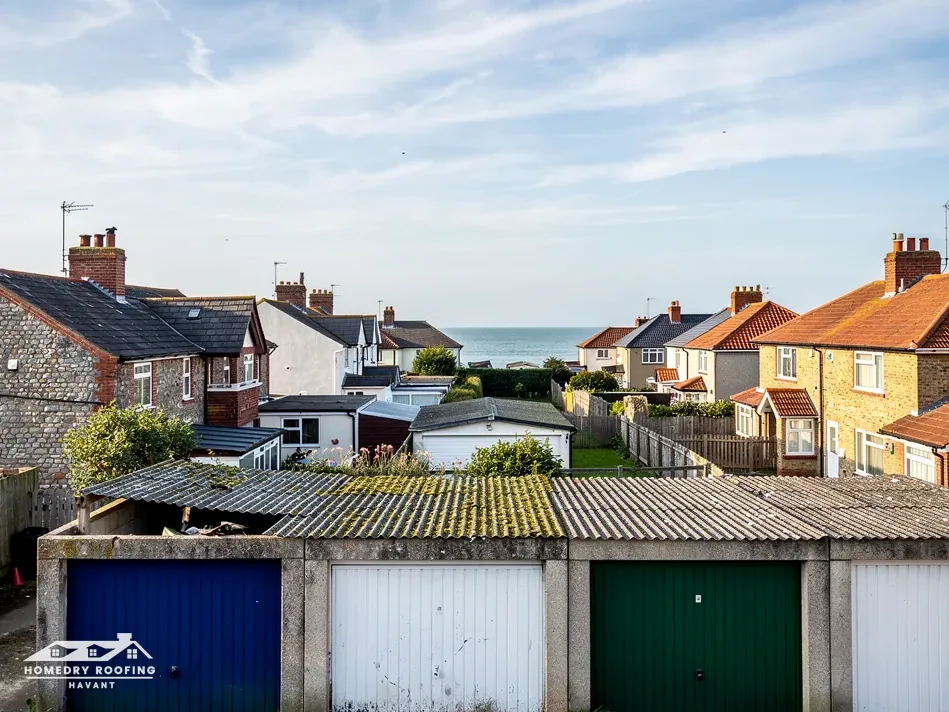
An old garage with a corrugated grey roof raises a question for its owner: can I take this down myself, or does it have to go to a specialist? The answer is not a single yes or no, because the law and the guidance split the job into parts.
The Health and Safety Executive (HSE) sorts asbestos work into three groups: licensed, notifiable non-licensed (NNLW) and non-licensed. Where a sheet of asbestos cement falls depends on how it is handled and what condition it is in. Then comes a separate question, which is where the waste can legally go and who may carry it.
This post sets out what HSE says, what the Hampshire and West Sussex recycling-centre pages say, and where the published guidance stops. It is general information and not a ruling on your roof. Because the topic is statutory and a mistake can harm people, it also says plainly when the sensible step is to stop and get a survey.
Start by assuming the roof contains asbestos
HSE's guidance is direct: if the building was built or refurbished before 2000, assume that there is asbestos in it. A garage roof can be asbestos cement sheeting, and the rule applies whether or not the roof looks old or damaged.
You cannot tell by eye. Cement sheets that contain asbestos and cement sheets that do not can look the same, and the only way to be sure is to have a sample tested by a competent person. MyJobQuote gives the average asbestos survey cost as around £325 in 2026, which is a third-party figure and not a quote for your roof.
Until the result is in, treat the roof as asbestos cement. That affects three things:
- You do not drill, scrape, break or power-wash the sheets, because any of those can release fibres.
- You do not walk on them, as HSE's sheet A14 says asbestos cement roofs are always fragile.
- You do not put any of the material in a household bin or a standard skip.
Our guide to how to tell if a garage roof is asbestos explains what a survey looks at. Ask what the report will say about the condition of the sheets, because the later categories turn on it. A survey is a short job, and it turns a guess into a fact before any money is spent on the roof itself. It also tells you whether anything else on the building, such as a soffit, belongs in the same conversation.
What HSE says about non-licensed work
HSE describes the work on asbestos cement in categories, and the category depends on what happens to the sheet. These are the lines that matter for a garage roof.
| Work | HSE category |
|---|---|
| Asbestos cement sheets, carefully handled/removed without breaking up (weathered but not otherwise substantially damaged cement stays in this category) | Non-licensed work |
| Asbestos cement sheets that are substantially damaged or broken up, creating significant quantities of dust and debris, for example by dropping a roof | Notifiable non-licensed work |
| Asbestos insulating board, such as a soffit, where the risk assessment shows the work will not be of short duration | Licensed work |
HSE's sheet A14 covers small-scale removal and dismantling of a small structure such as a shed or garage, as long as the asbestos cement stays intact during removal. Once it begins breaking up and giving off significant dust, it becomes notifiable non-licensed work. Notifiable means the work has to be notified, a step beyond non-licensed work.
Read those lines for what they say. Non-licensed means the work does not need a licence as described. It does not mean low risk, and the condition is that the sheets come off whole, handled with care. A roof whose sheets are cracked, crumbling or held on by seized fixings may not meet that condition. Ask the person who surveys the roof to say in writing which of these categories they believe applies and why.
The primary sources are HSE's page on non-licensed work and its sheet A14.
Why the roof itself is the first danger
Before the legal question comes a physical one. HSE says asbestos cement roofs are always fragile, and says all roofs should be treated as fragile until a competent person has confirmed they are not. An old sheet that looks solid can fail under the weight of a person.
HSE counts roof work in almost one in five of the deaths in construction. Some are specialist roofers, and others were doing no more than repairing or cleaning a roof. A garage roof is low, but a fall through a sheet to the floor below is still a serious injury, and a sheet that breaks as someone falls through it releases the very dust the guidance warns about.
That is why the manner of removal matters as much as the category. Whole sheets have to come off from access that does not rely on standing on them. Fixings are released and not forced. The sheets are lowered and not dropped, because HSE names dropping an asbestos cement roof as an example of work that turns non-licensed into notifiable.
If you are not certain you can do that without walking on the roof or breaking a sheet, that is the point to stop. Neither HSE nor the councils whose pages this post draws on treat a confident attitude as a substitute for the right method. A contractor can bring the access equipment and the method, and published costs are set out later in this post.
Where the waste can go
Removal is only half of the job. The waste has its own rules, and they can stop a plan that looked straightforward.
- HSE's waste guidance (EM9) calls for a lockable skip for asbestos and rules out throwing sheeting over a standard one. An open skip does not meet that wording.
- The household exemption from consignment notes applies to domestic hazardous waste, and asbestos waste is left out of it.
- A roofer's asbestos waste counts as trade waste, carried under a consignment note by a registered carrier.
The householder route is the recycling centre, and the rules depend on the council. Hampshire County Council takes cement-bonded asbestos at only five of its recycling centres: Andover, Basingstoke, Efford, Netley and Portsmouth. Neither Havant nor Hayling Island has a centre on that list. You must phone the centre in advance to pre-book, items larger than 1200mm by 600mm cannot be accepted, and the limit is 15 sheets. Work on a property by a tradesperson cannot count towards a household's DIY allowance.
The size limit matters. A roof sheet can be far bigger than 1200mm by 600mm, so whole sheets may not fit that rule, and cutting or breaking them to fit is exactly what HSE's category turns on. Check with the council before you lift anything.
For West Sussex addresses, West Sussex County Council says cement bonded asbestos waste, up to a maximum of 200kg, can only be taken to Burgess Hill, Chichester, Crawley and Worthing, double wrapped in clear 1,000-gauge polythene and sealed with tape. For Portsmouth and Southampton, check with the city council. Our page on where to take cement-bonded asbestos in Hampshire covers the Hampshire route in more detail.
What published guides say it costs
Cost is what drives the question for an owner, so here are the third-party figures, with their dates. None is a price for your garage.
- MyJobQuote, 2026: the average garage roof replacement costs between £750 and £3,500.
- MyJobQuote: the average asbestos removal cost for a roof in the UK is around £2,750.
- MyJobQuote: the average cost of an asbestos survey is around £325 in 2026.
- Which? Trusted Traders, November 2025, excluding VAT: felt on a typical single garage (6m x 3m), £1,400 to £3,500, with Which? noting that South East prices are likely to sit towards the upper end of the scale.
The size of the garage, the number of sheets, how the roof is reached and the state of the deck beneath all shape a real price, which is why guides give ranges and not prices. Those figures come from separate guides and separate surveys, so they do not add up to a total. They do show why the first decision matters. If the roof is asbestos cement, removal and disposal are part of the job, and a quote that leaves them out cannot sensibly be set beside one that includes them.
When you ask for quotes, ask each roofer to say whether the written total covers taking the old sheets off, where the waste goes and how it travels, and whether VAT and any scaffold sit inside the total. A quote from us is a single total issued after the survey, so the whole job sits in the one number.
If you decide to do some of the work yourself, tell the roofer, and be clear about who does what, because different rules apply to the recycling-centre route and the trade-waste route. Work done by a tradesperson cannot be counted in a household allowance, as Hampshire's page says.
So can you remove it yourself?
Read as a whole, the guidance does not give a simple permission. HSE's pages place careful removal of whole sheets in the non-licensed category, which means that work does not need a licence. Everything else about the job is still there, including the risk of falling and the waste rules.
It comes down to three questions, and all three need a yes before a self-removal makes sense.
- Has a survey confirmed what the roof is made of, and what condition it is in?
- Can the sheets come off whole, from safe access, without anyone standing on them?
- Is there somewhere lawful for the waste to go, within its size and quantity limits?
If any answer is no, the job belongs with a contractor who has the access, the method and the waste route. We start with a survey of the roof and tell you what it needs, and the written total comes after that. For the wider picture, see garage roofs, and our page on a lockable skip for asbestos explains the skip rule.
Do not rely on this post alone for a decision. It reports what published sources say on the dates given, and rules change. Nothing here replaces advice about your particular roof. For a roof you suspect is asbestos, the first action is the survey, and the second is to read HSE's own guidance for your case. Keep the survey report with the house papers, whoever does the work.
Filed under Garage roofs