
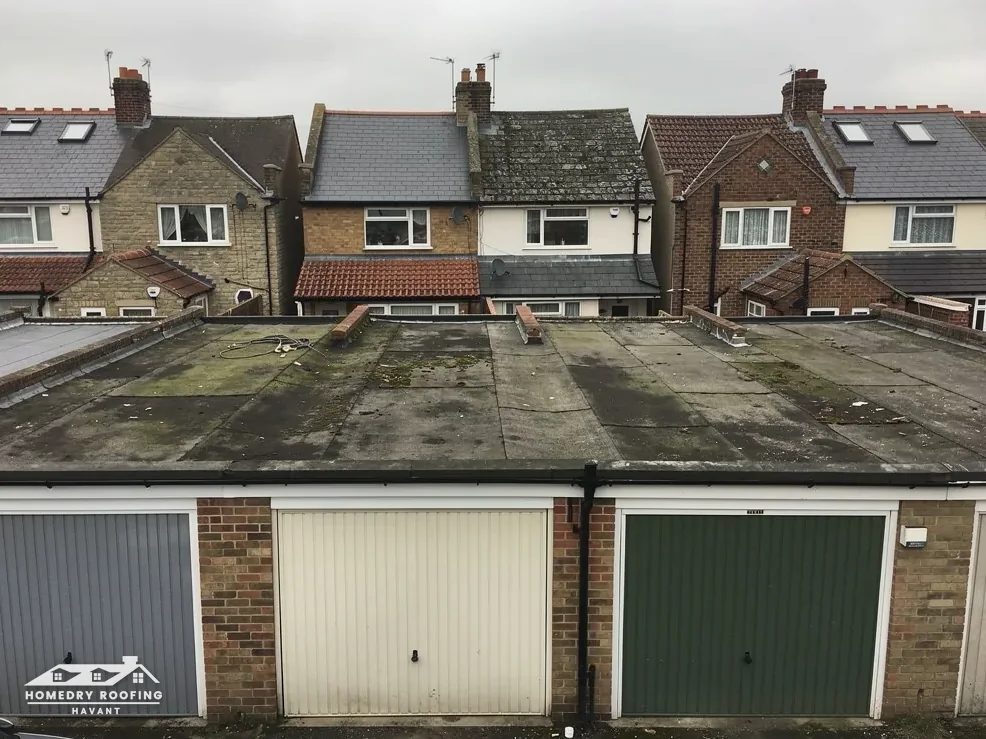
A garage roof is a small roof, and that makes the price feel like something you can shop around for. In one sense you can. In another, the lowest number on a quote can cover less than the next one up, and the gap turns up later as a repair, a second visit or a roof that needs doing again sooner than it should.
This post looks at the question the way a careful buyer would. It sets out what shapes the price of a garage roof, what the published cost guides say and when they were written, how long the main coverings are said to last, and the special case of a garage roof made of asbestos cement sheets, which changes the job completely.
Every figure here comes from a third party and is dated. No figure here prices your own garage, and none should be added to another. What counts is one total in writing, from a survey of your own roof.
What sets the price of a garage roof
Two garages of the same footprint can be priced very differently, because the footprint is the least of it. A roofer pricing the job is working out several things at once, and each of them can move the total.
- The covering: felt, rubber (EPDM), glass-reinforced plastic (GRP) or something else, each with its own materials and method.
- The deck beneath it, and whether the boards are sound or need replacing.
- Falls and drainage, meaning whether water runs to a gutter or outlet, or stands on the roof.
- The edges and details: trims, a wall upstand, anything that passes through.
- What has to come off, and where it goes, including whether the old roof is asbestos cement.
- Access: how the roof is reached and whether scaffold is needed.
A quote that names only the size and the covering has left out most of those. That is the first place a low number can come from, and it is worth asking what the roofer has assumed about each item before comparing totals. Ask too whether the price is for the whole roof or for part of it, because a part-roof figure can look attractive until the rest has to be done.
It also explains why guides give ranges and not single figures, and why a stranger's price for a garage you have never seen tells you little. The range is the spread across different garages, and your garage sits somewhere inside it, or outside it. A quote far below a published range deserves a question about scope, and one far above it deserves a question about what has been included.
What published guides put on a garage roof
These are the third-party figures, each with its source and date. They answer different questions, so they are set out separately and not blended.
| Source | What it covers | Figure |
|---|---|---|
| Which? Trusted Traders, November 2025 | Felt roof on what Which? calls a typical single garage (6m x 3m); VAT excluded | £1,400 to £3,500 |
| Which? Trusted Traders, November 2025 | PVC or rubber EPDM on that garage, with new boards; VAT excluded | £1,950 to £4,000 |
| MyJobQuote, 2026 | The average garage roof replacement | £750 to £3,500 |
| MyJobQuote, 2026 | The average rubber roof at around £60 per square metre, fully installed | £1,050 |
The Which? figures come from a survey of 11 Trusted Traders. Hampshire and West Sussex sit in the South East, and Which? expects prices there to run towards the upper end of its scale. MyJobQuote gives no VAT basis, so do not read those as including or excluding it.
Treat a table like this as a starting point. If your garage is larger or smaller than 6m x 3m, or has a rooflight, a parapet or an awkward join to the house, the published figure describes a different job from yours, and the gap can run either way.
Notice how much the ranges overlap and how wide they are. A range from £750 to £3,500 spans a factor of more than four, and the felt and EPDM ranges from Which? overlap. Neither guide claims that one covering beats another on price, and a quote should not claim it without showing why.
When the lowest quote leaves something out
When two quotes for the same garage differ by a wide margin, the difference can lie in the scope, not in how well anyone has priced the same job. A short checklist shows where.
- Does the quote say what happens to the deck? The Which? EPDM range is stated with new boards, so the boards are a real part of the figure.
- Does it name the covering and describe how it is fixed, including the edges and any upstand?
- Does it say whether the old roof is taken away and where it goes?
- Does it state if VAT is in the total, and if scaffold or access equipment is?
- Does it say how the finished fall is set, so that water runs off and does not stand?
- Does it say what the roofer will do if the deck is worse than it looks from outside?
A quote that cannot answer those has either not looked closely or has left the answer to be argued about later. The second is the more costly way for a low number to go wrong, because an extra sum added to a roof half finished is hard to refuse.
This is why we give one written total after a survey, with the scope described in the quote. A single number is easy to compare only when the same work sits behind each one, so ask each roofer to describe the job in the same terms and compare the descriptions first. If one quote is silent where another is specific, treat the silence as a question and not as good news.
How long each covering is published to last
The other way a low quote costs more is time. A covering that lasts for a shorter period has to be replaced sooner, and the published lifespans for the common garage coverings are not the same. Two sources give them, and they disagree, so both are named here.
- Torch-on felt: HomeBuilding gives 10 to 15 years, and Less says 10 to 20 years depending on quality and installation.
- EPDM: HomeBuilding gives 25 to 30 years, and Less says a rubber membrane typically lasts 30 to 50 years.
- GRP: HomeBuilding gives 25 to 30 years, and Less says 25 to 40 years with minimal maintenance.
These are not guarantees, and they say nothing about how long your particular roof will last, since the deck, the falls and the workmanship all affect it. They do suggest a way to think about the choice. If one covering is published to last for a much shorter period than another, paying less for it now does not settle which is the better value, because the roof may have to be laid again.
No arithmetic is offered here, because no guide gives the price of both coverings on the same garage. Ask each roofer for the covering they propose, the reason, and what they would expect the roof to need over the years you plan to own the garage. A roofer who has thought about that will have an answer. One who has not may have priced the job to win it.
If the sheets are asbestos cement
An older garage may have a roof of corrugated asbestos cement sheets, and that changes everything about price. Where a building was built or refurbished before 2000, HSE tells owners to assume asbestos is in it. A survey tests the sheets and confirms what they are.
MyJobQuote's 2026 survey average is around £325, and its average for removing asbestos from a roof is around £2,750. Those are separate averages from separate guides and cannot be added together, but they show the scale of what an asbestos roof adds to the job.
The sheets also need handling that avoids breaking them. HSE's sheet A14 calls roofs of this material always fragile, and sheets that break up and throw off significant dust move the work into the notifiable category. The waste needs a lockable skip. Cutting corners here is the clearest case in which a low quote costs more, and not only in money.
- Disposal is its own question: a quote should say how the sheets are carried, where they are taken and who is responsible for that.
- Arrange the survey before you ask for quotes. Then every roofer prices the same facts, and if the sheets prove not to be asbestos the job returns to the ordinary range.
Our post on whether you can remove an asbestos garage roof yourself goes through the HSE categories and the recycling-centre rules. If a quote for an old garage says nothing about asbestos, ask why it does not. A reasonable answer is a survey result; an unreasonable one is a shrug. Whatever the result, the quote should record it, so the same facts sit behind every price you are asked to compare.
Repair, re-cover and what to ask before you say yes
The lowest cost is sometimes no replacement at all. If the covering is sound over much of the roof and the problem is local, a repair can be the sensible choice, and it should be offered first. Our page on whether to repair or replace a felt garage roof goes through the decision.
Checkatrade's June 2026 table gives EPDM rubber repairs at £120 to £170 per m², with GRP fibreglass repairs at £130 to £180 per m², on rates for up to 3 m² and excluding VAT. Access equipment is not included. Treat those as rates for a small patch, never as a figure to multiply by the size of a roof.
If the answer is replacement, these are the questions that matter before you agree. They take a few minutes to ask, and the answers go straight into the written quote, where they can be checked once the work is finished and the scaffold, if there was any, has gone.
- Which covering, and why that one for this roof?
- What is the deck like, and what happens if it needs replacing?
- What fall is the finished roof designed to? BS 6229:2025 sets a minimum finished fall of 1:80, and IKO reports that the code of practice has the roof designed for 1:40 to reach it.
- Is the old roof asbestos, and how is it dealt with?
- Are VAT, waste and access inside the total?
With those answered, the price on the page is one you can compare. Our garage roofs page covers the work, and the guide on the average price to replace a garage roof goes through the published figures in more detail.
Filed under Garage roofs